 | This article needs additional citations for verification .(February 2019) (Learn how and when to remove this template message) |
Phillip Gifford was the Deputy Governor of Bombay from 1670 to 1676.
| | This article needs additional citations for verification .(February 2019) (Learn how and when to remove this template message) |
Phillip Gifford was the Deputy Governor of Bombay from 1670 to 1676.
Tristan da Cunha, colloquially Tristan, is a remote group of volcanic islands in the south Atlantic Ocean. It is the most remote inhabited archipelago in the world, lying approximately 1,732 miles (2,787 km) off the coast of Cape Town in South Africa, 1,514 miles (2,437 km) from Saint Helena and 2,487 miles (4,002 km) off the coast of the Falkland Islands. These distances equate respectively to 1505, 1316 and 2161 nautical miles.
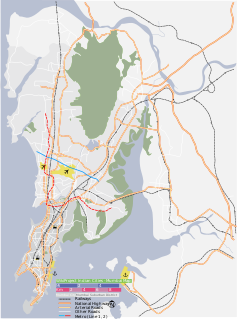
The Marathi and official name for Sion is Sheev. Sion is a neighbourhood of Mumbai. In the 17th century the village formed the boundary between Mumbai and Salsette Island. The British named it marking the end of the city. The name remained even after Mumbai was joined to the Salsette and extended up to Mulund. One of the local historical places in Sion is a hilltop garden commonly known as Sion Fort or Sheevon Killa in the Marathi language.
The following is a timeline of the growth of Mumbai's population over the last four centuries:

Mahim is a neighbourhood in Mumbai, India. The Mahim railway station is in the Mahim area, on the Mumbai suburban railway on the Western Railway line. Mahim is often considered as the heart of Mumbai. Mahim upholds the values of Indian culture and diversity. In fact one finds a temple, church, mosque and fire-temple existing within a few meters of each other.

Worli (IAST:Varaḷī) is a locality in South Mumbai, Maharashtra. It is one of the two peninsulas of Mumbai while the other being Colaba. The sea connects it with Bandra via the Bandra-Worli Sea Link. Historic spellings include Warli, Worlee, Varli, and Varel. Originally Worli was a separate island, one of the Seven Islands of Bombay which were ceded by the Portuguese to England in 1661; it was linked up with the other islands in the 19th century.

Vasai is a historical place and important city in Mumbai's western suburbs, located in Palghar district. It also forms a part of Vasai-Virar city in the state of Maharashtra in the Konkan division in India. Vasai was in the Thane district prior to 2014.

Inaccessible Island is an extinct volcano, last active six million years ago, with Cairn Peak reaching 449 m (1,473 ft). The island is 12.65 km2 (4.88 sq mi) in area, rising out of the South Atlantic Ocean 31 km (19 mi) south-west of Tristan da Cunha.
Human habitation of Mumbai existed since the Stone Age, the Kolis and Aagri were the earliest known settlers of the islands. The Maurya Empire gained control of the islands during the 3rd century BCE and transformed it into a centre of Buddhist culture and religion. Later, between the 2nd century BCE and 9th century CE, the islands came under the control of successive indigenous dynasties: Satavahanas, Abhiras, Vakatakas, Kalachuris, Konkan Mauryas, Chalukyas and Rashtrakutas, before being ruled by the Silharas from 810 to 1260.

Bombay, now called Mumbai, Bombaim in Portuguese, is the financial and commercial capital of India and one of the most populous cities in the world. At the time of arrival of the Portuguese, current Bombay was an archipelago of seven islands. Between the third century BCE and 1348, the islands came under the control of successive Hindu dynasties. The Muslim rulers of Gujarat, who had been ruling current Thane and Vasai for a few decades, annexed the islands in 1348, that were later governed by the Gujarat Sultanate from 1391 to 1534. Growing apprehensive of the power of the Mughal emperor Humayun, Sultan Bahadur Shah of the Gujarat Sultanate was obliged to sign the Treaty of Bassein with the Portuguese Empire on 23 December 1534. According to the treaty, the seven islands of Bombay, the nearby strategic town of Bassein and its dependencies were offered to the Portuguese. The territories were later surrendered on 25 October 1535.

Tristão de Bragança Cunha, alternatively spelled as Tristao de Braganza Cunha, was a prominent Indian nationalist and anti-colonial activist from Goa. He is popularly known as the "Father of Goan nationalism", and was the organiser of the first movement to end Portuguese rule in Goa.
Gerson da Cunha is an Indian stage and film actor, social worker, and author. Former advertising man, he has acted in numerous plays and movies such as Electric Moon (1992), Cotton Mary (1999), Asoka (2001) and Water (2005), among others.
Henry Young was the Deputy Governor of Bombay from 1668 to 13 November 1669.
John Vaux was the Deputy Governor of Bombay in 1689.
Charles Ward was the Deputy Governor of Bombay from 1682 to 1683. He was appointed to the office by his brother-in-law John Child with the intention that he should reduce the costs of operations for the East India Company in Bombay. The prospect of reduced pay was not liked by the troops so they revolted and imprisoned Ward and declared Richard Keigwin their new governor.
George Cooke was the Deputy Governor of Bombay from 1689 to 1690.
José Gerson da Cunha was a Goan physician who achieved international renown as an orientalist, historian, linguist and numismatist.

The 20th National Film Awards, presented by Ministry of Information and Broadcasting, India to felicitate the best of Indian Cinema released in the year 1972.
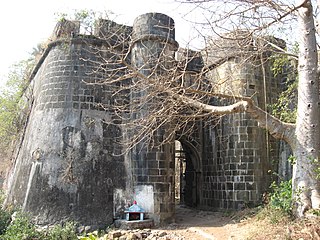
The military history of Bassein encompasses the period from 1526, when the Portuguese established their first factory at Bassein, until 1818, when Bassein lost its strategic importance following the defeat of the Marathas by the British.
Blenden Hall or Blendon Hall was launched in 1811 at Bridlington. A French frigate captured her in 1813, but then abandoned her. After her recovery she returned to trade. She was wrecked in 1821 at Inaccessible Island in a notable incident.
 | This article about a British politician is a stub. You can help Wikipedia by expanding it. |