
Look up pinza in Wiktionary, the free dictionary.
Pinza (1950–1977) was a Thoroughbred racehorse.
Pinza may also refer to:
Pinza (1950–1977) was a Thoroughbred racehorse.
Pinza may also refer to:

A trilogy is a set of three distinct works that are connected and can be seen either as a single work or as three individual works. They are commonly found in literature, film, and video games. Three-part works that are considered components of a larger work also exist, such as the triptych or the three-movement sonata, but they are not commonly referred to with the term "trilogy".
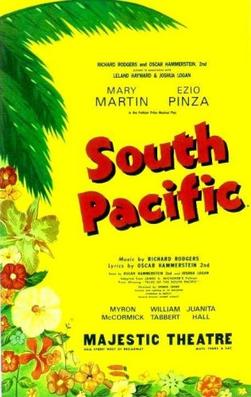
South Pacific is a musical composed by Richard Rodgers, with lyrics by Oscar Hammerstein II and book by Hammerstein and Joshua Logan. The work premiered in 1949 on Broadway and was an immediate hit, running for 1,925 performances. The plot is based on James A. Michener's Pulitzer Prize–winning 1947 book Tales of the South Pacific and combines elements of several of those stories. Rodgers and Hammerstein believed they could write a musical based on Michener's work that would be financially successful and, at the same time, send a strong progressive message on racism.

Ezio Fortunato Pinza was an Italian opera singer. Pinza possessed a rich, smooth and sonorous voice, with a flexibility unusual for a bass. He spent 22 seasons at New York's Metropolitan Opera, appearing in more than 750 performances of 50 operas. At the San Francisco Opera, Pinza sang 26 roles during 20 seasons from 1927 to 1948. Pinza also sang to great acclaim at La Scala, Milan and at the Royal Opera House, Covent Garden, London.
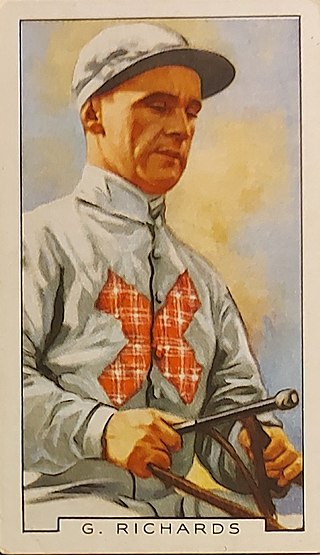
Sir Gordon Richards was an English jockey who was the British flat racing Champion Jockey 26 times, and is often considered the world's greatest jockey. He remains the only flat jockey to have been knighted.

The Bell Telephone Hour, also known as The Telephone Hour, is a concert series broadcast on NBC Radio Network from April 29, 1940 to June 30, 1958. Sponsored by Bell Telephone as the name implies, it showcased the best in classical and Broadway music, reaching eight to nine million listeners each week. It continued on television from 1959 to 1968. Throughout the program's run on both radio and television, the studio orchestra on the program was conducted by Donald Voorhees.
"Some Enchanted Evening" is a show tune from the 1949 Rodgers and Hammerstein musical South Pacific. It has been described as "the single biggest popular hit to come out of any Rodgers and Hammerstein show." Andrew Lloyd Webber describes it as the "greatest song ever written for a musical".
"Kalinka" is a Russian folk-style song written in 1860 by the composer and folklorist Ivan Larionov and first performed in Saratov as part of a theatrical entertainment that he had composed. Soon it was added to the repertory of a folk choral group.
Pinza (1950–1977) was a Thoroughbred racehorse and sire. In a career which lasted just over a year– from July 1952 until July 1953– he ran seven times and won five races. He was the best British colt of his generation in 1953, when he won The Derby and the King George VI & Queen Elizabeth Stakes. He was then retired to stud, where he had little success.

Strictly Dishonorable is a 1951 romantic comedy film written, produced and directed by Melvin Frank and Norman Panama, and starring Ezio Pinza and Janet Leigh. It is the second film to be based on Preston Sturges' 1929 hit Broadway play of the same name after a pre-Code film released by Universal Pictures in 1931 with the same title.
Strictly Dishonorable can refer to:
The Pinza-Abu Cave Man is a prehistoric people known from bones found in the Pinza-Abu Cave, near Ueno in Miyako Island, southern Japan. The remains appear to have the modern man anatomical type and have been dated to about 30,000 years ago, i.e. 25,800 ± 900 and 26,800 ± 1,300 before present. The name "Pinza-Abu" literally means "goat cave" in the local Miyakoan language.
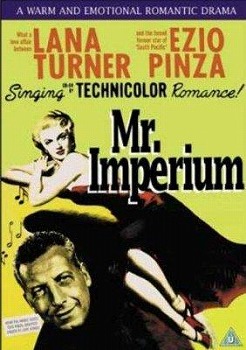
Mr. Imperium is a 1951 romantic musical drama film produced by Metro-Goldwyn-Mayer and starring Lana Turner and singer Ezio Pinza. Filmed in Technicolor, it was directed by Don Hartman, who cowrote the screenplay with Edwin H. Knopf based on a play written by Knopf. The musical score was composed by Bronisław Kaper. Turner's singing voice was dubbed by Trudy Erwin.

Spiramide (developmental code name AMI-193) is an experimental antipsychotic that acts as a selective 5-HT2A, 5-HT1A, and D2 receptor antagonist. It has negligible affinity for the 5-HT2C receptor.
Dogma 95 is a 1995 avant-garde filmmaking movement founded by the Danish directors Lars von Trier and Thomas Vinterberg, who created the "Dogme 95 Manifesto" and the "Vows of Chastity". These were rules to create films based on the traditional values of story, acting, and theme, and excluding the use of elaborate special effects or technology. It was supposedly created as an attempt to "take back power for the directors as artists", as opposed to the studio. They were later joined by fellow Danish directors Kristian Levring and Søren Kragh-Jacobsen, forming the Dogme 95 Collective or the Dogme Brethren. Dogme is the Danish word for dogma.
Aureole (1950–1974) was a British Thoroughbred racehorse and sire who was owned by Queen Elizabeth II. In a career that lasted from August 1952 until July 1954, he ran fourteen times and won eleven races. As a three-year-old in 1953, he won the Lingfield Derby Trial before finishing second to Pinza in both the Derby and the King George VI and Queen Elizabeth Stakes. He reached his peak as a four-year-old in 1954 when he won his last four races: the Victor Wild Stakes at Kempton, the Coronation Cup at Epsom, the Hardwicke Stakes at Royal Ascot and Britain's most prestigious all-aged race, the King George VI and Queen Elizabeth Stakes. After retiring from racing he was sent to stud, where he became a successful sire of winners.

The pinza or putàna is a traditional dessert flan of the Veneto region of Italy. However, the name pinza also indicates completely different desserts, such as the pinza bolognese or pinza triestina.
The Murus Terreus Carinarum is an obscure earthwork fortification of the ancient city of Rome known from a passage in the works of Varro. The Murus Terreus may have been a part of Rome's earliest fortifications, often referred to as the Servian Wall. While the location of the Murus Terreus remains unknown and debated, it is thought likely that it belonged to the fortifications of the Oppian Hill, thus placing it between the Carinae and the Subura. Pinza suggested that the works were located on the summit of the Oppian.
Andiamo may refer to:
Claudia Pinza Bozzolla was an Argentine-American operatic soprano, vocal coach, and voice teacher of Italian origin. As a singer she performed in operas throughout Italy and the United States, including appearances at La Scala, the Metropolitan Opera, and the San Francisco Opera.
The RCA Victor Show is a 1950s American television program broadcast on NBC that eventually became The Dennis Day Show. It began on November 23, 1951, and ended on August 2, 1954.