
Computer animation is the process used for digitally generating moving images. The more general term computer-generated imagery (CGI) encompasses both still images and moving images, while computer animation only refers to moving images. Modern computer animation usually uses 3D computer graphics.
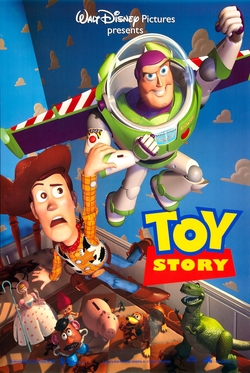
Toy Story is a 1995 American animated adventure comedy film produced by Pixar Animation Studios for Walt Disney Pictures. It is the first installment in the Toy Story franchise, the first entirely computer-animated feature film, as well as the first feature film from Pixar. The film was directed by John Lasseter, written by Joss Whedon, Andrew Stanton, Joel Cohen, and Alec Sokolow based on a story by Lasseter, Stanton, Pete Docter, and Joe Ranft, produced by Bonnie Arnold and Ralph Guggenheim, and features the voices of Tom Hanks, Tim Allen, Annie Potts, John Ratzenberger, Don Rickles, Wallace Shawn, and Jim Varney.
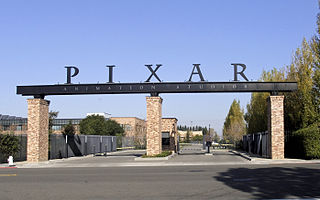
Pixar Animation Studios, known simply as Pixar, is an American animation studio based in Emeryville, California, known for its critically and commercially successful computer-animated feature films. Pixar is a subsidiary of Walt Disney Studios, a division of Disney Entertainment, a segment of The Walt Disney Company.
Modern animation in the United States from the late 1980s to 2004 is frequently referred to as the renaissance age of American animation. During this period, many large American entertainment companies reformed and reinvigorated their animation departments, following the dark age, and the United States had an influence on global and worldwide animation.
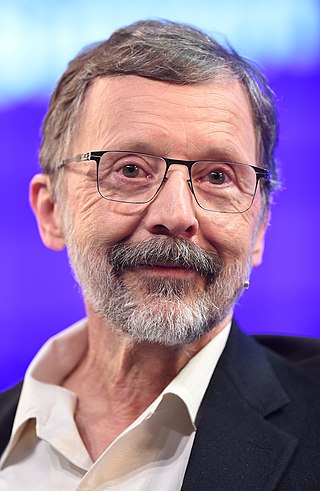
Edwin Earl Catmull is an American computer scientist and animator who served as the co-founder of Pixar and the President of Walt Disney Animation Studios. He has been honored for his contributions to 3D computer graphics, including the 2019 ACM Turing Award.

Tin Toy is a 1988 American animated short film produced by Pixar and directed by John Lasseter. The short film, which runs for five minutes, stars Tinny, a tin one-man band toy, trying to escape from Billy, a human baby. The third short film produced by the company's small animation division, it was a risky investment: due to the low revenue produced by Pixar's main product, the Pixar Image Computer, the company was under financial constraints.

Geri's Game is a 1997 American animated short film produced by Pixar and written and directed by Jan Pinkava. The film was Pixar's first film to feature a human as its main character. The character later made an appearance in Toy Story 2 as "The Cleaner", where he was voiced by Jonathan Harris and Bob Peterson.
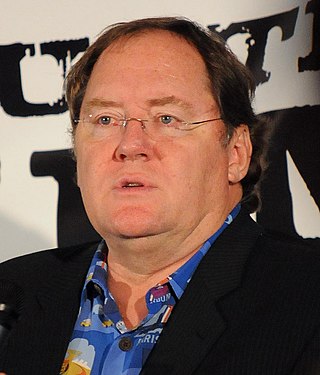
John Alan Lasseter is an American film director, producer, and animator. He has served as the head of animation at Skydance Animation since 2019. Previously, he acted as the chief creative officer of Pixar Animation Studios, Walt Disney Animation Studios, and Disneytoon Studios, as well as the Principal Creative Advisor for Walt Disney Imagineering.
The Computer Animation Production System (CAPS) was a proprietary collection of software, scanning camera systems, servers, networked computer workstations, and custom desks developed by The Walt Disney Company and Pixar in the late 1980s. Although outmoded by the mid-2000s, it succeeded in reducing labor costs for ink and paint and post-production processes of traditionally animated feature films produced by Walt Disney Animation Studios (WDAS). It also provided an entirely new palette of digital tools to the animation filmmakers.

Red's Dream is a 1987 American animated short film written and directed by John Lasseter and produced by Pixar. The short film, which runs four minutes, stars Red, a unicycle. Propped up in the corner of a bicycle store on a rainy night, Red dreams of a fantasy where it becomes the star of a circus. Red's Dream was Pixar's second computer-animated short following Luxo Jr. in 1986, also directed by Lasseter.

The Adventures of André & Wally B. is a 1984 American animated short film produced by the Lucasfilm Computer Graphics Project, a division of Lucasfilm and the predecessor of Pixar. The short was groundbreaking by the standards of the time and helped spark the film industry's interest in computer animation.

Circle Seven Animation was a short-lived division of Walt Disney Feature Animation specializing in computer-generated imagery (CGI) animation and was originally intended to create sequels to the Disney-owned Pixar properties, leading rivals and animators to derisively nickname the division "Pixaren't". The studio did not release any films during its existence, nor were any of its scripts used by Pixar.
The name RenderMan can cause confusion because it has been used to refer to different things developed by Pixar Animation Studios:

Glenn John McQueen was a Canadian supervisor of digital animation and supervising character animator at Pixar and Pacific Data Images.
Pixar Canada was a short-lived, wholly owned subsidiary of Pixar Animation Studios. It was located in Vancouver, British Columbia. The studio was tasked to produce short films based on Pixar’s feature film characters.
TVPaint Animation is a 2D paint and digital animation software package developed by TVPaint Developpement SARL based in Lorraine, France. Originally released for Amiga in 1991, version 3.0 (1994) introduced support for other platforms. In 1999, the last Amiga version 3.59 was released as free download. TVPaint Animation currently runs on Mac, Windows, Linux, and Android operating systems.
