
Jet streams are fast flowing, narrow air currents in the earth's atmosphere.

Michael Jeter was an American actor. Known for his career on stage and screen, Jeter played diverse characters, taking on roles ranging from eccentric and pretentious to weak and ineffectual. He won a Tony Award and a Primetime Emmy Award. He portrayed Herman Stiles on the sitcom Evening Shade from 1990 until 1994.

Deep Space 2 was a NASA space probe, part of the New Millennium Program. It included two highly advanced miniature space probes that were sent to Mars aboard the Mars Polar Lander in January 1999. The probes were named "Scott" and "Amundsen", in honor of Robert Falcon Scott and Roald Amundsen, the first explorers to reach the Earth's South Pole. Intended to be the first spacecraft to penetrate below the surface of another planet, after entering the Mars atmosphere DS2 was to detach from the Mars Polar Lander mother ship and plummet to the surface using only an aeroshell impactor, with no parachute. The mission was declared a failure on March 13, 2000, after all attempts to reestablish communications following the descent went unanswered.

Eureka is a small research base on Fosheim Peninsula, Ellesmere Island, Qikiqtaaluk Region, in the Canadian territory of Nunavut. It is located on the north side of Slidre Fiord, which enters Eureka Sound farther west. It is the third-northernmost permanent research community in the world. The only two farther north are Alert, which is also on Ellesmere Island, and Nord, in Greenland. Eureka has the lowest average annual temperature and the lowest amount of precipitation of any weather station in Canada.
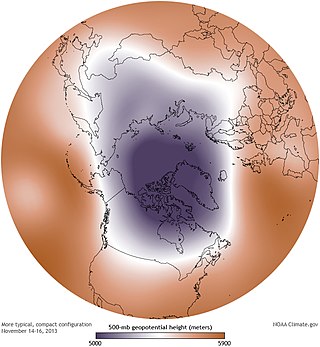
A circumpolar vortex, or simply polar vortex, is a large region of cold, rotating air; polar vortices encircle both of Earth's polar regions. Polar vortices also exist on other rotating, low-obliquity planetary bodies. The term polar vortex can be used to describe two distinct phenomena; the stratospheric polar vortex, and the tropospheric polar vortex. The stratospheric and tropospheric polar vortices both rotate in the direction of the Earth's spin, but they are distinct phenomena that have different sizes, structures, seasonal cycles, and impacts on weather.
The polar bear is a large bear native to the Arctic and nearby areas.
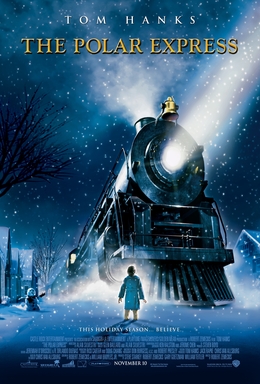
The Polar Express is a 2004 American animated Christmas adventure film directed by Robert Zemeckis, who co-wrote the screenplay with William Broyles Jr., based on the 1985 children's book of the same name by Chris Van Allsburg. It stars Tom Hanks, Daryl Sabara, Nona Gaye, Jimmy Bennett, and Eddie Deezen. The film depicts human characters using live action and motion capture computer animation, with production sequences for the latter taking place from June 2003 to May 2004. Set on Christmas Eve, it tells the story of a young boy who sees a mysterious train bound for the North Pole stop outside his window and is invited aboard by its conductor. He joins other children as they embark on a journey to visit Santa Claus, who is preparing for Christmas.
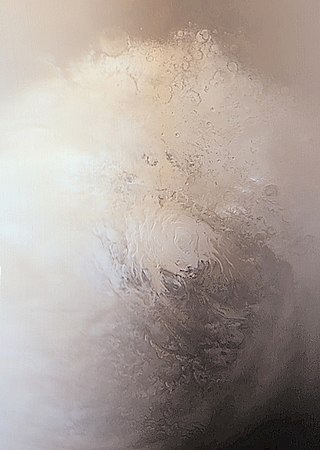
Planum Australe is the southern polar plain on Mars. It extends southward of roughly 75°S and is centered at 83.9°S 160.0°E. The geology of this region was to be explored by the failed NASA mission Mars Polar Lander, which lost contact on entry into the Martian atmosphere.

Niger Vallis is a valley on Mars that appears to have been carved by water. It has been identified as an outflow channel. It merges with Dao Vallis which runs southwestward into Hellas Planitia from the volcanic Hadriacus Mons. Like Dao, it was formed around the Late Noachian and Early Hesperian Epochs. It is named after the Niger River in Africa.

Polar amplification is the phenomenon that any change in the net radiation balance tends to produce a larger change in temperature near the poles than in the planetary average. This is commonly referred to as the ratio of polar warming to tropical warming. On a planet with an atmosphere that can restrict emission of longwave radiation to space, surface temperatures will be warmer than a simple planetary equilibrium temperature calculation would predict. Where the atmosphere or an extensive ocean is able to transport heat polewards, the poles will be warmer and equatorial regions cooler than their local net radiation balances would predict. The poles will experience the most cooling when the global-mean temperature is lower relative to a reference climate; alternatively, the poles will experience the greatest warming when the global-mean temperature is higher.
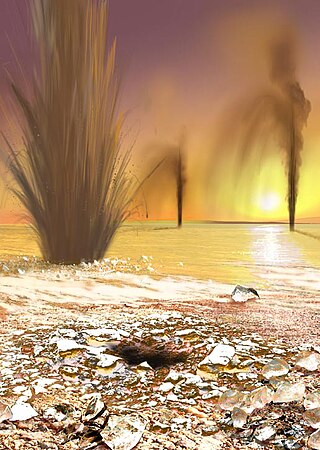
Martian geysers are putative sites of small gas and dust eruptions that occur in the south polar region of Mars during the spring thaw. "Dark dune spots" and "spiders" – or araneiforms – are the two most visible types of features ascribed to these eruptions.

McMurdo is a crater in the Mare Australe quadrangle of Mars, located at 84.4° S and 359.1° W. It is 30.3 km in diameter and was named after McMurdo Station in Antarctica.
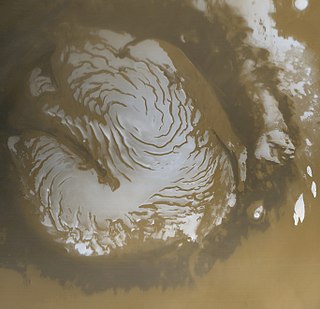
The planet Mars has two permanent polar ice caps of water ice and some dry ice (frozen carbon dioxide, CO2). Above kilometer-thick layers of water ice permafrost, slabs of dry ice are deposited during a pole's winter, lying in continuous darkness, causing 25–30% of the atmosphere being deposited annually at either of the poles. When the poles are again exposed to sunlight, the frozen CO2 sublimes. These seasonal actions transport large amounts of dust and water vapor, giving rise to Earth-like frost and large cirrus clouds.

Saturn's hexagon is a persistent approximately hexagonal cloud pattern around the north pole of the planet Saturn, located at about 78°N. The sides of the hexagon are about 14,500 km (9,000 mi) long, which is about 2,000 km (1,200 mi) longer than the diameter of Earth. The hexagon may be a bit more than 29,000 km (18,000 mi) wide, may be 300 km (190 mi) high, and may be a jet stream made of atmospheric gases moving at 320 km/h (200 mph). It rotates with a period of 10h 39m 24s, the same period as Saturn's radio emissions from its interior. The hexagon does not shift in longitude like other clouds in the visible atmosphere.
Jennifer Ann Francis is an American atmospheric scientist. She became a senior scientist at Woods Hole Research Center in 2018, after being a research professor at Rutgers University's Institute of Marine and Coastal Sciences starting in 1994.
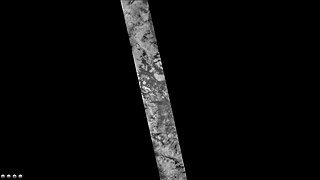
Main is an impact crater on Mars, located in the Mare Australe quadrangle at 76.6°S latitude and 310.9°W longitude. It measures 109.0 kilometers in diameter and was named after Rev. Robert Main. The name was approved in 1973, by the International Astronomical Union (IAU) Working Group for Planetary System Nomenclature (WGPSN). The floor of Main shows dark portions which are caused by pressurized carbon dioxide blowing dust in the atmosphere in the spring when the temperature goes up. Some of the dust is shaped into streaks if there is a wind.
Joly is an impact crater on Mars, located at 74.7°S latitude and 42.7°W longitude in the Mare Australe quadrangle. It measures 79.9 kilometres (49.6 mi) in diameter and was named after Irish physicist John Joly (1857–1933). The name was approved in 1973, by the International Astronomical Union (IAU) Working Group for Planetary System Nomenclature (WGPSN).

Reynolds is an impact crater on Mars, located in the Mare Australe quadrangle at 75.1°S latitude and 157.9°W longitude and is in the southernmost portion of Terra Sirenum. It measures 91 kilometers in diameter and was named after British physicist Osborne Reynolds.

Top Wing is a Canadian animated television series created by Matthew Fernandes of Industrial Brothers. It was produced by 9 Story Media Group. In Canada, the series debuted on Treehouse on January 5, 2018. Nickelodeon acquired the rights to the show outside of Canada, and it premiered on Nickelodeon in the United States on November 6, 2017. In the UK, the main cast's voices are dubbed with British voice actors, replacing their original Canadian voices.
