
An aquifer is an underground layer of water-bearing material, consisting of permeable or fractured rock, or of unconsolidated materials. Aquifers vary greatly in their characteristics. The study of water flow in aquifers and the characterization of aquifers is called hydrogeology. Related terms include aquitard, which is a bed of low permeability along an aquifer, and aquiclude, which is a solid, impermeable area underlying or overlying an aquifer, the pressure of which could lead to the formation of a confined aquifer. The classification of aquifers is as follows: Saturated versus unsaturated; aquifers versus aquitards; confined versus unconfined; isotropic versus anisotropic; porous, karst, or fractured; transboundary aquifer.

In geology, a placer deposit or placer is an accumulation of valuable minerals formed by gravity separation from a specific source rock during sedimentary processes. The name is from the Spanish word placer, meaning "alluvial sand". Placer mining is an important source of gold, and was the main technique used in the early years of many gold rushes, including the California Gold Rush. Types of placer deposits include alluvium, eluvium, beach placers, aeolian placers and paleo-placers.

An alluvial fan is an accumulation of sediments that fans outwards from a concentrated source of sediments, such as a narrow canyon emerging from an escarpment. They are characteristic of mountainous terrain in arid to semiarid climates, but are also found in more humid environments subject to intense rainfall and in areas of modern glaciation. They range in area from less than 1 square kilometer (0.4 sq mi) to almost 20,000 square kilometers (7,700 sq mi).

Placer mining is the mining of stream bed (alluvial) deposits for minerals. This may be done by open-pit or by various surface excavating equipment or tunneling equipment.

Hydraulic mining is a form of mining that uses high-pressure jets of water to dislodge rock material or move sediment. In the placer mining of gold or tin, the resulting water-sediment slurry is directed through sluice boxes to remove the gold. It is also used in mining kaolin and coal.

A berm is a level space, shelf, or raised barrier separating areas in a vertical way, especially partway up a long slope. It can serve as a terrace road, track, path, a fortification line, a border/separation barrier for navigation, good drainage, industry, or other purposes.

Coalbed methane, coalbed gas, or coal seam gas (CSG) is a form of natural gas extracted from coal beds. In recent decades it has become an important source of energy in United States, Canada, Australia, and other countries.

The tin mining industry on Dartmoor, Devon, England, is thought to have originated in pre-Roman times, and continued right through to the 20th century, when the last commercially worked mine closed in November 1930. From the 12th century onwards tin mining was regulated by a stannary parliament which had its own laws.

A yakhchāl is an ancient type of ice house, which also made ice. They are primarily found in the Dasht-e Lut and Dasht-e-Kavir deserts, whose climates range from cold (BWk) to hot (BWh) desert regions.

An ab anbar is a traditional reservoir or cistern of drinking water in Greater Iran in antiquity.

Clastic rocks are composed of fragments, or clasts, of pre-existing minerals and rock. A clast is a fragment of geological detritus, chunks, and smaller grains of rock broken off other rocks by physical weathering. Geologists use the term clastic to refer to sedimentary rocks and particles in sediment transport, whether in suspension or as bed load, and in sediment deposits.
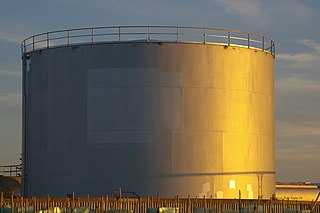
Storage tanks are containers that hold liquids or compressed gases. The term can be used for reservoirs, and for manufactured containers. The usage of the word "tank" for reservoirs is uncommon in American English but is moderately common in British English. In other countries, the term tends to refer only to artificial containers. In the U.S., storage tanks operate under no pressure, distinguishing them from pressure vessels.

A tube well is a type of water well in which a long, 100–200 millimetres (3.9–7.9 in)-wide, stainless steel tube or pipe is bored underground. The lower end is fitted with a strainer, and a pump lifts water for irrigation. The required depth of the well depends on the depth of the water table.
Seasonal thermal energy storage (STES), also known as inter-seasonal thermal energy storage, is the storage of heat or cold for periods of up to several months. The thermal energy can be collected whenever it is available and be used whenever needed, such as in the opposing season. For example, heat from solar collectors or waste heat from air conditioning equipment can be gathered in hot months for space heating use when needed, including during winter months. Waste heat from industrial process can similarly be stored and be used much later or the natural cold of winter air can be stored for summertime air conditioning.
Petrophysics is the study of physical and chemical rock properties and their interactions with fluids.

The Little Para River is a seasonal creek running across the Adelaide Plains in the Australian state of South Australia, whose catchment fills reservoirs that supply some of the water needs of Adelaide’s northern suburbs.
Natural gas is a commodity that can be stored for an indefinite period of time in natural gas storage facilities for later consumption.
Porosity or void fraction is a measure of the void spaces in a material, and is a fraction of the volume of voids over the total volume, between 0 and 1, or as a percentage between 0% and 100%. Strictly speaking, some tests measure the "accessible void", the total amount of void space accessible from the surface.
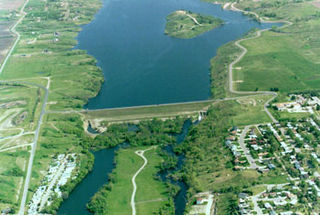
The Jamestown Dam is a rolled-earth dam spanning the James River in Stutsman County in the U.S. state of North Dakota, serving the primary purpose of flood control. It is north of the city of Jamestown, North Dakota. Built from April 1952 to September 1953, the dam measures 1,418 feet (432 m) long at the crest and 85 feet (26 m) high. It impounds the James River to form the Jamestown Reservoir. A small islet lies shortly upstream of the dam, where the James River previously split into two channels.
The exposed strata at the surface in and around Wichita Falls are the products of one ancient period of deposition with a modest amount of recent and modern alteration. In all cases, the strata are products of terrigenous (non-marine) environments dominated by fluvial depositional and erosional systems.
