
Mortadella is a large Italian sausage or luncheon meat made of finely hashed or ground, heat-cured pork, which incorporates at least 15% small cubes of pork fat. Mortadella is a product of Bologna, Italy. It is flavoured with spices, including whole or ground black pepper, myrtle berries, and pistachios.

A sausage is a cylindrical meat product usually made from ground meat, often pork, beef, or veal, along with salt, spices and other flavourings, and breadcrumbs, encased by a skin. Typically, a sausage is formed in a casing traditionally made from intestine, but sometimes from synthetic materials. Sausages that are sold raw are cooked in many ways, including pan-frying, broiling and barbecuing. Some sausages are cooked during processing and the casing may then be removed.

Salami is a type of cured sausage consisting of fermented and air-dried meat, typically pork. Historically, salami was popular among southern, eastern, and central European peasants because it can be stored at room temperature for up to 40 days once cut, supplementing a potentially meager or inconsistent supply of fresh meat. Countries and regions across Europe make their own traditional varieties of salami.

Chorizo or chouriço is a type of pork sausage. Traditionally, it uses natural casings made from intestines, a method used since Roman times.

Linguiça is a form of smoke-cured pork sausage seasoned with garlic and paprika in Portuguese-speaking countries.

Cumberland sausage is a form of sausage that originated in the ancient county of Cumberland, England, now part of Cumbria. They are traditionally very long, up to 21 inches, and sold rolled in a flat, circular coil, but within western Cumbria, they are more often served in long, curved lengths.

The Centro Region or Central Portugal is one of the statistical regions of Portugal. The cities with major administrative status inside this region are Coimbra, Aveiro, Viseu, Leiria, Castelo Branco, Covilhã and Guarda. It is one of the seven Regions of Portugal. It is also one of the regions of Europe, as given by the European Union for statistical and geographical purposes. Its area totals 28,462 km2 (10,989 sq mi). As of 2011, its population totalled 2,327,026 inhabitants, with a population density of 82 inhabitants per square kilometre.

The origins of meat preservation are lost to the ages but probably began when humans began to realize the preservative value of salt. Sausage making originally developed as a means to preserve and transport meat. Primitive societies learned that dried berries and spices could be added to dried meat. The procedure of stuffing meat into casings remains basically the same today, but sausage recipes have been greatly refined and sausage making has become a highly respected culinary art.

The alheira is a type of Portuguese sausage, made with meats and bread.

Coimbra Airport, also known as Bissaya Barreto Aerodrome, is an airport serving Coimbra, Portugal.

Farinheira is a Portuguese smoked sausage made mainly from wheat flour, pork fat and seasonings. It has a yellow/brown colour and is served in traditional dishes like feijoada or cozido à portuguesa. It is also eaten on its own, roasted or fried. In modern versions, it is previously cooked, then peeled and mixed with scrambled eggs and served on bread or toast as a starter.
Meat Products of India Ltd (MPI) is a major Indian meat processing, packaging, and distribution company based in Edayar, Koothattukulam in the district of Ernakulam, Kerala.

Metworst or droge worst is a type of traditional Dutch sausage. The sausages have a very strong flavour and are made from raw minced pork which is then air dried.
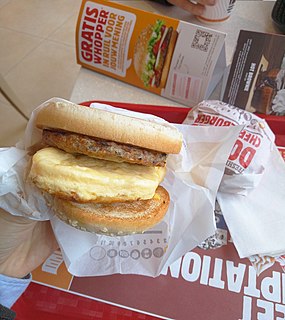
International fast-food restaurant chain Burger King and its Australian franchise Hungry Jack's have had a variety of breakfast sandwiches in their product portfolio since 1978. The Croissan'wich was the first major breakfast sandwich product introduced by the company.

Kielbasa is any type of meat sausage from Poland, and a staple of Polish cuisine. In American English the word typically refers to a coarse, u-shaped smoked sausage of any kind of meat, which closely resembles the Wiejskasausage in British English.


