
Justinian I, also known as Justinian the Great, was the Eastern Roman emperor from 527 to 565.

The 4th century was the time period which lasted from 301 through 400. In the West, the early part of the century was shaped by Constantine the Great, who became the first Roman emperor to adopt Christianity. Gaining sole reign of the empire, he is also noted for re-establishing a single imperial capital, choosing the site of ancient Byzantium in 330 to build the city soon called Nova Roma ; it was later renamed Constantinople in his honor.
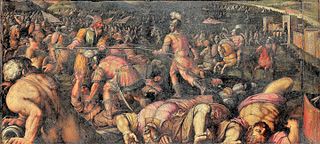
The 400s decade ran from January 1, 400, to December 31, 409.
The 470s decade ran from January 1, 470, to December 31, 479.
The 360s decade ran from January 1, 360, to December 31, 369.

Anicius Olybrius was Roman emperor from July 472 until his death later that same year; his rule as augustus in the western Roman Empire was not recognised as legitimate by the ruling augustus in the eastern Roman Empire, Leo I. He was in reality a puppet ruler raised to power by Ricimer, the magister militum of Germanic descent, and was mainly interested in religion, while the actual power was held by Ricimer and his nephew Gundobad.

Leo I was Eastern Roman emperor from 457 to 474. He was a native of Dacia Aureliana near historic Thrace. Sometimes, he is called Leo the Great, probably to distinguish him from his young grandson and co-augustus Leo II.

Procopius Anthemius was western Roman emperor from 467 to 472.
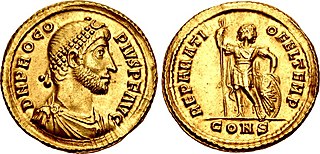
Procopius was a Roman usurper against Valens, and a member of the Constantinian dynasty.
Maximus is the Latin term for "greatest" or "largest". In this connection it may refer to:
Flavius Procopius Anthemius was a politician of the Eastern Roman Empire, son of Western Roman Emperor Anthemius.

The Leonid dynasty produced five Roman emperors during Late Antiquity, reigning over the Roman Empire from 457 to 518. The dynasty's patriarch was Leo I, who was made Roman emperor in 457. Leo's daughter Ariadne became empress and mother to an emperor, and her two husbands were themselves each made emperor in turn. Another relative whose name does not survive of Leo I or his wife Verina married the future augustus Julius Nepos, the last emperor in the western Roman Empire. The dynasty of Leo succeeded the preceding Valentinianic dynasty and Theodosian dynasty whose family trees were conjoined and ruled concurrently. Besides Julius Nepos, who administered no more than a rump state the Roman province of Dalmatia in the western empire during the fall of the west, the dynasty's emperors governed the eastern empire.
Flavius Marcianus was a member of the House of Leo and a usurper against Emperor Zeno in 479.
Flavius Anthemius was a high-ranking official of the late Roman Empire. He is notable as a praetorian prefect of the East in the later reign of Arcadius and the first years of Theodosius II, during which time he led the government of the Eastern Roman Empire on behalf of the child emperor and supervised the construction of the first set of the famous Theodosian Walls.

Procopius of Scythopolis is venerated as a martyr and saint. He was a famous ascetic and erudite theologian and philosopher. Eusebius of Caesarea wrote of his martyrdom, which occurred during the persecution of Roman Emperor Diocletian, and stated that "he was born at Jerusalem, but had gone to live in Scythopolis, where he held three ecclesiastical offices. He was reader and interpreter in the Syriac language, and cured those possessed of evil spirits." Eusebius wrote that Procopius was sent with his companions from Scythopolis to Caesarea Maritima, where he was decapitated.
Marcia Euphemia was the wife of Anthemius, Western Roman Emperor.
Leontius or Leontios was a Byzantine emperor.
Anthemius (420-472) was a Western Roman Emperor.
Procopius was a Roman patrician and military leader.
Romulus was a member of the House of Theodosius, son of Western Roman Emperor Anthemius.
This page is based on this
Wikipedia article Text is available under the
CC BY-SA 4.0 license; additional terms may apply.
Images, videos and audio are available under their respective licenses.
