The Star Trek fictional universe contains a variety of weapons, ranging from missiles to melee. The Star Trek franchise consists mainly of several multi-season television shows and a dozen movies, as well as various video games and inspired merchandise. Many aspects of the Star Trek universe impact modern popular culture, especially its fictitious terminology and the concept of weaponry on spacecraft. The franchise has had a widespread influence on its audiences from the late 20th to early 21st century. Notably, Star Trek's science fiction concepts have been studied by real scientists; NASA described it in relation to the real world as "entertaining combination of real science, imaginary science gathered from lots of earlier stories, and stuff the writers make up week-by-week to give each new episode novelty." For example, NASA noted that the Star Trek "phasers" were a fictional extrapolation of real-life lasers, and compared them to real-life microwave based weapons that have a stunning effect.

Non-lethal weapons, also called nonlethal weapons, less-lethal weapons, less-than-lethal weapons, non-deadly weapons, compliance weapons, or pain-inducing weapons are weapons intended to be less likely to kill a living target than conventional weapons such as knives and firearms with live ammunition. It is often understood that unintended or incidental casualties are risked wherever force is applied, but non-lethal weapons try to minimise the risk of casualties as much as possible. Non-lethal weapons are used in policing and combat situations to limit the escalation of conflict where employment of lethal force is prohibited or undesirable, where rules of engagement require minimum casualties, or where policy restricts the use of conventional force. These weapons occasionally cause serious injuries or death; the term "less-lethal" has been preferred by some organizations as it describes the risks of death more accurately than the term "non-lethal", which some have argued is a misnomer.
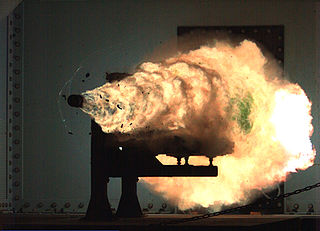
A railgun or rail gun is a linear motor device, typically designed as a weapon, that uses electromagnetic force to launch high-velocity projectiles. The projectile normally does not contain explosives, instead relying on the projectile's high kinetic energy to inflict damage. The railgun uses a pair of parallel conductors (rails), along which a sliding armature is accelerated by the electromagnetic effects of a current that flows down one rail, into the armature and then back along the other rail. It is based on principles similar to those of the homopolar motor.

A taser is a conducted energy device (CED) primarily used to incapacitate people, allowing them to be approached and handled in an unresisting and thus safe manner. Sold by Axon, formerly TASER International, the device fires two small barbed darts intended to puncture the skin and remain attached to the target, at 55 m/s. Their range extends from 4.5 m (15 ft) for non-Law Enforcement Tasers to 10.5 m (34 ft) for Law Enforcement Tasers. The darts are connected to the main unit by thin insulated copper wire and deliver a modulated electric current designed to disrupt voluntary control of muscles, causing "neuromuscular incapacitation." The effects of a taser may only be localized pain or strong involuntary long muscle contractions, based on the mode of use and connectivity of the darts.
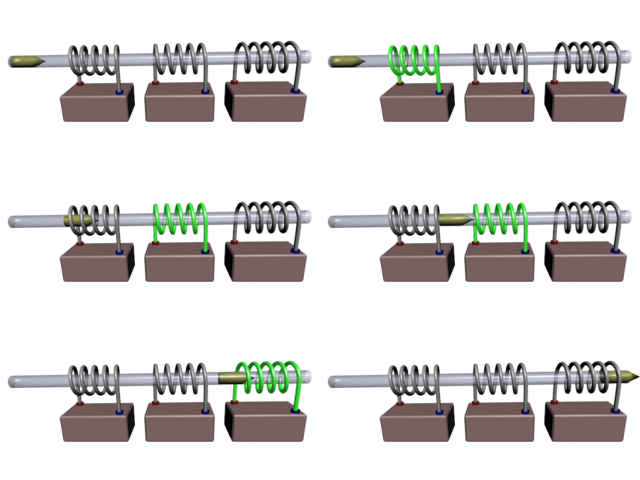
A coilgun is a type of mass driver consisting of one or more coils used as electromagnets in the configuration of a linear motor that accelerate a ferromagnetic or conducting projectile to high velocity. In almost all coilgun configurations, the coils and the gun barrel are arranged on a common axis. A coilgun is not a rifle as the barrel is smoothbore.
Muzzle velocity is the speed of a projectile with respect to the muzzle at the moment it leaves the end of a gun's barrel. Firearm muzzle velocities range from approximately 120 m/s (390 ft/s) to 370 m/s (1,200 ft/s) in black powder muskets, to more than 1,200 m/s (3,900 ft/s) in modern rifles with high-velocity cartridges such as the .220 Swift and .204 Ruger, all the way to 1,700 m/s (5,600 ft/s) for tank guns firing kinetic energy penetrator ammunition. To simulate orbital debris impacts on spacecraft, NASA launches projectiles through light-gas guns at speeds up to 8,500 m/s (28,000 ft/s). FPS and MPH are the most common American measurements for bullets. Several factors, including the type of firearm, the cartridge, and the barrel length, determine the bullet's muzzle velocity.
An electroshock weapon is an incapacitating weapon. It delivers an electric shock aimed at temporarily disrupting muscle functions and/or inflicting pain without usually causing significant injury.

A directed-energy weapon (DEW) is a ranged weapon that damages its target with highly focused energy without a solid projectile, including lasers, microwaves, particle beams, and sound beams. Potential applications of this technology include weapons that target personnel, missiles, vehicles, and optical devices.
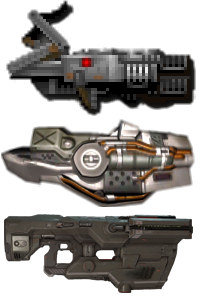
The BFG is a fictional weapon found in many video games, mostly in id Software-developed series' such as Doom and Quake.

A ranged weapon is any weapon that can engage targets beyond hand-to-hand distance, i.e. at distances greater than the physical reach of the user holding the weapon itself. The act of using such a weapon is also known as shooting. It is sometimes also called projectile weapon or missile weapon because it typically works by launching solid projectiles ("missiles"), though technically a fluid-projector and a directed-energy weapon are also ranged weapons. In contrast, a weapon intended to be used in hand-to-hand combat is called a melee weapon.
A particle beam is a stream of charged or neutral particles. In particle accelerators, these particles can move with a velocity close to the speed of light. There is a difference between the creation and control of charged particle beams and neutral particle beams, as only the first type can be manipulated to a sufficient extent by devices based on electromagnetism. The manipulation and diagnostics of charged particle beams at high kinetic energies using particle accelerators are main topics of accelerator physics.
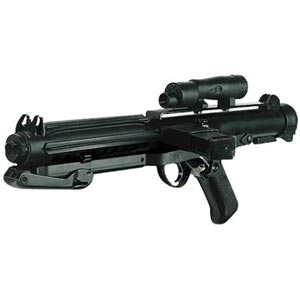
A blaster is a fictional gun that appears in the Star Wars universe. Lucasfilm defines the blaster as "ranged energized particle weaponry". Many blasters mirror the appearance, functions, components, operation, and usage of real life firearms. They are also said to be able to be modified with certain add-ons and attachments, with Han Solo's blaster being said to be illegally modified to provide greater damage without increasing power consumption.
A kinetic bombardment or a kinetic orbital strike is the hypothetical act of attacking a planetary surface with an inert kinetic projectile from orbit, where the destructive power comes from the kinetic energy of the projectile impacting at very high speeds. The concept originated during the Cold War.
Pulsed energy projectile or PEP is a technology of non-lethal weaponry. The U.S. military is developing PEP using an invisible laser pulse which ablates the target's surface and creates a small amount of exploding plasma. This produces a pressure wave that stuns the target and electromagnetic radiation that affects nerve cells causing a painful sensation. The technology can be used as a lethal weapon.

A laser weapon is a type of directed-energy weapon that uses lasers to inflict damage. Despite decades of research and development, as of 2023, directed-energy weapons, including lasers, remain at the experimental stage. Whether they will be deployed as practical, high-performance military weapons remains to be seen. One of the major issues with laser weapons is atmospheric thermal blooming, which is still largely unsolved. This issue is exacerbated when there is fog, smoke, dust, rain, snow, smog, foam, or purposely dispersed obscurant chemicals present. In essence, a laser generates a beam of light that requires clear air or a vacuum to operate.

Dry firing is the act of activating the firing mechanism a bow, crossbow, firearm or other projectile discharging weapon while unloaded or without live ammunition. The expression is also used to refer to practicing with an inert laser/infrared training platform and may also include the use of a target/feedback system.
The legality of the potato-firing potato cannon varies among jurisdictions.

A raygun is a science-fiction directed-energy weapon that releases energy, usually with destructive effect. They have various alternate names: ray gun, death ray, beam gun, blaster, laser gun, laser pistol, phaser, zap gun, etc. In most stories, when activated, a raygun emits a ray, typically visible, usually lethal if it hits a human target, often destructive if it hits mechanical objects, with properties and other effects unspecified or varying.
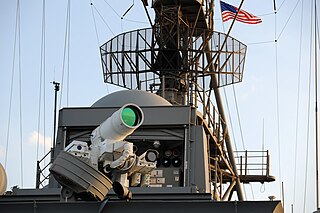
The AN/SEQ-3 Laser Weapon System or XN-1 LaWS is a laser weapon developed by the United States Navy. The weapon was installed on USS Ponce for field testing in 2014. In December 2014, the United States Navy reported that the LaWS system worked perfectly against low-end asymmetric threats, and that the commander of Ponce was authorized to use the system as a defensive weapon.

