A rifled breech loader (RBL) is an artillery piece which, unlike the smoothbore cannon and rifled muzzle loader which preceded it, has rifling in the barrel and is loaded from the breech at the rear of the gun.
Blowback is a system of operation for self-loading firearms that obtains energy from the motion of the cartridge case as it is pushed to the rear by expanding gas created by the ignition of the propellant charge.

Gas-operation is a system of operation used to provide energy to operate locked breech, autoloading firearms. In gas-operation, a portion of high-pressure gas from the cartridge being fired is used to power a mechanism to dispose of the spent case and insert a new cartridge into the chamber. Energy from the gas is harnessed through either a port in the barrel or a trap at the muzzle. This high-pressure gas impinges on a surface such as a piston head to provide motion for unlocking of the action, extraction of the spent case, ejection, cocking of the hammer or striker, chambering of a fresh cartridge, and locking of the action.
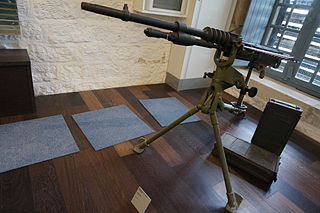
The Mle 1914 Hotchkiss machine gun chambered for the 8mm Lebel cartridge became the standard machine gun of the French Army during the latter half of World War I. It was manufactured by the French arms company Hotchkiss et Cie, which had been established in the 1860s by American industrialist Benjamin B. Hotchkiss. The gas-actuated Hotchkiss system was first formulated in 1893 by Odkolek von Ujezda and improved into its final form by Hotchkiss armament engineers, American Laurence Benét and his French assistant Henri Mercié.
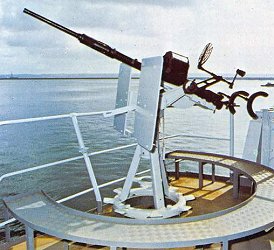
The Oerlikon 20 mm cannon is a series of autocannons based on an original German Becker Type M2 20 mm cannon design that appeared very early in World War I. It was widely produced by Oerlikon Contraves and others, with various models employed by both Allied and Axis forces during World War II. Many versions of the cannon are still used today.

Rotating bolt is a method of locking the breech of a firearm closed for firing. Johann Nicolaus von Dreyse developed the first rotating bolt firearm, the "Dreyse needle gun", in 1836. The Dreyse locked using the bolt handle rather than lugs on the bolt head like the Mauser M 98 or M16. The first rotating bolt rifle with two lugs on the bolt head was the Lebel Model 1886 rifle. The concept has been implemented on most firearms chambered for high-powered cartridges since the 20th century.

The MAC mle 1931 machine gun, was a machine gun used in French tanks of the World War II era, as well as in fortifications such as the Maginot line. It is also sometimes known as the JM Reibel, from Jumelage de mitrailleuses, or Reibel twin-mounted guns and really refers to the specialized twin-mounting frame used in JM cloche cupolas on the Maginot Line fortifications, while MAC mle 1931 refers specifically to the gun. The JM twin-mounts were the standard emplacement for the mle 1931 in fixed fortifications, while tanks and other AFVs received single guns.
A muzzle booster or recoil booster is a device fixed to the muzzle of a firearm, intended to harness the energy of the escaping propellant to augment the force of recoil on portions of the firearm. In spite of its name, a muzzle booster does not increase muzzle force or velocity but instead is usually used to improve the reliability and/or rate of fire of a recoil operated firearm. It was invented by Hiram Maxim in 1894.

The 8×50mmR Lebel rifle cartridge was the first smokeless powder cartridge to be made and adopted by any country. It was introduced by France in 1886. Formed by necking down the 11×59mmR Gras black powder cartridge, the smokeless 8mm Lebel cartridge started a revolution in military rifle ammunition. Standard 8mm Lebel military ammunition was also the first rifle ammunition to feature a spitzer boat tail bullet, which was adopted in 1898. The long-range ballistic performance of the 8mm Lebel bullet itself was exceptional for its time. For use in the magazine tube-fed early Lebel rifle, the 8 mm case was designed to protect against accidental percussion inside the tube magazine by a circular groove around the primer cup which caught the tip of the following pointed bullet. However, the shape of its rimmed bottle-necked case, having been designed for the Lebel rifle's tube magazine, also precluded truly efficient vertical stacking inside a vertical magazine. The bolt thrust of the 8mm Lebel is relatively high compared to many other service rounds used in the early 20th century. Although it was once revolutionary, the 8mm Lebel was declared obsolete after World War I and was soon after replaced with the 7.5×54mm French round.
The Meunier rifle, known as the "Meunier A6" or "STA No. 8", evolved as a part of the program initiated in 1890 by the French military to develop a semi-automatic infantry rifle that would eventually replace the Mle 1886–93 Lebel rifle. Four government research establishments proposed over 20 prototypes. About half of them were based on recoil and the others were gas operated. This secret program was placed under the direction of General Naquet-Laroque who headed the Puteaux (APX) government arsenal.

The Mendoza RM2 was a light machine gun similar to the M1918 BAR manufactured in Mexico by Productos Mendoza, S.A. Rafael Mendoza have been producing machine guns for the Mexican Army since 1933 and all have been noted for their lightness, simplicity, ease of maintenance, and economic construction without sacrificing reliability.

The Hotchkiss 13.2 mm machine gun, also known as the Hotchkiss M1929 machine gun, was a heavy machine gun, primarily intended for anti-aircraft use, designed and manufactured by French arms manufacturer Hotchkiss et Cie from the late 1920s until World War II, which saw service with various nations' forces, including Italy and Japan where the gun was built under license.

The French St. Étienne Mle 1907 was a controversial gas operated air-cooled machine gun in 8mm Lebel which was widely used only in the early years of the First World War. For “political reasons”, the "St.Etienne Mle 1907" was developed not to derive from the patented Hotchkiss machine gun. Instead, to avoid patent infringement and royalties, it borrowed its gas operated, blow-forward design from the semi-automatic Bang rifle of 1903. The Bang system, first transposed by 1905 to the French Puteaux APX Machine Gun, had proved unsatisfactory enough to inspire its redesign by 1907 as the "St-Étienne" machine gun. However the Mle 1907 "St-Étienne" was only a partial redesign: the original blow-forward gas piston, rack-and-pinion system, and bolt mechanism of the Mle 1905 "Puteaux" machine gun had all been kept only slightly modified inside the newer weapon. Eventually a total of over 39,700 "St-Étienne" Mle 1907 machine guns were manufactured between 1908 and late 1917. They were widely used by French infantry only during the early part of World War I until their replacement by the more reliable Hotchkiss M1914 machine gun.

The Model 1922 Bang rifle is a US semi-automatic rifle designed by the Danish arms designer Søren Hansen Bang. It was a modification of the earlier Models of 1909 and Model 1911 Bang rifles, both chambered in the .30-06 Springfield round.

The Puteaux SA 18 was a French single-shot, breech-loading cannon, used in World War I through World War II, primarily mounted on combat vehicles. It is closely related to the Canon d'Infanterie de 37 modèle 1916 TRP, also produced by Puteaux.
The Fusil Automatique Modèle 1917, also called the RSC M1917, was a gas-operated, semi-automatic rifle placed into service by the French Army during the latter part of World War I. It was chambered in 8mm Lebel, the rimmed cartridge used in other French Army infantry weapons of the time. In total, the French national armories, primarily Manufacture d'armes de Saint-Étienne (MAS) and Manufacture Nationale d'Armes de Tulle (MAT), manufactured 86,000 RSC M1917 rifles until production ended in late November 1918. However, very few examples have survived in fully functional, semi-automatic condition and those have become highly sought-after collectibles.
Recoil operation is an operating mechanism used to implement locked-breech autoloading firearms. Recoil operated firearms use the energy of recoil to cycle the action, as opposed to gas operation or blowback operation using the pressure of the propellant gas.
The Atelier de Construction de Puteaux (APX) was a state arsenal belonging to the French Army. It was located at 8, quai national in Puteaux.

The Canon de 75 antiaérien mle 1913–1917 were a family of French 75 mm anti-aircraft guns designed and manufactured by Schneider et Cie at Le Creusot. The guns were used by the French Army during the First World War and Second World War.

The 37 mm McClean Automatic Cannon Mk. III was a light artillery piece produced in the United States during World War I for the Imperial Russian Army.


