
Chaos theory is an interdisciplinary area of scientific study and branch of mathematics focused on underlying patterns and deterministic laws of dynamical systems that are highly sensitive to initial conditions, and were once thought to have completely random states of disorder and irregularities. Chaos theory states that within the apparent randomness of chaotic complex systems, there are underlying patterns, interconnection, constant feedback loops, repetition, self-similarity, fractals, and self-organization. The butterfly effect, an underlying principle of chaos, describes how a small change in one state of a deterministic nonlinear system can result in large differences in a later state. A metaphor for this behavior is that a butterfly flapping its wings in Texas can cause a tornado in Brazil.
Da, DA, dA, DÄ and other variants may refer to:
In cryptography, RC4 is a stream cipher. While it is remarkable for its simplicity and speed in software, multiple vulnerabilities have been discovered in RC4, rendering it insecure. It is especially vulnerable when the beginning of the output keystream is not discarded, or when nonrandom or related keys are used. Particularly problematic uses of RC4 have led to very insecure protocols such as WEP.
In computer science, reference counting is a programming technique of storing the number of references, pointers, or handles to a resource, such as an object, a block of memory, disk space, and others.
R&C, RC, R/C, Rc, or rc may refer to:
C5, C05, C V or C-5 may refer to:

In cryptography, RC6 is a symmetric key block cipher derived from RC5. It was designed by Ron Rivest, Matt Robshaw, Ray Sidney, and Yiqun Lisa Yin to meet the requirements of the Advanced Encryption Standard (AES) competition. The algorithm was one of the five finalists, and also was submitted to the NESSIE and CRYPTREC projects. It was a proprietary algorithm, patented by RSA Security.
A cryptographically secure pseudorandom number generator (CSPRNG) or cryptographic pseudorandom number generator (CPRNG) is a pseudorandom number generator (PRNG) with properties that make it suitable for use in cryptography. It is also loosely known as a cryptographic random number generator (CRNG).

In electronics a relaxation oscillator is a nonlinear electronic oscillator circuit that produces a nonsinusoidal repetitive output signal, such as a triangle wave or square wave. The circuit consists of a feedback loop containing a switching device such as a transistor, comparator, relay, op amp, or a negative resistance device like a tunnel diode, that repetitively charges a capacitor or inductor through a resistance until it reaches a threshold level, then discharges it again. The period of the oscillator depends on the time constant of the capacitor or inductor circuit. The active device switches abruptly between charging and discharging modes, and thus produces a discontinuously changing repetitive waveform. This contrasts with the other type of electronic oscillator, the harmonic or linear oscillator, which uses an amplifier with feedback to excite resonant oscillations in a resonator, producing a sine wave.
EA is an initialism for Electronic Arts, an American video game company.
Cycle, cycles, or cyclic may refer to:
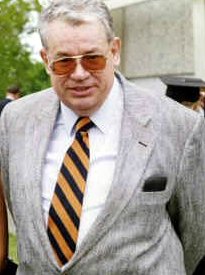
Per Brinch Hansen was a Danish-American computer scientist known for his work in operating systems, concurrent programming and parallel and distributed computing.
C3, C-3, C.3, C03, C.III or C-III may refer to:

A radio-controlled helicopter is model aircraft which is distinct from a RC airplane because of the differences in construction, aerodynamics, and flight training. Several basic designs of RC helicopters exist, of which some are more maneuverable than others. The more maneuverable designs are often harder to fly, but benefit from greater aerobatic capabilities.
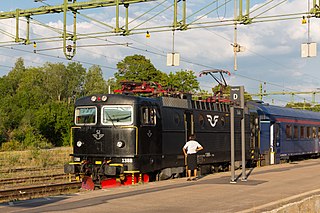
The Rc class is the most used electric locomotive in Sweden. Rc is a universal locomotive used both in freight and passenger trains. The largest operator is Green Cargo, although SJ, Tågab, Hector Rail and the Swedish Transport Administration operate it as well. Previous operators include Veolia Transport.
Selenium is an open source umbrella project for a range of tools and libraries aimed at supporting browser automation. It provides a playback tool for authoring functional tests across most modern web browsers, without the need to learn a test scripting language. It also provides a test domain-specific language (Selenese) to write tests in a number of popular programming languages, including JavaScript (Node.js), C#, Groovy, Java, Perl, PHP, Python, Ruby and Scala. Selenium runs on Windows, Linux, and macOS. It is open-source software released under the Apache License 2.0.
RC2 or RC-2 may refer to:
