
The history of Madagascar is distinguished clearly by the early isolation of the landmass from the ancient supercontinent containing Africa and India, and by the island's late colonization by human settlers arriving in outrigger canoes from the Sunda islands between 200 BCE and 500 CE. These two factors facilitated the evolution and survival of thousands of endemic plant and animal species, some of which have gone extinct or are currently threatened with extinction due to the pressures of a growing human population. Over the past two thousand years the island has received waves of settlers of diverse origins including Austronesian, Bantu, Arab, South Asian, Chinese and European. The majority of the population of Madagascar today is a mixture of Austronesian, Bantu, North Indian, Arab and Somali settlers.
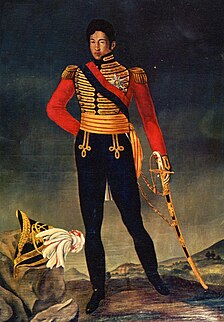
Radama I "the Great" (1793–1828) was the first Malagasy sovereign to be recognized as King of Madagascar (1810-1828) by a European state. He came to power at the age of 18 following the death of his father, King Andrianampoinimerina. Under Radama's rule and at his invitation, the first Europeans entered his central highland Kingdom of Imerina and its capital at Antananarivo. Radama encouraged these London Missionary Society envoys to establish schools to teach tradecraft and literacy to nobles and potential military and civil service recruits; they also introduced Christianity and taught literacy using the translated Bible. A wide range of political and social reforms were enacted under his rule, including an end to the international slave trade, which had historically been a key source of wealth and armaments for the Merina monarchy. Through aggressive military campaigns he successfully united two-thirds of the island under his rule. Abuse of alcohol weakened his health and he died prematurely at age 35. He was succeeded by his highest-ranking wife, Ranavalona I.
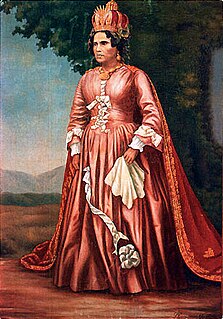
Ranavalona I, also known as Ramavo and Ranavalo-Manjaka I, was sovereign of the Kingdom of Madagascar from 1828 to 1861. After positioning herself as queen following the death of her young husband and second cousin, Radama I, Ranavalona pursued a policy of isolationism and self-sufficiency, reducing economic and political ties with European powers, repelling a French attack on the coastal town of Foulpointe, and taking vigorous measures to eradicate the small but growing Malagasy Christian movement initiated under Radama I by members of the London Missionary Society. She made heavy use of the traditional practice of fanompoana to complete public works projects and develop a standing army of between 20,000 and 30,000 Merina soldiers, whom she deployed to pacify outlying regions of the island and further expand the realm. The combination of regular warfare, disease, difficult forced labor and harsh measures of justice resulted in a high mortality rate among soldiers and civilians alike during her 33-year reign.
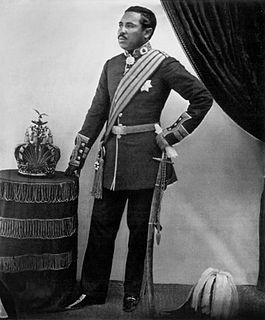
Radama II was the son and heir of Queen Ranavalona I and ruled from 1861 to 1863 over the Kingdom of Madagascar, which controlled virtually the entire island. Radama's rule, although brief, was a pivotal period in the history of the Kingdom of Madagascar. Under the unyielding and often harsh 33-year rule of his mother, Queen Ranavalona I, Madagascar had successfully preserved its cultural and political independence from French and British designs. Rejecting the queen's policy of isolationism and Christian persecution, Radama II permitted religious freedom and re-opened Madagascar to European influence. Under the terms of the Lambert Charter, which Radama secretly contracted in 1855 with French entrepreneur Joseph-François Lambert while Ranavalona still ruled, the French were awarded exclusive rights to the exploitation of large tracts of valuable land and other lucrative resources and projects. This agreement, which was later revoked by Prime Minister Rainilaiarivony, was key to establishing France's claim over Madagascar as a protectorate and, in 1896, as a colony.
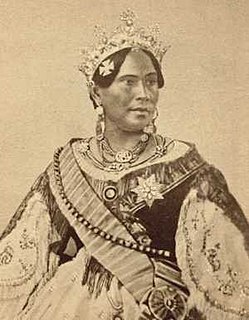
Rasoherina was Queen of Madagascar from 1863 to 1868, succeeding her husband Radama II following his presumed assassination.
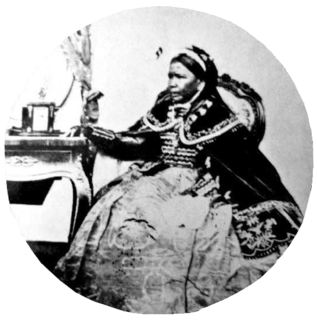
Ranavalona II was Queen of Madagascar from 1868 to 1883, succeeding Queen Rasoherina, her first cousin. She is best remembered for Christianizing the royal court during her reign.

The Merina people are the largest ethnic group in Madagascar. They are the "highlander" Malagasy ethnic group of the African island and one of the country's eighteen official ethnic groups. Their origins are mixed, predominantly with Malayo-Indonesians arriving before the 5th century AD, then many centuries later by Arabs, Africans and other ethnic groups. They speak the Merina dialect of the official Malagasy language of Madagascar.
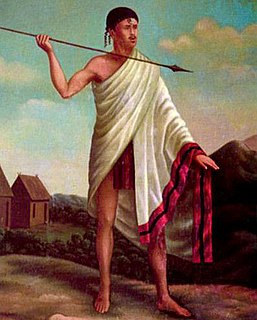
Andrianampoinimerina (1745–1810) ruled the Kingdom of Imerina from 1787 until his death. His reign was marked by the reunification of Imerina following 77 years of civil war, and the subsequent expansion of his kingdom into neighboring territories, thereby initiating the unification of Madagascar under Merina rule. Andrianampoinimerina is a cultural hero and holds near mythic status among the Merina people, and is considered one of the greatest military and political leaders in the history of Madagascar.

The Malagasy Protectorate was a French protectorate in what is now Madagascar. Through the protectorate, France attempted to control the foreign affairs of the Kingdom of Imerina through its representative at Antananarivo. France declared the island a protectorate in 1882 after reaching an agreement with Britain, which had been the first European power to establish a lasting influence and presence on the island that dated back to the arrival of London Missionary Society missionaries around 1820; Britain agreed to sanction French claims to Madagascar in exchange for French recognition of its claims to Zanzibar. The French justified the establishment of a protectorate on the basis of land claims over outlying islands like Nosy Be and Nosy Boraha and a treaty signed with a local leader of the western coastal Sakalava people. It was further justified through documents signed by King Radama II, including a letter he was possibly tricked into signing that entreated Napoleon III to support a coup d'état against Ranavalona I, and land ownership agreements with French industrialist Joseph-François Lambert that were revoked upon Radama's assassination in 1863. It ended in 1897 as Madagascar became a French colony.

Menabe is a region in western Madagascar, with its capital at Morondava. It covers an area of 46,121 square kilometres, and its population was estimated to be 592,113 in 2013. The population mostly belongs to the Sakalava ethnic group. The region is named after the 18th-century Sakalava Kingdom of Menabe. The name "Menabe", in turn, means "big red", after the color of laterite rock that dominates the landscape.

Rainilaiarivony was a Malagasy politician who served as the Prime Minister of Madagascar from 1864 to 1895, succeeding his older brother Rainivoninahitriniony, who had held the post for thirteen years. His career mirrored that of his father Rainiharo, a renowned military man who became Prime Minister during the reign of Queen Ranavalona I.

Joseph-François Lambert, the "Duke of Imerina" (1824–1873) was a French adventurer, businessman, and diplomat who fathered the Lambert Charter.

The Franco-Hova Wars or Franco-Malagasy Wars comprised two French military interventions in Madagascar between 1883 and 1896 that overthrew the ruling monarchy of the Merina Kingdom, and resulted in Madagascar becoming a French colony. Hova refers to a class within the Merina social structure.

The Rova of Antananarivo is a royal palace complex (rova) in Madagascar that served as the home of the sovereigns of the Kingdom of Imerina in the 17th and 18th centuries, as well as of the rulers of the Kingdom of Madagascar in the 19th century. Its counterpart is the nearby fortified village of Ambohimanga, which served as the spiritual seat of the kingdom in contrast to the political significance of the Rova in the capital. Located in the central highland city of Antananarivo, the Rova occupies the highest point on Analamanga, formerly the highest of Antananarivo's many hills. Merina king Andrianjaka, who ruled Imerina from around 1610 until 1630, is believed to have captured Analamanga from a Vazimba king around 1610 or 1625 and erected the site's first fortified royal structure. Successive Merina kings continued to rule from the site until the fall of the monarchy in 1896, frequently restoring, modifying or adding royal structures within the compound to suit their needs.

Rainivoninahitriniony (1824–1868), also called Raharo, was Prime Minister of the Kingdom of Madagascar between 1852 and 1864. He was the chief engineer of the Aristocratic Revolution initialized upon the attempted assassination of King Radama II. His excesses and participation in the regicide saw him fall from favor, ultimately being relieved of his position and replaced as Prime Minister by his younger brother Rainilaiarivony. Rainivoninahitriniony died in exile on May 5, 1868, shortly after an attempted coup meant to enable him to regain his position upon the death of Queen Rasoherina ended in failure.
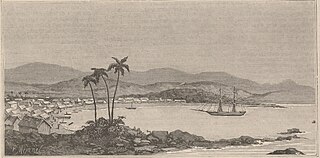
The First Madagascar expedition was the beginning of the Franco-Hova War and consisted of a French military expedition against the Merina Kingdom on the island of Madagascar in 1883. It was followed by the Second Madagascar expedition in 1895.

The twelve sacred hills of Imerina are hills of historical significance to the Merina people of Madagascar. Located throughout Imerina, the central area of the highlands of Madagascar, the sites were often ancient capitals, the birthplaces of key public figures, or the tomb sites of esteemed political or spiritual leaders. The first set of sacred sites was designated by early 17th-century king Andrianjaka. The notion was re-sanctified under late 18th-century king Andrianampoinimerina, who replaced several of the earlier sites with new ones. More than 12 sites were thus designated as sacred over time, although the notion of twelve sacred hills was perpetuated because of the significance of the number 12 in Malagasy cosmology. Today, little concrete evidence of the former importance of many of these sites remains, but the significant archeological and cultural heritage of several of the sites has been preserved. The historic significance of the sites is best represented by the Rova of Antananarivo at Analamanga, the ancient fortified city at Alasora, the houses and tombs of the andriana at Antsahadinta and the ancient fortifications and palaces at Ambohimanga, protected as a UNESCO World Heritage Site since 2001.

David Jones was a pioneering Welsh Christian missionary to Madagascar. A gifted linguist, he was noted for establishing the orthography of the Malagasy language and for his translation of the Bible into Malagasy, a work that he undertook with fellow missionary David Griffiths.
Christianity in Madagascar is practiced by 41% of Madagascans, according to the U.S. Department of State in 2011, or by 85% of them according to the Pew Research Center in 2010, often in syncretic form with traditional religious practices. Protestantism was introduced by the first envoys of the London Missionary Society in 1818, who proselytized and taught literacy through a Malagasy language Bible at the public schools they established in the highlands at the request of King Radama I. The number of converts remained low but gradually grew under repression during the reign of his successor, Queen Ranavalona I, and the more permissive religious policies of her son, Radama II, and his widow, Queen Rasoherina. The spread of Protestantism among the Merina upper classes by the mid-19th century, including Queen Ranavalona II, coupled with the growing political influence of the British missionaries, led Prime Minister Rainilaiarivony to legislate the conversion of the royal court. This prompted widespread popular conversion to Protestantism throughout the highlands in the late 19th century. Roman Catholicism was introduced principally through French diplomats and missionaries beginning in the mid-19th century but only gained significant converts under French colonization of Madagascar beginning in 1896. The early spread of Protestantism among the Merina elite resulted in a degree of class and ethnic differentiation among practitioners of Christianity, with the association of Protestantism with the upper classes and Merina ethnic group, and Catholicism attracting more adherents among the popular classes and coastal regions. Practitioners of Protestantism slightly outnumber adherents to Catholicism.
