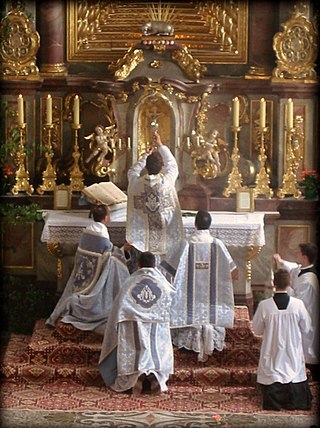
Traditionalist Catholicism is a movement that emphasizes beliefs, practices, customs, traditions, liturgical forms, devotions and presentations of teaching associated with the Catholic Church before the Second Vatican Council (1962–1965). Traditionalist Catholics particularly emphasize the Tridentine Mass, the Roman Rite liturgy largely replaced in general use by the post-Second Vatican Council Mass of Paul VI.
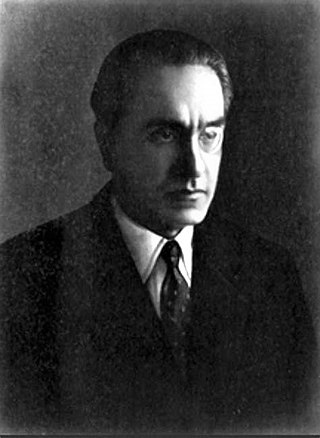
Giulio Cesare Andrea "Julius" Evola was an Italian far-right philosopher. Evola regarded his values as traditionalist, aristocratic, martial, and imperialist. An eccentric thinker in Fascist Italy, he also had ties to Nazi Germany; in the post-war era, he was an ideological mentor of the Italian neo-fascist and militant Right.

Traditionalism posits the existence of a perennial wisdom or perennial philosophy, primordial and universal truths which form the source for, and are shared by, all the major world religions. Historian Mark Sedgwick identified René Guénon, Ananda Coomaraswamy, Julius Evola, Mircea Eliade, Frithjof Schuon, Seyyed Hossein Nasr and Alexandr Dugin to be the seven most prominent Traditionalists.
Tyr: Myth—Culture—Tradition is an American “radical traditionalist” journal, edited by Joshua Buckley, Michael Moynihan, and Collin Cleary.
The Remnant is a Traditionalist Catholic newspaper published twice a month in the United States. Although its editors are not affiliated with any particular institute or traditionalist group, the paper is sympathetic to Archbishop Marcel Lefebvre and the Society of St. Pius X. Founded in 1968, it is the oldest Traditionalist Catholic newspaper in the United States.

Ralph Shapey was an American composer and conductor.

John Frederick Carden Michell was an English author and esotericist who was a prominent figure in the development of the pseudoscientific Earth mysteries movement. Over the course of his life he published over forty books on an array of different subjects, being a proponent of the Traditionalist school of esoteric thought.
Traditionalism is the adherence to traditional beliefs or practices. It may also refer to:
Traditionalist conservatism, often known as classical conservatism, is a political and social philosophy that emphasizes the importance of transcendent moral principles, manifested through certain posited natural laws to which it is claimed society should adhere. It is one of many different forms of conservatism. Traditionalist conservatism, as known today, is rooted in Edmund Burke's political philosophy, which represented a combination of Whiggism and Jacobitism, as well as the similar views of Joseph de Maistre, who attributed the rationalist rejection of Christianity during previous decades of being directly responsible for the Reign of Terror which followed the French Revolution. Traditionalists value social ties and the preservation of ancestral institutions above what they perceive as excessive rationalism and individualism. One of the first uses of the phrase "conservatism" began around 1818 with a monarchist newspaper named "Le Conservateur", written by Francois Rene de Chateaubriand with the help of Louis de Bonald.

Traditionalist architecture is an architectural movement in Europe since the beginning of the 20th century in the Netherlands, Scandinavia, Germany et al. In the Netherlands Traditionalism was a reaction to the Neo Gothic and Neo-Renaissance styles by Pierre Cuypers. One of the first influential buildings of Traditionalism was the Beurs van Berlage in Amsterdam, finished in 1903. Since the 1920s Traditionalist architecture has been a parallel movement to Modern architecture.
Mark J. Sedgwick is a British historian of Islam. He is Full Professor of Arab and Islamic Studies at Aarhus University in Denmark. Sedgwick is notable for pioneering historical research into the religious movement called Traditionalism.
Neotraditional may refer to:
New Tradition may refer to:

Atharism is a school of theology in Sunni Islam which developed from circles of the Ahl al-Hadith, a group that rejected rationalistic theology in favor of strict textualism in interpretation the Quran and the hadith.
Benjamin Raphael Teitelbaum is an American ethnographer and political commentator. An associate professor of ethnomusicology at the University of Colorado, Boulder and former Head of Nordic Studies at the same institution. He is best known for his ethnographic research into far-right groups in Scandinavia and commentary on immigration, and is frequently cited as an expert in Scandinavian and American media.

Traditionalism is a Spanish political doctrine formulated in the early 19th century and developed until today. It understands politics as implementing Catholic social teaching and the social kingship of Jesus Christ, with Catholicism as the state religion and Catholic religious criteria regulating public morality and every legal aspect of Spain. In practical terms it advocates a loosely organized monarchy combined with strong royal powers, with some checks and balances provided by organicist representation, and with society structured on a corporative basis. Traditionalism is an ultra-reactionary doctrine; it rejects concepts such as democracy, human rights, constitution, universal suffrage, sovereignty of the people, division of powers, religious liberty, freedom of speech, equality of individuals, and parliamentarism. The doctrine was adopted as the theoretical platform of the Carlist socio-political movement, though it appeared also in a non-Carlist incarnation. Traditionalism has never exercised major influence among the Spanish governmental strata, yet periodically it was capable of mass mobilization and at times partially filtered into the ruling practice.
Traditionalist conservatism in the United States is a political, social philosophy and variant of conservatism. It has been influenced by thinkers such as John Adams and Russell Kirk.
In the context of Muslim society in Indonesia, traditionalism or traditionalist Islam refers to a religious strand which puts emphasis on preserving traditionally established local rituals and scholarship. Traditionalist Muslims refer to themselves as ahlussunnah wal-jamā'ah or aswaja. Traditionalism is often contrasted with modernism, which is inspired by modernity and rationalism. Traditionalism has been the most adhered Muslim religious orientation in the history of contemporary Muslim Indonesia. The extent of traditionalism widely overlaps with the influence of a socio-religious organization Nahdlatul Ulama, the biggest Muslim organization in Indonesia. Traditionalism is also a critical element within the Muslim intellectual movement known as Islam Nusantara.
In the context of Muslim society in Indonesia, Modernism or modernist Islam refers to a religious movement which puts emphasis on teachings purely derived from the Islamic religious scriptures, the Qur'an and Hadith. Modernism is often contrasted with traditionalism, which upholds ulama-based and syncretic vernacular traditions. Modernism is inspired by reformism during the late-19th to early 20th century based in the Middle East, such as the Islamic modernist, Salafiyya and Wahhabi movements. Throughout the history of contemporary Muslim Indonesia, these movements have inspired various religious organizations; from the mass organization Muhammadiyah (1912), political party Masyumi Party (1943), to missionary organization Indonesian Islamic Dawah Council (1967).

Islamic neo-traditionalism also known as Wasatism is a contemporary strand of Sunni Islam that emphasizes adherence to the four principal Sunni schools of law (Madhahib), belief in one of the Ash'ari, Maturidi and Athari creeds (Aqaid) and the practice of Sufism (Tasawwuf), which Islamic neo-traditionalists consider to be the Sunni tradition.
