 | Look up rely in Wiktionary, the free dictionary. |
Rely may refer to:
- Rely, Pas-de-Calais, a commune (town) in France
- Rely (tampon), a brand of tampon
- Rely (car), a brand of automobiles by Chery
| Look up rely in Wiktionary, the free dictionary. |
Rely may refer to:
 | This disambiguation page lists articles associated with the title Rely. If an internal link led you here, you may wish to change the link to point directly to the intended article. |

Kleenex is a brand name for a variety of paper-based products such as facial tissue, bathroom tissue, paper towels, tampons, and diapers. Often used informally as a genericized trademark for facial tissue in the United States, the name Kleenex is a registered trademark of Kimberly-Clark Worldwide, Inc. Kleenex products are manufactured in 30 countries and sold in more than 170 countries. Kleenex brands include Cottonelle, Huggies, and VIVA. This is not to be confused with the brand "Klinex", a Unilever brand that specialises in detergents.

A tampon is a feminine hygiene product designed to absorb menstrual flow by insertion into the vagina during menstruation. Unlike a pad, it is placed internally, inside of the vaginal canal. Once inserted correctly, a tampon is held in place by the vagina and expands as it soaks up menstrual blood. In addition to menstrual blood, the tampon also absorbs the vagina's natural lubrication and bacteria, which can change the normal pH, increasing the risk of infections from the bacterium Staphylococcus aureus, which can lead to toxic shock syndrome (TSS). TSS is a rare, but life-threatening infection that requires immediate medical attention.

Toxic shock syndrome (TSS) is a condition caused by bacterial toxins. Symptoms may include fever, rash, skin peeling, and low blood pressure. There may also be symptoms related to the specific underlying infection such as mastitis, osteomyelitis, necrotising fasciitis, or pneumonia.

A menstrual cup is a feminine hygiene device which is inserted into the vagina during menstruation. Its purpose is to collect menstrual fluid and prevent its leaking onto clothes. Menstrual cups are usually made of flexible medical grade silicone, latex, or a thermoplastic isomer. They are shaped like a bell with a stem. The stem is used for insertion and removal. The bell-shaped cup seals against the vaginal wall just below the cervix. Every 4–12 hours, the cup is removed, emptied, rinsed, and reinserted. After each period, the cup requires cleaning.

A sanitary napkin, sanitary towel, sanitary pad, menstrual pad, or pad is an absorbent item worn in the underwear when menstruating, bleeding after giving birth, recovering from gynecologic surgery, experiencing a miscarriage or abortion, or in any other situation where it is necessary to absorb a flow of blood from the vagina. A menstrual pad is a type of feminine hygiene product that is worn externally, unlike tampons and menstrual cups which are worn inside the vagina. The pad has to be changed several times in 24 hours depending on whether menstrual flow is heavy or light.
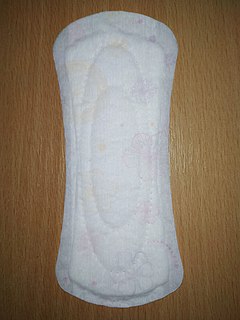
Kotex is a brand of menstrual hygiene products, which includes the Kotex maxi, thin and ultra thin pads, the Security tampons, and the Lightdays pantiliners. Most recently, the company has added U by Kotex to its line of menstrual hygiene products. Kotex is owned and managed by Kimberly-Clark, a consumer products corporation active in more than 80 countries.
Tampax is a brand of tampon currently owned by Procter & Gamble and sold in over 100 countries.

Playtex is an American brand name for undergarments, baby products, gloves, feminine products and sunscreen. The brand began in 1947, when International Latex Corporation (ILC) created a division named Playtex to produce and sell latex products. Playtex was the first to advertise undergarments on national television in 1955, written by Howard Shavelson at Olgilvie and Mather, and the first to show a woman wearing only a bra from the waist-up in a commercial in 1977.
Rely was a brand of superabsorbent tampons made by Procter & Gamble starting in 1975. The brand's advertising slogan was "It even absorbs the worry!", and claimed it could hold up longer than the leading tampon, because it was made differently. "Remember, They named it Rely" was the last line of most commercials.
Always is an American brand of menstrual hygiene products, including maxi pads, ultra thin pads, pantyliner, disposable underwear for night time wear, and vaginal wipes, produced by Procter & Gamble. It was first introduced in the United States in test markets in the spring of 1983, then nationally in May 1984. By the end of 1984, Always had also been introduced internationally in United Kingdom, Canada, France, Germany, and Africa.
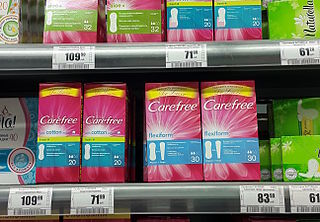
Carefree is a brand of pantyliners from Johnson & Johnson. In the US, the Carefree brand was formerly marketed by McNeil-PPC and currently being marketed by Edgewell Personal Care.
Android may refer to:

The Procter & Gamble Company (P&G) is an American multinational consumer goods corporation headquartered in Cincinnati, Ohio, founded in 1837 by William Procter and James Gamble. It specializes in a wide range of personal health/consumer health, and personal care and hygiene products; these products are organized into several segments including Beauty; Grooming; Health Care; Fabric & Home Care; and Baby, Feminine, & Family Care. Before the sale of Pringles to Kellogg's, its product portfolio also included foods, snacks, and beverages. P&G is incorporated in Ohio.

Lil-lets is a brand providing feminine hygiene products that operates principally in the UK, Ireland and South Africa. Since 2000, the company has restructured through two management buyouts (MBO) to become a business crossing all sectors of the feminine hygiene market, including tampons, sanitary napkins, pantyliners and intimate care. They also do programmes for schools that teach young girls the changes that occur when they begin to menstruate.
Realism, Realistic, or Realists may refer to:
Judith Esser-Mittag, commonly known as Judith Esser, was a German gynecologist. Her extensive studies of the female anatomy helped her improve the digital style tampon.

Bella is a brand of feminine hygiene products, including maxi pads, ultra thin pads, and female wipes. Bella is currently owned by Polish company Toruńskie Zakłady Materiałów Opatrunkowych.

o.b. is a brand of tampon, originally developed in Germany in 1950 and manufactured by Carl Hahn GmbH. It is now owned by Edgewell Personal Care. The product was named by the gynecologist Judith Esser-Mittag who also developed it. The initials "o.b." are an abbreviation of the German phrase "ohne Binde".

"Tampon tax" is a popular term used to call attention to tampons, and other feminine hygiene products, being subject to value-added tax or sales tax, unlike the tax exemption status granted to other products considered basic necessities. Proponents of tax exemption argue that tampons, sanitary napkins, menstrual cups and comparable products constitute basic, unavoidable necessities for women and thus should be made tax exempt.