Dieting is the practice of eating food in a regulated way to decrease, maintain, or increase body weight, or to prevent and treat diseases such as diabetes and obesity. As weight loss depends on calorie intake, different kinds of calorie-reduced diets, such as those emphasising particular macronutrients, have been shown to be no more effective than one another. As weight regain is common, diet success is best predicted by long-term adherence. Regardless, the outcome of a diet can vary widely depending on the individual.
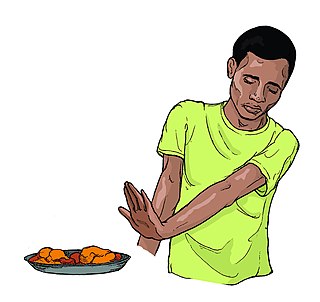
Anorexia is a medical term for a loss of appetite. While the term outside of the scientific literature is often used interchangeably with anorexia nervosa, many possible causes exist for a loss of appetite, some of which may be harmless, while others indicate a serious clinical condition or pose a significant risk.
An eating disorder is a mental disorder defined by abnormal eating behaviors that negatively affect a person's physical or mental health. Types of eating disorders include binge eating disorder, where the patient eats a large amount in a short period of time; anorexia nervosa, where the person has an intense fear of gaining weight and restricts food or overexercises to manage this fear; bulimia nervosa, where individuals eat a large quantity (binging) then try to rid themselves of the food (purging); pica, where the patient eats non-food items; rumination syndrome, where the patient regurgitates undigested or minimally digested food; avoidant/restrictive food intake disorder (ARFID), where people have a reduced or selective food intake due to some psychological reasons; and a group of other specified feeding or eating disorders. Anxiety disorders, depression and substance abuse are common among people with eating disorders. These disorders do not include obesity. People often experience comorbidity between an eating disorder and OCD. It is estimated 20-60% of patients with an ED have a history of OCD.
Orthorexia nervosa (ON) is a proposed eating disorder characterized by an excessive preoccupation with eating healthy food. The term was introduced in 1997 by American physician Steven Bratman, M.D. He suggested that some people's dietary restrictions intended to promote health may paradoxically lead to unhealthy consequences, such as social isolation; anxiety; loss of ability to eat in a natural, intuitive manner; reduced interest in the full range of other healthy human activities; and, in rare cases, severe malnutrition or even death.
Appetite is the desire to eat food items, usually due to hunger. Appealing foods can stimulate appetite even when hunger is absent, although appetite can be greatly reduced by satiety. Appetite exists in all higher life-forms, and serves to regulate adequate energy intake to maintain metabolic needs. It is regulated by a close interplay between the digestive tract, adipose tissue and the brain. Appetite has a relationship with every individual's behavior. Appetitive behaviour also known as approach behaviour, and consummatory behaviour, are the only processes that involve energy intake, whereas all other behaviours affect the release of energy. When stressed, appetite levels may increase and result in an increase of food intake. Decreased desire to eat is termed anorexia, while polyphagia is increased eating. Dysregulation of appetite contributes to anorexia nervosa, bulimia nervosa, cachexia, overeating, and binge eating disorder.

A fad diet is a diet that becomes popular for a short time, similar to fads in fashion, without being a standard dietary recommendation, and often making pseudoscientific or unreasonable claims for fast weight loss or health improvements. Fad diets are not supported by clinical research and their health recommendations are not peer-reviewed, thus they often make unsubstantiated statements about health and disease.
Emetophobia is a phobia that causes overwhelming, intense anxiety pertaining to vomit. This specific phobia can also include subcategories of what causes the anxiety, including a fear of vomiting or seeing others vomit. Emetephobes might also avoid the mentions of "barfing", vomiting, "throwing up", or "puking."

In nutrition, diet is the sum of food consumed by a person or other organism. The word diet often implies the use of specific intake of nutrition for health or weight-management reasons. Although humans are omnivores, each culture and each person holds some food preferences or some food taboos. This may be due to personal tastes or ethical reasons. Individual dietary choices may be more or less healthy.

An underweight person is a person whose body weight is considered too low to be healthy. A person who is underweight is malnourished.
Anorexia athletica, also referred to as hypergymnasia, is an eating disorder characterized by excessive and compulsive exercise. An athlete with sports anorexia tends to overexercise to give themselves a sense of having control over their body. Most often, people with the disorder tend to feel they have no control over their lives other than their control of food and exercise. In actuality, they have no control; they cannot stop exercising or regulating food intake without feeling guilty. Generally, once the activity is started, it is difficult to stop because the person is seen as being addicted to the method adopted.
A fear of eating is associated with:
Avoidant/restrictive food intake disorder (ARFID) is an eating disorder in which people avoid eating or eat only a very narrow range of foods. This can be either due to the sensory characteristics of food, such as its appearance, smell, texture, or taste, or due to fear of negative consequences such as choking or vomiting. Others might show no interest in eating or food.

Anorexia nervosa (AN), often referred to simply as anorexia, is an eating disorder characterized by low weight, food restriction, body image disturbance, fear of gaining weight, and an overpowering desire to be thin. Anorexia is a term of Greek origin: an- (ἀν-, prefix denoting negation) and orexis (ὄρεξις, "appetite"), translating literally to "a loss of appetite"; the adjective nervosa indicating the functional and non-organic nature of the disorder. Anorexia nervosa was coined by Gull in 1873 but, despite literal translation, the feeling of hunger is frequently present and the pathological control of this instinct is a source of satisfaction for the patients.
Drunkorexia is a colloquialism for anorexia or bulimia combined with an alcohol use disorder. The term is generally used to denote the utilization of extreme weight control methods to compensate for planned binge drinking. Research on the combination of an eating disorder and binge drinking has primarily focused on college-aged women, though the phenomenon has also been noted among young men. Studies suggest that individuals engage in this combination of self-imposed malnutrition and binge drinking to avoid weight gain from alcohol, to save money for purchasing alcohol, and to facilitate alcohol intoxication.
Other specified feeding or eating disorder (OSFED) is a subclinical DSM-5 category that, along with unspecified feeding or eating disorder (UFED), replaces the category formerly called eating disorder not otherwise specified (EDNOS) in the DSM-IV-TR. It captures feeding disorders and eating disorders of clinical severity that do not meet diagnostic criteria for anorexia nervosa (AN), bulimia nervosa (BN), binge eating disorder (BED), avoidant/restrictive food intake disorder (ARFID), pica, or rumination disorder. OSFED includes five examples:
Emotional eating, also known as stress eating and emotional overeating, is defined as the "propensity to eat in response to positive and negative emotions". While the term commonly refers to eating as a means of coping with negative emotions, it sometimes include eating for positive emotions, such as overeating when celebrating an event or to enhance an already good mood.
Food aversion may refer to:
Taste aversion is associated with:
Atypical anorexia nervosa is an eating disorder in which individuals meet all the qualifications for anorexia nervosa, including a body image disturbance and a history of restrictive eating and weight loss, except that they are not currently underweight. Atypical anorexia qualifies as a mental health disorder in the Diagnostic and Statistical Manual of Mental Disorders (DSM-5), under the category Other Specified Feeding and Eating Disorders (OSFED). The characteristics of people with atypical anorexia generally do not differ significantly from anorexia nervosa patients except for their current weight.
The term selective eating might refer or relate to:
