
Look up reward in Wiktionary, the free dictionary.
Reward may refer to:
Reward may refer to:


A loyalty program or a rewards program is a marketing strategy designed to encourage customers to continue to shop at or use the services of one or more businesses associated with the program.
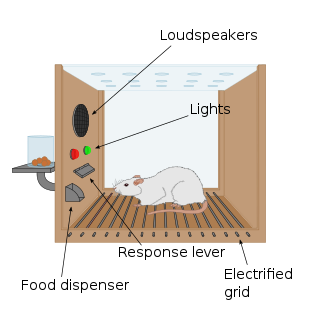
In behavioral psychology, reinforcement refers to consequences that increase the likelihood of an organism's future behavior, typically in the presence of a particular antecedent stimulus. For example, a rat can be trained to push a lever to receive food whenever a light is turned on. In this example, the light is the antecedent stimulus, the lever pushing is the operant behavior, and the food is the reinforcer. Likewise, a student that receives attention and praise when answering a teacher's question will be more likely to answer future questions in class. The teacher's question is the antecedent, the student's response is the behavior, and the praise and attention are the reinforcements.
Bounty or bounties commonly refers to:
The mesolimbic pathway, sometimes referred to as the reward pathway, is a dopaminergic pathway in the brain. The pathway connects the ventral tegmental area in the midbrain to the ventral striatum of the basal ganglia in the forebrain. The ventral striatum includes the nucleus accumbens and the olfactory tubercle.

In general, incentives are anything that persuade a person or organization to alter their behavior to produce the desired outcome. The laws of economists and of behavior state that higher incentives amount to greater levels of effort and therefore higher levels of performance. For comparison, a disincentive is something that discourages from certain actions.

The nucleus accumbens is a region in the basal forebrain rostral to the preoptic area of the hypothalamus. The nucleus accumbens and the olfactory tubercle collectively form the ventral striatum. The ventral striatum and dorsal striatum collectively form the striatum, which is the main component of the basal ganglia. The dopaminergic neurons of the mesolimbic pathway project onto the GABAergic medium spiny neurons of the nucleus accumbens and olfactory tubercle. Each cerebral hemisphere has its own nucleus accumbens, which can be divided into two structures: the nucleus accumbens core and the nucleus accumbens shell. These substructures have different morphology and functions.

Dopamine receptors are a class of G protein-coupled receptors that are prominent in the vertebrate central nervous system (CNS). Dopamine receptors activate different effectors through not only G-protein coupling, but also signaling through different protein interactions. The neurotransmitter dopamine is the primary endogenous ligand for dopamine receptors.
Motivational salience is a cognitive process and a form of attention that motivates or propels an individual's behavior towards or away from a particular object, perceived event or outcome. Motivational salience regulates the intensity of behaviors that facilitate the attainment of a particular goal, the amount of time and energy that an individual is willing to expend to attain a particular goal, and the amount of risk that an individual is willing to accept while working to attain a particular goal.
Salience is the property by which some thing stands out. Salient events are an attentional mechanism by which organisms learn and survive; those organisms can focus their limited perceptual and cognitive resources on the pertinent subset of the sensory data available to them.
Referral marketing is a word-of-mouth initiative designed by a company to incentivize existing customers to introduce their family, friends, and contacts to become new customers. It differs from pure word-of-mouth strategies, which are primarily customer directed with the company unable to track, influence and measure message content, referral marketing encourages and rewards the referrer for allowing a company to do so.
Kent C. Berridge is an American academic, currently working as a professor of psychology (biopsychology) and neuroscience at the University of Michigan. Berridge was a joint winner of the 2018 Grawemeyer Award for Psychology.
Brain stimulation reward (BSR) is a pleasurable phenomenon elicited via direct stimulation of specific brain regions, originally discovered by James Olds and Peter Milner. BSR can serve as a robust operant reinforcer. Targeted stimulation activates the reward system circuitry and establishes response habits similar to those established by natural rewards, such as food and sex. Experiments on BSR soon demonstrated that stimulation of the lateral hypothalamus, along with other regions of the brain associated with natural reward, was both rewarding as well as motivation-inducing. Electrical brain stimulation and intracranial drug injections produce robust reward sensation due to a relatively direct activation of the reward circuitry. This activation is considered to be more direct than rewards produced by natural stimuli, as those signals generally travel through the more indirect peripheral nerves. BSR has been found in all vertebrates tested, including humans, and it has provided a useful tool for understanding how natural rewards are processed by specific brain regions and circuits, as well the neurotransmission associated with the reward system.
Loyalty marketing is a marketing strategy in which a company focuses on growing and retaining existing customers through incentives. Branding, product marketing, and loyalty marketing all form part of the customer proposition – the subjective assessment by the customer of whether to purchase a brand or not based on the integrated combination of the value they receive from each of these marketing disciplines.

The reward system is a group of neural structures responsible for incentive salience, associative learning, and positively-valenced emotions, particularly ones involving pleasure as a core component. Reward is the attractive and motivational property of a stimulus that induces appetitive behavior, also known as approach behavior, and consummatory behavior. A rewarding stimulus has been described as "any stimulus, object, event, activity, or situation that has the potential to make us approach and consume it is by definition a reward". In operant conditioning, rewarding stimuli function as positive reinforcers; however, the converse statement also holds true: positive reinforcers are rewarding.The reward system motivates animals to approach stimuli or engage in behaviour that increases fitness. Survival for most animal species depends upon maximizing contact with beneficial stimuli and minimizing contact with harmful stimuli. Reward cognition serves to increase the likelihood of survival and reproduction by causing associative learning, eliciting approach and consummatory behavior, and triggering positively-valenced emotions. Thus, reward is a mechanism that evolved to help increase the adaptive fitness of animals. In drug addiction, certain substances over-activate the reward circuit, leading to compulsive substance-seeking behavior resulting from synaptic plasticity in the circuit.
An incentive program is a formal scheme used to promote or encourage specific actions or behavior by a specific group of people during a defined period of time. Incentive programs are particularly used in business management to motivate employees and in sales to attract and retain customers. Scientific literature also refers to this concept as pay for performance.

Desires are states of mind that are expressed by terms like "wanting", "wishing", "longing" or "craving". A great variety of features is commonly associated with desires. They are seen as propositional attitudes towards conceivable states of affairs. They aim to change the world by representing how the world should be, unlike beliefs, which aim to represent how the world actually is. Desires are closely related to agency: they motivate the agent to realize them. For this to be possible, a desire has to be combined with a belief about which action would realize it. Desires present their objects in a favorable light, as something that appears to be good. Their fulfillment is normally experienced as pleasurable in contrast to the negative experience of failing to do so. Conscious desires are usually accompanied by some form of emotional response. While many researchers roughly agree on these general features, there is significant disagreement about how to define desires, i.e. which of these features are essential and which ones are merely accidental. Action-based theories define desires as structures that incline us toward actions. Pleasure-based theories focus on the tendency of desires to cause pleasure when fulfilled. Value-based theories identify desires with attitudes toward values, like judging or having an appearance that something is good.

Addiction is a neuropsychological disorder characterized by a persistent and intense urge to use a drug or engage in a behavior that produces natural reward, despite substantial harm and other negative consequences. Repetitive drug use often alters brain function in ways that perpetuate craving and weakens self-control. This phenomenon – drugs reshaping brain function – has led to an understanding of addiction as a brain disorder with a complex variety of psychosocial as well as neurobiological factors that are implicated in the development of addiction.
Benefit(s) may refer to:

A hotel loyalty program or hotel reward program is a loyalty program typically run by a hotel chain. It is a marketing strategy used by hotel chains to attract and retain business at their properties. The program works to entice customers, especially business or other frequent hotel guests, to favour that particular brand or group of hotels over others when selecting a hotel by offering discounts or privileges, such as upgrades.
Pavlovian-instrumental transfer (PIT) is a psychological phenomenon that occurs when a conditioned stimulus that has been associated with rewarding or aversive stimuli via classical conditioning alters motivational salience and operant behavior. Two distinct forms of Pavlovian-instrumental transfer have been identified in humans and other animals – specific PIT and general PIT – with unique neural substrates mediating each type. In relation to rewarding stimuli, specific PIT occurs when a CS is associated with a specific rewarding stimulus through classical conditioning and subsequent exposure to the CS enhances an operant response that is directed toward the same reward with which it was paired. General PIT occurs when a CS is paired with one reward and it enhances an operant response that is directed toward a different rewarding stimulus.