
Wu-Tang Clan is an American hip hop musical collective formed in Staten Island, New York City, in 1992. Its members include RZA, GZA, Method Man, Raekwon, Ghostface Killah, Inspectah Deck, U-God, Masta Killa, and, until his death in 2004, Ol' Dirty Bastard. Close affiliate Cappadonna later became an official member. They are credited for revitalizing East Coast hip hop and are considered one of the greatest hip hop groups of all time.

Luoyang is a city located in the confluence area of the Luo River and the Yellow River in the west of Henan province, China. Governed as a prefecture-level city, it borders the provincial capital of Zhengzhou to the east, Pingdingshan to the southeast, Nanyang to the south, Sanmenxia to the west, Jiyuan to the north, and Jiaozuo to the northeast. As of December 31, 2018, Luoyang had a population of 6,888,500 inhabitants with 2,751,400 people living in the built-up area made of the city's five out of six urban districts and Yanshi District, now being conurbated. By the end of 2022, Luoyang Municipality had jurisdiction over 7 municipal districts, 7 counties and 1 development zone. The permanent population is 7.079 million.

Russell Tyrone Jones, professionally known as Ol' Dirty Bastard, was an American rapper. He was one of the founding members of the New York rap group Wu-Tang Clan, which formed in 1992. Jones also released music as a solo artist beginning with Return to the 36 Chambers: The Dirty Version (1995). He was noted for his "outrageously profane, free-associative rhymes delivered in a distinctive half-rapped, half-sung style".

Enter the Wu-Tang is the debut studio album by the American hip-hop collective Wu-Tang Clan, released on November 9, 1993, by Loud Records and RCA Records. The recording sessions took place during late 1992 to early 1993 at Firehouse Studio in New York City, and the album was produced by the group's de facto leader RZA. Its title originates from the martial arts films Enter the Dragon (1973) and The 36th Chamber of Shaolin (1978).
Deng is an East Asian surname of Chinese origin which has many variant spellings and transliterations. It is a transcription of 邓 or 鄧 (traditional). In 2019, Deng was the 21st most common surname in mainland China.

Xue is the pinyin romanization of the Chinese surname 薛 (Xuē). It is romanized as Hsüeh in Wade-Giles. In Hong Kong and Macau it is usually romanized through its Cantonese pronunciation Sit. In Korean, it corresponds to Seol (설), in Japanese to Setsu and in Vietnamese to Tiết. in Indonesia and Netherlands, it is commonly spelled as Siek. According to the 2010 Chinese Census, it is the 76th most common surname in China, a sharp decline from 48th in 1982. In a study by geneticist Yuan Yida on the distribution of Chinese surnames, people who carry the name Xue are dispersed throughout the country and is most heavily concentrated in Shanxi. It is the 68th name on the Hundred Family Surnames poem.
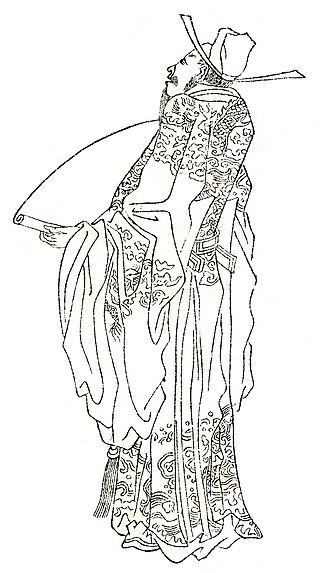
Judge Dee, or Judge Di, is a semi-fictional character based on the historical figure Di Renjie, county magistrate and statesman of the Tang court. The character appeared in the 18th-century Chinese detective and gong'an crime novel Di Gong An. After Robert van Gulik came across it in an antiquarian book store in Tokyo, he translated the novel into English and then used the style and characters to write his own original Judge Dee historical mystery stories.

Xiao is a Chinese-language surname. In the Wade-Giles system of romanization, it is rendered as Hsiao, which is commonly used in Taiwan. It is also romanized as Siauw, Shiao, Siaw, Siew, Siow, Seow, Siu, Shiu or Sui, as well as "Shaw" in less common situations, inspired by the transliteration of the surname of notable figures such as Irish playwright George Bernard Shaw and English actor Robert Shaw. It is the 99th name on the Hundred Family Surnames poem.

Di Renjie, courtesy name Huaiying (懷英), posthumous name Duke Wenhui of Liang (梁文惠公), was a Chinese politician of the Tang and Wu Zhou dynasties, twice serving as chancellor during the reign of Wu Zetian. He was one of the most celebrated officials of Wu Zetian's reign. Di Renjie is depicted in the Wu Shuang Pu by Jin Guliang.

"Protect Ya Neck" is the debut single by American hip hop group Wu-Tang Clan, originally released on December 14, 1992, through Wu-Tang Records and later re-released May 3, 1993 through Loud Records. The song appears on the group's debut studio album Enter the Wu-Tang . It was produced by RZA and features eight of the original nine Wu-Tang members.
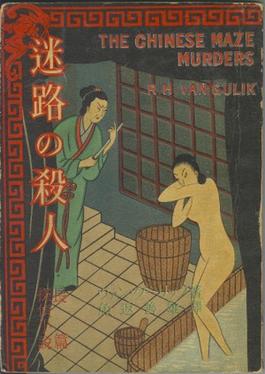
The Chinese Maze Murders is a gong'an historical mystery novel written by Robert van Gulik and set in Imperial China. It is a fiction based on the real character of Judge Dee, a magistrate and statesman of the Tang court, who lived roughly 630–700. However, van Gulik's novel is set not in the Tang, but in the Ming dynasty (1368–1644), with society and customs depicted in the book reflecting this period.

The Willow Pattern is a gong'an detective novel written by Robert van Gulik and set in Imperial China. It is a fiction based on the real character of Judge Dee, a magistrate and statesman of the Tang court, who lived roughly 630–700.

Poets and Murder is a gong'an detective novel written by Robert van Gulik and set in Imperial China. It is a fiction based on the real character of Judge Dee, a magistrate and statesman of the Tang court, who lived roughly 630–700.
Robert Tang Kwok-ching, GBM, SBS, JP is a retired Hong Kong judge. He previously served as a permanent judge of the Court of Final Appeal, and before that, the vice-president of the Court of Appeal in Hong Kong. Following his retirement, he was appointed a non-permanent judge of the Hong Kong Court of Final Appeal.

Andrew Cheung Kui-nung is a Hong Kong judge who serves as the 3rd Chief Justice of the Court of Final Appeal. He previously served as a Permanent Judge of the same court. He was the 4th and longest-serving Chief Judge of the High Court.

Robert Fitzgerald Diggs, better known by his stage name RZA or The RZA, is an American rapper, record producer, composer, actor, and filmmaker. He is the de facto leader of the hip hop group Wu-Tang Clan, having produced most albums for the group and its respective members. He is a cousin of two other original Wu-Tang Clan members: GZA and Ol' Dirty Bastard. He has also released solo albums under the alter-ego Bobby Digital, along with executive producing credits for side projects. After forming the Wu-Tang Clan, RZA was a founding member of the horrorcore group Gravediggaz, since 1992, where he went by the name The RZArector.

Tāng is a Chinese surname. It is 72nd surname in the Hundred Family Surnames or Baijiaxing of the Song dynasty and 101st in modern popularity. The Tang (湯) family name traces its lineage from Tang of Shang, the first ruler of the Shang dynasty. In modern times the character can also mean "soup" or "broth". In Cantonese the surname is pronounced Tong or Thong, and in Fujian, it is usually pronounced Theng or Teng.

Li or Lee is a common Chinese surname, it is the 4th name listed in the famous Hundred Family Surnames. Li is one of the most common surnames in Asia, shared by 92.76 million people in China, and more than 100 million in Asia. It is the second-most common surname in China as of 2018, the second-most common surname in Hong Kong, the most common surname in Macau and the 5th most common surname in Taiwan, where it is usually romanized as "Lee". The surname is pronounced as in Cantonese, Lí (poj) in Taiwanese Hokkien, but is often spelled as "Lee" in Hong Kong, Macau, Taiwan, Thailand and many overseas Chinese communities. In Macau, it is also spelled as "Lei". In Indonesia it is commonly spelled as "Lie". The common Korean surname, "Lee", and the Vietnamese surname, "Lý", are both derived from Lee and written with the same Chinese character (李). The character also means "plum" or "plum tree".

Wu-Tang Forever is the second studio album by the American hip hop group Wu-Tang Clan, released June 3, 1997, by Loud and RCA Records in the United States. Pressed as a double album, it was released after a long run of successful solo projects from various members of the group, and serves as the follow-up to their debut album Enter the Wu-Tang . Forever features several guest appearances from Wu-Tang affiliates Cappadonna, Streetlife, 4th Disciple, True Master, and Tekitha. The original run of compact discs featured an enhanced CD which allowed users to walk around the "Wu Mansion" and access additional content.

Shǐ (史) is a Chinese surname meaning "history" of "official historiographer". It is romanized Shih in Wade–Giles, or Sze or Si in Cantonese romanization. According to a 2008 study, it was the 82nd most common name in China. A 2013 study found that it is shared by 2.85 million people, or 0.210% of the population, with the province with the most people being Henan. It is the 63rd name on the Hundred Family Surnames poem.
