 | Look up rosin or rosin paper in Wiktionary, the free dictionary. |
Rosin is a solid form of resin obtained from pines and some other plants.
Rosin may also refer to:
- Rosin (surname)
- Rosin, Poland, a village
- Rosin (chemical), a glycoside ester
| Look up rosin or rosin paper in Wiktionary, the free dictionary. |
Rosin is a solid form of resin obtained from pines and some other plants.
Rosin may also refer to:


In polymer chemistry and materials science, resin is a solid or highly viscous substance of plant or synthetic origin that is typically convertible into polymers. Resins are usually mixtures of organic compounds. This article focuses on naturally occurring resins.

Rosin, also called colophony or Greek pitch, is a solid form of resin obtained from pines and some other plants, mostly conifers, produced by heating fresh liquid resin to vaporize the volatile liquid terpene components. It is semi-transparent and varies in color from yellow to black. At room temperature rosin is brittle, but it melts at stove-top temperature. It chiefly consists of various resin acids, especially abietic acid. The term "colophony" comes from colophonia resina, Latin for 'resin from Colophon', an ancient Ionic city.
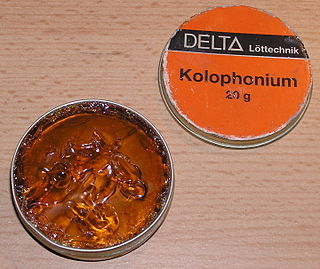
In metallurgy, a flux is a chemical cleaning agent, flowing agent, or purifying agent. Fluxes may have more than one function at a time. They are used in both extractive metallurgy and metal joining.
An ester is a functional group in organic chemistry; specifically a chemical compound derived from an acid in which at least one hydroxyl group is replaced by alkoxy group.
Tall oil, also called liquid rosin or tallol, is a viscous yellow-black odorous liquid obtained as a by-product of the kraft process of wood pulp manufacture when pulping mainly coniferous trees. The name originated as an anglicization of the Swedish tallolja. Tall oil is the third largest chemical by-product in a kraft mill after lignin and hemicellulose; the yield of crude tall oil from the process is in the range of 30–50 kg / ton pulp. It may contribute to 1.0–1.5% of the mill's revenue if not used internally.
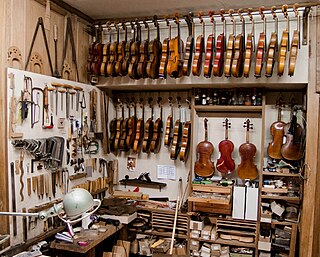
Making an instrument of the violin family, also called lutherie, may be done in different ways, many of which have changed very little in nearly 500 years since the first violins were made. Some violins, called "bench-made" instruments, are made by a single individual, either a master maker, or an advanced amateur working alone. Several people may participate in the making of a "shop-made" instrument, working under the supervision of a master. This was the preferred method of old violin makers who always put their names on violins crafted by their apprentices. Various levels of "trade violin" exist, often mass-produced by workers who each focus on a small part of the overall job, with or without the aid of machinery.

The Auschwitz Protocols, also known as the Auschwitz Reports, and originally published as The Extermination Camps of Auschwitz and Birkenau, is a collection of three eyewitness accounts from 1943–1944 about the mass murder that was taking place inside the Auschwitz concentration camp in German-occupied Poland during the Second World War. The eyewitness accounts are individually known as the Vrba–Wetzler report, Polish Major's report, and Rosin-Mordowicz report.
Hanna Rosin is an Israeli-born American writer. She is the editorial director for audio for New York Magazine Formerly, she was the co-host of the NPR podcast Invisibilia with Alix Spiegel. She was co-founder of DoubleX, the now closed women's site connected to the online magazine Slate, and the DoubleX podcast.
Glycerol ester of wood rosin, also known as glyceryl abietate or ester gum, is an oil-soluble food additive. The food-grade material is used in foods, beverages, and cosmetics to keep oils in suspension in water, and its name may be shortened in the ingredient list as glycerol ester of rosin. It is also used as an ingredient in the production of chewing-gum and ice cream. Similar, less pure materials are used as a component of certain low-cost adhesives.
Colophon may refer to:
Charles Scott Rosin is an American screenwriter and producer who has written for television since the late 1970s.

Hash oil, also known as honey oil or cannabis oil, is an oleoresin obtained by the extraction of cannabis or hashish. It is a cannabis concentrate containing many of its resins and terpenes – in particular, tetrahydrocannabinol (THC), cannabidiol (CBD), and other cannabinoids. There are various extraction methods, most involving a solvent, such as butane or ethanol. Hash oil is usually consumed by smoking, vaporizing or eating. Hash oil may be sold in cartridges used with pen vaporizers. Preparations of hash oil may be solid or colloidal depending on both production method and temperature and are usually identified by their appearance or characteristics. Color most commonly ranges from transparent golden or light brown, to tan or black. Cannabis retailers in California have reported about 40% of their sales are from cannabis oils. Hash oil is an extracted cannabis product that may use any part of the plant, with minimal or no residual solvent. It is generally thought to be indistinct from traditional hashish, according to the 1961 UN Single Convention on Narcotic Drugs, as it is "the separated resin, whether crude or purified, obtained from the cannabis plant".
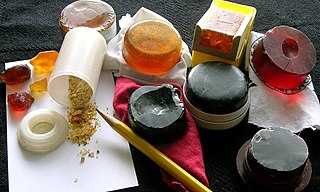
Abietic acid dermatitis is a contact dermatitis often seen in association with musical instruments.
Rosine may refer to:
Rosin-Rammler distribution may refer to:
"Old Rosin the Beau" is an American folk song popular in the 19th century, probably of British or Irish origin, first published in Philadelphia during 1838.
Rosin is a German surname. Rosin is also a jewish surname. Notable people with the surname include:
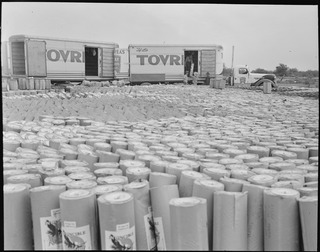
Red rosin paper is a 100% recycled heavy duty felt paper used in construction such as underlayment under flooring and siding. The name "rosin-sized sheathing paper", commonly used to describe the material, comes from the rosin used in the paper, the process of sizing it to add the rosin, and its use by builders. "Alum-rosin size was invented by Moritz Friedrich Illig in Germany in 1807..." and is known to have been used as a building paper by 1850.
Czesław Mordowicz was a Polish Jew who, with Arnošt Rosin, escaped from the Auschwitz concentration camp in German-occupied Poland on 27 May 1944, at the height of the Holocaust. A seven-page report dictated by Mordowicz and Rosin joined the Vrba-Wetzler report and a report by Jerzy Tabeau to become the Auschwitz Protocols, a detailed account of the mass murder taking place inside the camp.
Miranda Rosin is a Canadian politician who was the youngest MLA elected in the 2019 Alberta general election to represent the electoral district of Banff-Kananaskis in the 30th Alberta Legislature. Banff-Kananaskis was a new electoral district for this election. Miss Rosin is a member of the United Conservative Party. Miss Rosin sits on the standing committees for Public Accounts, Resource Stewardship, and Alberta's Economic Future. Miss Rosin was a former member of the Fair Deal Panel and is Deputy Chair of the Public Health Act Review Committee. Miss Rosin earned a BBA in Marketing and International Business from the University of Regina.