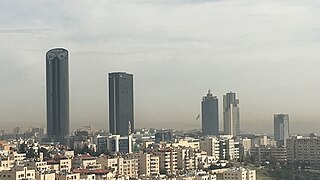
Amman is the capital and the largest city of Jordan, and the country's economic, political, and cultural center. With a population of 4,061,150 as of 2021, Amman is Jordan's primate city and is the largest city in the Levant region, the fifth-largest city in the Arab world, and the tenth-largest metropolitan area in the Middle East.
Jordan is divided into twelve historical regions, further subdivided into districts (liwa), and often into sub-districts (qada).
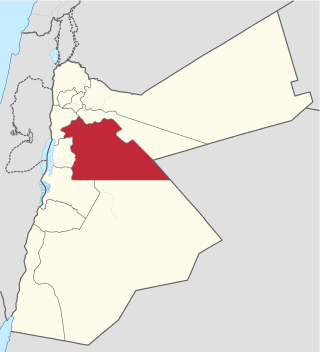
Amman Governorate, officially known as Muhafazat al-Asima, is one of the governorates in Jordan. The governorate's capital is the city of Amman, which is also the country's capital. The administrative center of the governorate as well as all government offices and parliament are located in the Abdali district.
Minjur is a town located in the outskirts of North Chennai, India. It is located in the Thiruvallur district in the Indian state of Tamil Nadu. Minjur is called 'Vada Kanchi' meaning North Kanchipuram. The town has two famous temples for Shiva and Vishnu, similar to Kanchipuram. The neighbourhood is served by Minjur railway station of the Chennai Suburban Railway Network.

Rujm el-Hiri is an ancient megalithic monument consisting of concentric circles of stone with a tumulus at center. It is located in the Israeli portion of the Golan Heights, some 16 kilometres (9.9 mi) east of the coast of the Sea of Galilee, in the middle of a large plateau covered with hundreds of dolmens.

The Samu incident or Battle of Samu was a large cross-border assault on 13 November 1966 by Israeli military on the Jordanian-controlled West Bank village of Samu in response to an al-Fatah land mine attack two days earlier near the West Bank border, which killed three Israeli soldiers on a border patrol. It purportedly originated from Jordanian territory. It was the largest Israeli military operation since the 1956 Suez Crisis and is considered to have been a contributing factor to the outbreak of the Six-Day War in 1967. Since 1965 Jordan had an active campaign to curb Fatah sabotage activities. The handling of the incident was widely criticised in Israeli political and military circles, and the United Nations responded with United Nations Security Council Resolution 228, censuring Israel for "violating the United Nations Charter and the General Armistice Agreement."
Periapalayam is a village about 40 km north of Chennai, in Tiruvallur district, Tamil Nadu State, India. The nearest Railway station is Thiruninravur.It is in Ellapuram block which stretches from east Thanakulam village, west Uthukottai, north Kosavanpettai and in the south up to Komakambedu village. It has one of the main routes to Andhra Pradesh.
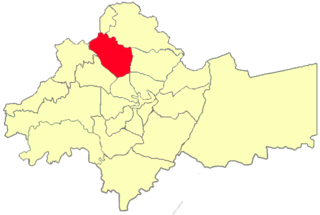
Al-Jubeiha (الجبيهة) is a city district and one of twenty-two areas in the Greater Amman Municipality of Jordan. Al-Jubeiha has seven neighborhoods: Al-Jama'a, Al-Rasheed, Qurneh, Al-Sadiq, Al-Zaitounah, Al-Mahabah, and Al-Baladiyat.
The Umayyad desert castles, of which the desert castles of Jordan represent a prominent part, are fortified palaces or castles in what was the then Umayyad province of Bilad al-Sham. Most Umayyad "desert castles" are scattered over the semi-arid regions of north-eastern Jordan, with several more in Syria, Israel and the West Bank (Palestine).
Rujm al-Shami is a town in the Amman Governorate in northwestern Jordan.

Rujm Al-Malfouf is one of a series of watchtowers from the Ammonite kingdom in modern day Amman, Jordan. Its name can be directly translated as the Hill of the Twisted [Stone], which derives from the tower's circular shape. Built in the first half of the first millennium BC, the watchtower is located on Jabal Amman. Rujm Al-Malfouf is next to the Jordanian Ministry of Antiquities.
Rujm is an Arabic word that appears as an element in numerous place names. It can be translated as 'mound, cairn, hill, spur', and also as 'stone heap' or 'tumulus'. The following is a list of place names that include Rujm as an element:
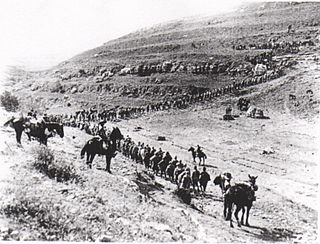
The First Transjordan attack on Amman and to their enemy as the First Battle of the Jordan took place between 21 March and 2 April 1918, as a consequence of the successful Battle of Tell 'Asur which occurred after the Capture of Jericho in February and the Occupation of the Jordan Valley began, during the Sinai and Palestine Campaign of World War I. During the First Transjordan attack large incursions into Ottoman territory occurred. Firstly the Passage of the Jordan River, was successfully captured between 21 and 23 March, followed by the first occupation of Es Salt in the hills of Moab between 24 and 25 March. The First Battle of Amman took place between 27 and 31 March when the Anzac Mounted Division and the Imperial Camel Corps Brigade were reinforced by two battalions of 181st Brigade followed by a second two battalions from the 180th Brigade and artillery. The Fourth Army headquarters located in Amman was strongly garrisoned and during the battle received reinforcements on the Hejaz railway, the strength of which eventually forced the attacking force to retire back to the Jordan Valley between 31 March and 2 April. The Jordan Valley would continue to be occupied by the Egyptian Expeditionary Force (EEF) through the summer until the middle of September 1918 when the Battle of Megiddo began.
The Capture of Jericho occurred between 19 and 21 February 1918 to the east of Jerusalem beginning the Occupation of the Jordan Valley during the Sinai and Palestine Campaign of the First World War. Fighting took place in an area bordered by the Bethlehem–Nablus road in the west, the Jordan River in the east, and north of a line from Jerusalem to the Dead Sea. Here a British Empire force attacked Ottoman positions, forcing them back to Jericho and eventually across the Jordan River.
The Third Transjordan attack by Chaytor's Force, part of the British Empire's Egyptian Expeditionary Force (EEF), took place between 21 and 25 September 1918, against the Ottoman Empire's Fourth Army and other Yildirim Army Group units. These operations took place during the Battle of Nablus, part of the Battle of Megiddo which began on 19 September in the final months of the Sinai and Palestine Campaign of World War I. Fought on the right flank and subsidiary to the Battle of Nablus, the Third Transjordan attack began northwards, with the assault on Kh Fasail. The following day a section of Chaytor's Force, attacked and captured the Ottoman Empire's 53rd Division on the main eastwards line of retreat out of the Judean Hills across the Jordan River. Retreating columns of the Yildirim Army Group were attacked during the battle for the Jisr ed Damieh bridge, and several fords to the south were also captured, closing this line of retreat. Leaving detachments to hold the captured bridge and fords, Chaytor's Force began their eastwards advance by attacking and capturing the Fourth Army garrison at Shunet Nimrin on their way to capture Es Salt for a third time. With the Fourth Army's VIII Corps in retreat, Chaytor's Force continued their advance to attack and capture Amman on 25 September during the Second Battle of Amman. Several days later, to the south of Amman, the Fourth Army's II Corps which had garrisoned the southern Hejaz Railway, surrendered to Chaytor's Force at Ziza, effectively ending military operations in the area.
The following is a timeline of the history of the city of Amman, Kingdom of Jordan.
Jamla is a village in southwestern Syria, administratively part of the Daraa Governorate and immediately east of the Israeli-occupied Golan Heights. It is situated on the eastern slopes of the Wadi Ruqqad valley. Nearby localities include Abdin to the south, the nahiyah ("subdistrict") center of al-Shajara to the southwest, Nafia to the east, Ayn Zakar to the northeast and Saida to the north. According to the Syria Central Bureau of Statistics (CBS), Jamla had a population of 1,916 in the 2004 census. Its inhabitants are predominantly Sunni Muslims.

The 2018 AFC Women's Asian Cup was the 19th edition of the AFC Women's Asian Cup, the quadrennial international football tournament in Asia competed by the women's national teams in the Asian Football Confederation (AFC). It was originally scheduled to be held in Jordan between 7 and 22 April 2018, but later was changed to 6 to 20 April 2018.

Agaram is a neighbourhood of Perambur and a developed residential area in North Chennai, a metropolitan city in Tamil Nadu, India.

The glossary of Arabic toponyms gives translations of Arabic terms commonly found as components in Arabic toponyms. A significant number of them were put together during the PEF Survey of Palestine carried out in the second half of the 19th century.


 Jordan
