
Takasago was a protected cruiser of the Imperial Japanese Navy, designed and built by the Armstrong Whitworth shipyards in Elswick, in the United Kingdom. The name Takasago derives from a location in Hyōgo Prefecture, near Kobe.

Rurik was the last armored cruiser to be built for the Imperial Russian Navy. The ship was designed by the British firm Vickers and built in their shipyard, being laid down in 1905 and completed in 1908. She was armed with a main battery of four 254 mm (10 in) guns and a secondary battery of eight 203 mm (8 in) guns; her top speed was rated at 21 knots. Despite her powerful gun armament, Rurik was rendered obsolescent even before she was completed by the advent of the British battlecruisers of the Invincible class, which were more powerfully armed and faster. Her design is nevertheless well regarded and naval historians rate her as one of the best vessels of her type ever built.

The Bayan class was a group of four armored cruisers built for the Imperial Russian Navy around the beginning of the 20th century. Two of the ships were built in France, as Russian shipyards had no spare capacity. The lead ship, Bayan, was built several years earlier than the later three. The ship participated in several of the early naval battles of the Russo-Japanese War of 1904–05, and provided naval gunfire support for the Imperial Russian Army until she struck a mine. Bayan was trapped in harbor during the subsequent Siege of Port Arthur, and was sunk by Japanese artillery. She was salvaged and put into service with the Imperial Japanese Navy with the name of Aso. She mostly served as a training ship before she was converted into a minelayer in 1920. The ship was sunk as a target in 1932.

Novík was a protected cruiser in the Imperial Russian Navy, built by Schichau shipyards in Elbing near Danzig, Germany.
At least five warships of Russia have borne the name Admiral Nakhimov, in honour of Pavel Nakhimov an admiral of the Imperial Russian Navy.

The cruiser Bayan was the name ship of the four Bayan-class armoured cruisers built for the Imperial Russian Navy in the first decade of the 20th century. The ship had to be built in France because there was no available capacity in Russia. Bayan was assigned to the First Pacific Squadron after completion and based at Port Arthur from the end of 1903. She suffered minor damage during the Battle of Port Arthur at the beginning of the Russo-Japanese War of 1904–05 and supported destroyers as they patrolled outside the harbour. After bombarding Japanese positions in July 1904, the ship struck a mine and was out of action for the next several months. Bayan was sunk during the Siege of Port Arthur and was then salvaged by the Japanese after the war.
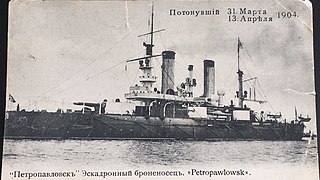
Petropavlovsk was the lead ship of her class of three pre-dreadnought battleships built for the Imperial Russian Navy during the last decade of the 19th century. The ship was sent to the Far East almost immediately after entering service in 1899, where she participated in the suppression of the Boxer Rebellion the next year and was the flagship of the First Pacific Squadron.
At least three warships of Russia have borne the name Pallada:

The QF 3-pounder Hotchkiss or in French use Canon Hotchkiss à tir rapide de 47 mm were a family of long-lived light 47 mm naval guns introduced in 1886 to defend against new, small and fast vessels such as torpedo boats and later submarines. There were many variants produced, often under license which ranged in length from 32 to 50 calibers but 40 caliber was the most common version. They were widely used by the navies of a number of nations and often used by both sides in a conflict. They were also used ashore as coastal defense guns and later as an anti-aircraft gun, whether on improvised or specialized HA/LA mounts.
Suzuya may refer to one of two cruisers of the Imperial Japanese Navy, named for the Susuya River in Karafuto:
Pallada is the name of several ships of the Russian navy.

Bayan was the third of the four Bayan-class armoured cruisers built for the Imperial Russian Navy in the early 1900s. The ship was assigned to the Baltic Fleet. She was modified to lay mines shortly after World War I began. Bayan laid mines herself and provided cover for other ships laying minefields. The ship fought several inconclusive battles with German ships during the war, including the Battle of Åland Islands in mid-1915. She also participated in the Battle of Moon Sound during the German invasion of the Estonian islands in late 1917, where she was damaged. Bayan was decommissioned in 1918 and sold for scrap in 1922.
At least six ships of the Imperial Russian Navy, Soviet Navy or Russian Navy have been named Sevastopol after the Siege of Sevastopol (1854–1855) or the city of the same name.
6 ships of the Imperial Russian and Soviet Navies have been named Petropavlovsk after the 1854 Siege of Petropavlovsk.
At least five ships in the Imperial Russian, Soviet or Russian Navies have been named Varyag after the Varangian people, the Viking ancestors of the Rus.

The 203 mm 45 caliber Pattern 1892 was a Russian naval gun developed in the years before the Russo-Japanese War that armed a variety of warships of the Imperial Russian Navy during the Russo-Japanese War and World War I. Guns salvaged from scrapped ships found a second life as coastal artillery. It is believed none were in service during World War II.

The 75 mm 50 caliber Pattern 1892 was a Russian naval gun developed in the years before the Russo-Japanese War that armed the majority of warships of the Imperial Russian Navy during the Russo-Japanese War and World War I. The majority of ships built or refit between 1890-1922 carried Pattern 1892 guns. During its career the role of the guns evolved from one of anti-torpedo boat defense to coastal artillery and anti-aircraft use.
The 15 cm/45 41st Year Type was a British naval gun designed by the Elswick Ordnance Company for export in the years before World War I that armed warships of the Imperial Japanese Navy. These guns served aboard Japanese ships during World War I and as coastal artillery during World War II.
At least two warships of Japan have borne the name Aso:
This page is based on this
Wikipedia article Text is available under the
CC BY-SA 4.0 license; additional terms may apply.
Images, videos and audio are available under their respective licenses.

