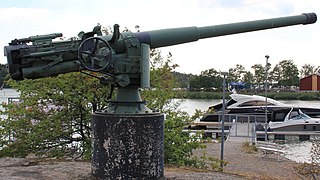
Russian gunboat Sivuch

Last updated

Russian gunboat Sivuch may refer to:

Related Research Articles

<i>Bora</i>-class hovercraft

The Bora-class hoverborne guided missile corvette of the Russian Navy, also bears the NATO class name Dergach, is one of the few types of military surface effect ship built solely for marine combat purposes, rather than troop landing or transport. Its designation in the Soviet and Russian navies is Project 1239; the first vessel produced under this designation was Sivuch, which was later renamed Bora. It is one of the largest combat sea vehicles with catamaran design.

Four ships of the Royal Navy and one shore establishment have borne the name HMS Goldfinch, probably after the bird the European goldfinch:

Twelve ships of the Royal Navy have borne the name HMS Mosquito, or the archaic HMS Musquito, after the tropical insect, the Mosquito:

HMVS Victoria is the name of two ships serving in the Victorian Naval Forces, the colonial navy of the colony of Victoria, Australia, which is also the ships' namesake:

Two ships of the Royal Navy have borne the name HMS Moth after the insect, the Moth:

Oskar Enqvist

Oskar Wilhelm Enqvist was a Finland-Swedish admiral in the Imperial Russian Navy, noted for his role in the Russo-Japanese War of 1904-1905.

Two ships of the Royal Norwegian Navy have borne the name HNoMS Gor, after Gór – the mythological co-founder of Norway:

Six ships of the Royal Navy have borne the name HMS Banterer:

Japanese gunboat Sumida may refer to:

Two gunboats of the Imperial Japanese Navy were named Uji:

HMS Widgeon may refer to one of several Royal Navy ships named after the Widgeon:

Four ships of the Royal Navy have borne the name HMS Rambler:

Gremyashchy can refer to a number of Russian or Soviet warships:

In addition to several other ships, two ships of the Imperial German Navy and one ship of the Austro-Hungarian Navy have been named SMS Nautilus, after the Greek word for a sailor.

102 mm 60 caliber Pattern 1911 Naval gunRailway gunCoastal artillery

The 102 mm 60 caliber Pattern 1911 was a Russian naval gun developed in the years before World War I that armed a variety of warships of the Imperial Russian Navy during World War I. Pattern 1911 guns found a second life on river gunboats and armored trains during the Russian Civil War and as coastal artillery during World War II. In 1941 it was estimated that 146 guns were in service. Of these, 49 were in the Baltic Fleet, 30 in the Black Sea Fleet, 30 in the Pacific Fleet, 18 in the Northern Fleet, 9 in the Caspian Flotilla and 6 in the Pinsk Flotilla.

Russian gunboat <i>Sivuch</i> (1884)

Sivuch was a Sivuch-class gunboat of the Imperial Russian Navy. She entered service in 1884 and was powered by sail and steam. She took an active role in mapping the northern Pacific Ocean and nearby seas as well as periodically being stationed in Chinese and Korean ports and protecting seal rookeries, principally from American poachers. She also took part in the suppression of the Boxer Rebellion (1899–1901).

Russian gunboat <i>Sivuch</i> (1907)

Sivuch was a Gilyak-class gunboat of the Imperial Russian Navy. During World War I, she was sunk in the Gulf of Riga during the Battle of the Gulf of Riga on 19 August 1915 by the German battleships Nassau and Posen.

Three ships of the Imperial German Navy and one of the Austro-Hungarian Navy have been named SMS Möwe: