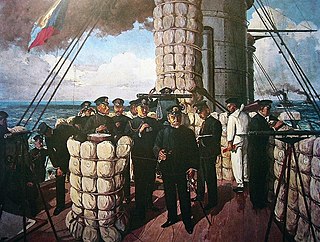
The Battle of Tsushima, also known as the Battle of Tsushima Strait and the Naval Battle of the Sea of Japan in Japan, was a major naval battle fought between Russia and Japan during the Russo-Japanese War. It was naval history's first, and last, decisive sea battle fought by modern steel battleship fleets, and the first naval battle in which wireless telegraphy (radio) played a critically important role. It has been characterized as the "dying echo of the old era – for the last time in the history of naval warfare, ships of the line of a beaten fleet surrendered on the high seas".

The Borodino-class battleships were a group of five pre-dreadnought battleships built for the Imperial Russian Navy around the end of the 19th century. Their design was based on that of the French-built Tsesarevich modified to use Russian equipment. The first four ships were finished after the start of the Russo-Japanese War of 1904–1905 and were among the ships ordered to sail from the Baltic Sea to the Far East to relieve the Pacific Squadron besieged by the Japanese in Port Arthur. Three of these ships were sunk and one was captured by the Imperial Japanese Navy at the Battle of Tsushima in 1905. The fifth and final ship, Slava, was not completed in time to participate in the war and served with the Baltic Fleet through World War I.

Nikolai Ivanovich Nebogatov was a rear admiral in the Imperial Russian Navy, noted for his role in the final stages of the Russo-Japanese War of 1904–1905.

The Andrei Pervozvanny class were a pair of pre-dreadnought battleships built in the first decade of the twentieth century for the Baltic Fleet of the Imperial Russian Navy. They were conceived by the Naval Technical Committee in 1903 as an incremental development of the Borodino-class battleships with increased displacement and heavier secondary armament. The disastrous experiences of the Russo-Japanese War of 1904–1905 and the unrest resulting from the 1905 Russian Revolution led to countless redesigns, change orders and delays in construction. Despite the designers' repeated attempts to modernize the ships while under construction, they were obsolete in concept from the beginning, and even more so when they entered service in 1911.

The Imperator Aleksandr II-class battleships were two battleships built for the Imperial Russian Navy in the 1880s. They were intended to counter the small armored ships of the other Baltic powers. Construction was very prolonged and the ships were virtually obsolescent when completed. They were optimized for ramming.

Imperator Nikolai I was a Russian Imperator Aleksandr II-class battleship built for the Baltic Fleet in the late 1880s. She participated in the celebration of the 400th anniversary of the discovery of America in New York City in 1892. She was assigned to the Mediterranean Squadron and visited Toulon in October 1893. She sailed for the Pacific Ocean during the First Sino-Japanese War and remained in the Pacific until late 1896, when she returned to the Mediterranean Squadron and supported Russian interests during the Cretan Revolt. She returned to the Baltic in April 1898 and had a lengthy refit, which replaced all of her machinery, before returning to the Mediterranean in 1901.
The fleets at the Battle of Tsushima, 27–28 May 1905.

Borodino was the lead ship of her class of five pre-dreadnought battleships built for the Imperial Russian Navy in the first decade of the twentieth century. Completed after the beginning of the Russo-Japanese War in 1904, Borodino was assigned to the Second Pacific Squadron that was sent to the Far East a few months after her completion to break the Japanese blockade of Port Arthur. The Japanese captured the port while the squadron was in transit and their destination was changed to Vladivostok. The ship was sunk during the Battle of Tsushima in May 1905 due to explosions set off by a Japanese shell hitting a magazine. There was only a single survivor from her crew of 855 officers and enlisted men.

Imperator Aleksandr III was one of five Borodino-class battleships built for the Russian Imperial Navy in the first decade of the 20th century. The ship was completed a few months before the start of the Russo-Japanese War in February 1904 and was assigned to the Second Pacific Squadron that was sent to the Far East six months later to break the Japanese blockade of Port Arthur. The Japanese captured the port while the squadron was in transit and their destination was changed to Vladivostok. During the Battle of Tsushima in May 1905, Imperator Alexander III was sunk by Japanese gunfire with the loss of 778 men, her entire crew.
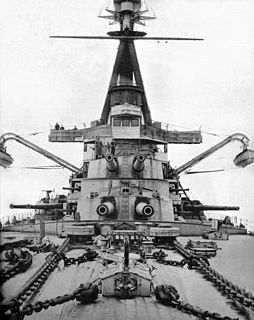
Superfiring armament is a naval military building technique in which two turrets are located in a line, one behind the other, with the second turret located above ("super") the one in front so that the second turret can fire over the first. This configuration meant that both forward or aft turrets could fire at any target within their sector, even when the target was in the same vertical plane as the turrets.

Imperator Pavel I was one of two Andrei Pervozvanny-class predreadnought battleships built for the Imperial Russian Navy in the first decade of the 20th century. The ship's construction was greatly delayed by design changes as a result of the Russo-Japanese War and labor unrest after the 1905 Revolution, and she took nearly six years to build. Imperator Pavel I was not very active during World War I and her bored sailors were the first to mutiny in early 1917. The ship was laid up in 1918 and she was scrapped in 1923.

Sevastopol was the last of three ships in the Petropavlovsk class of pre-dreadnought battleships built for the Imperial Russian Navy in the 1890s.
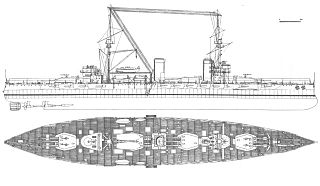
Imperator Nikolai I was a Russian dreadnought built during World War I for service in the Black Sea. She was designed to counter multiple prospective Ottoman dreadnoughts which had been placed under order by the Ottoman government, since this raised the possibility that the Russian dreadnoughts being built for the Black Sea Fleet could be outclassed. The ship used the same main armament as the preceding Imperatritsa Mariya class, but was larger and more heavily armored. Imperator Nikolai I was launched in 1916, but construction was suspended on 24 October 1917. The Soviets considered completing her in 1923, but later rejected the idea. She was towed to Sevastopol in 1927 and scrapped.
At least seven ships of the Imperial Russian and Soviet Navies have been named Poltava after the Russian victory in the Battle of Poltava:
At least seven ships of the Imperial Russian Navy have been named Chesma after the victory during the Battle of Chesma in 1770:
Imperator Nikolai I was a wooden-hulled, steam-powered, first-rate ship of the line built for the Imperial Russian Navy in the late 1850s. She served as a gunnery training ship and troopship with the Baltic Fleet for a number of years after her completion. The ship was stricken from the Navy List in 1874.
At least three ships of the Imperial Russian Navy have been named Tsesarevich after the Tsesarevich, the title of the male heir apparent.
Two ships of the Japanese Navy have been named Iki:
This page is based on this
Wikipedia article Text is available under the
CC BY-SA 4.0 license; additional terms may apply.
Images, videos and audio are available under their respective licenses.

