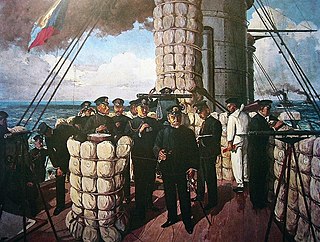
The Battle of Tsushima, also known as the Battle of Tsushima Strait and the Naval Battle of the Sea of Japan in Japan, was a major naval battle fought between Russia and Japan during the Russo-Japanese War. It was naval history's first, and last, decisive sea battle fought by modern steel battleship fleets, and the first naval battle in which wireless telegraphy (radio) played a critically important role. It has been characterized as the "dying echo of the old era – for the last time in the history of naval warfare, ships of the line of a beaten fleet surrendered on the high seas".
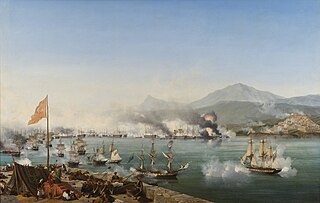
The Battle of Navarino was a naval battle fought on 20 October 1827, during the Greek War of Independence (1821–32), in Navarino Bay, on the west coast of the Peloponnese peninsula, in the Ionian Sea. Allied forces from Britain, France, and Russia decisively defeated Ottoman and Egyptian forces which were trying to suppress the Greeks, thereby making Greek independence much more likely. An Ottoman armada which, in addition to Imperial warships, included squadrons from the eyalets (provinces) of Egypt and Tunis, was destroyed by an Allied force of British, French and Russian warships. It was the last major naval battle in history to be fought entirely with sailing ships, although most ships fought at anchor. The Allies' victory was achieved through superior firepower and gunnery.

Baron Kantarō Suzuki was an admiral in the Imperial Japanese Navy, member and final leader of the Imperial Rule Assistance Association and Prime Minister of Japan from 7 April to 17 August 1945.

A warship or combatant ship is a naval ship that is built and primarily intended for naval warfare. Usually they belong to the armed forces of a state. As well as being armed, warships are designed to withstand damage and are usually faster and more maneuverable than merchant ships. Unlike a merchant ship, which carries cargo, a warship typically carries only weapons, ammunition and supplies for its crew. Warships usually belong to a navy, though they have also been operated by individuals, cooperatives and corporations.
Two ships in service with the Imperial Japanese Navy were named Yamato:
Navarino or Navarin may refer to:
The name Musashi (武蔵) has been borne by three ships of the Japanese Navy and may refer to:

Navarin was a pre-dreadnought battleship built for the Imperial Russian Navy in the late 1880s and early 1890s. The ship was assigned to the Baltic Fleet and spent the early part of her career deployed in the Mediterranean and in the Far East. She participated in the suppression of the Boxer Rebellion in 1900 before returning to the Baltic Fleet in 1901. Several months after the beginning of the Russo-Japanese War in February 1904, she was assigned to the 2nd Pacific Squadron to relieve the Russian forces blockaded in Port Arthur. During the Battle of Tsushima in May 1905, she was sunk by Japanese destroyers which spread twenty-four linked mines across her path during the night. Navarin struck two of these mines and capsized with the loss of most of her crew.

Sissoi Veliky was a pre-dreadnought battleship built for the Imperial Russian Navy in the 1890s. The ship's construction was marred by organizational, logistical and engineering problems and dragged on for more than five years. She was commissioned in October 1896 with an appalling number of design and construction faults, and only a few of them were fixed during her lifetime. Immediately after sea trials, Sissoi Veliky sailed to the Mediterranean to enforce the naval blockade of Crete during the Greco-Turkish War. On March 15 [O.S. March 3], 1897 she suffered a devastating explosion of the aft gun turret that killed 21 men. After nine months in the docks of Toulon for repairs, the ship sailed to the Far East to reinforce the Russian presence there. In the summer of 1900, Sissoi Veliky supported the international campaign against the Boxer Rebellion in China. Sailors from Sissoi Veliky and the battleship Navarin participated in the defence of the International Legations in Beijing for more than two months.

Six ships of the French Navy have borne the name Républicain ("Revolutionary"):
Four ships of the French Navy have borne the name Iéna in honour of the Battle of Jena-Auerstedt:

The 12-inch 40-caliber naval gun was the standard main weapon of the pre-dreadnought battleships of the Imperial Russian Navy. Sixty-eight guns of the first production run were built in 1895–1906 by the Obukhov Works in Saint Petersburg. They were installed on seventeen battleships starting with Sissoi Veliky and Tri Sviatitelia and ending with the Andrei Pervozvanny class. A second production run was ordered to Russian and British gunmakers during World War I.
At least seven ships of the Imperial Russian and Soviet Navies have been named Poltava after the Russian victory in the Battle of Poltava:
The Russian corvette Navarin was an Egyptian corvette captured during the Russo-Turkish War of 1828–1829 and placed into service by the Russians. She remained in the Mediterranean until 1830 when she was transferred to the Baltic Fleet. Navarin remained there until she was ordered to the Far East in late 1853. She was so badly damaged by a series of storms en route that she was deemed too expensive to repair and was sold for scrap in the Netherlands in 1854.
At least seven ships of the Imperial Russian Navy have been named Chesma after the victory during the Battle of Chesma in 1770:
Several naval ships were named Helgoland after the island of Heligoland or the Battle of Helgoland, an action during the Second Schleswig War.
Francesco Caracciolo or Ammiraglio Caracciolo or simply Caracciolo was the name of at least two ships of the Italian Navy named in honour of Francesco Caracciolo and may refer to:
This page is based on this
Wikipedia article Text is available under the
CC BY-SA 4.0 license; additional terms may apply.
Images, videos and audio are available under their respective licenses.

