
The Kirov class, Soviet designation Project 1144 Orlan, is a class of nuclear-powered guided missile cruisers of the Soviet Navy and Russian Navy, the largest and heaviest surface combatant warships in operation in the world. Among modern warships, they are second in size only to large aircraft carriers, and of similar size to a World War I era battleship. The Soviet classification of the ship-type is "heavy nuclear-powered guided missile cruiser". The ships are often referred to as battlecruisers by Western defence commentators due to their size and general appearance.

The Russian Navy is the naval arm of the Russian Armed Forces. It has existed in various forms since 1696, the present iteration of which was formed in January 1992 when it succeeded the Navy of the Commonwealth of Independent States.
Vladimir or Wladimir may refer to:

The Soviet Navy was the naval warfare uniform service branch of the Soviet Armed Forces. Often referred to as the Red Fleet, the Soviet Navy made up a large part of the Soviet Union's strategic planning in the event of a conflict with the opposing superpower, the United States, during the cold war period between the two countries. The influence of the Soviet Navy played a large role in the events involving the Cold War (1945-1991), as the majority of conflicts centred around the American-led NATO alliance in western Europe or power projection to maintain its sphere of influence in eastern Europe.

The Kiev class, Soviet designation Project 1143 Krechyet (gyrfalcon), was the first class of both fixed-wing aircraft carriers and battlecruisers built in the Soviet Union for the Soviet Navy.
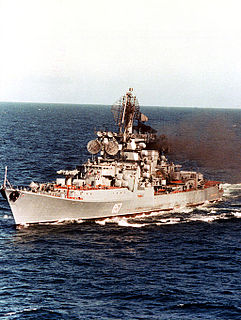
The Kresta II class, Soviet designation Project 1134A Berkut A, was a class of guided missile cruiser built by the Soviet Union for the Soviet Navy. The NATO lists the class as "cruisers" mainly due to the Metel anti-ship missile system capable to strike not only submarines but also surface vessels.

K-551 Vladimir Monomakh is a Russian ballistic missile submarine of the fourth generation Borei class that became operational in 2015. It is named after Vladimir II Monomakh (1053–1125), the Grand Duke of Kievan Rus'.
The Russian and Soviet Navy's ship naming conventions were similar to those of other nations. A problem for the non-Russian reader is the need to transliterate the Cyrillic names into the Latin alphabet. There are often several different Latin spellings of the same Russian name.
U-26 may refer to one of the following German submarines:

Vladimir Monomakh was an armoured cruiser built for the Imperial Russian Navy during the 1880s. The vessel was named after Vladimir II Monomakh, Grand Prince of Kiev. She spent most of her career in the Far East, although the ship was in the Baltic Sea when the Russo-Japanese War began in 1904. Vladimir Monomakh was assigned to the Third Pacific Squadron and participated in the Battle of Tsushima in May 1905. She was tasked to protect the Russian transports and was not heavily engaged during the daylight portion of the battle. The ship was torpedoed during the night and was scuttled the following morning by her captain to prevent her capture by the Japanese.
At least three warships of Russia have borne the name Pallada:

The JSC PO Sevmash is a Russian joint-stock enterprise under the vertically integrated United Shipbuilding Corporation. The shipbuilding operations of the JSC PO Sevmash is in the port city of Severodvinsk on the White Sea in the Russian Federation.

The QF 3-pounder Hotchkiss or in French use Canon Hotchkiss à tir rapide de 47 mm were a family of long-lived light 47 mm naval guns introduced in 1886 to defend against new, small and fast vessels such as torpedo boats and later submarines. There were many variants produced, often under license which ranged in length from 32 to 50 calibers but 40 caliber was the most common version. They were widely used by the navies of a number of nations and often used by both sides in a conflict. They were also used ashore as coastal defense guns and later as an anti-aircraft gun, whether on improvised or specialized HA/LA mounts.
U-113 may refer to one of the following German submarines:
Following the dissolution of the Soviet Union in the 1990s, the Russian Navy struggled to adjust Cold War force structures while suffering severely with insufficient maintenance and a lack of funding. However, improvements in the Russian economy over the last decade have seen a significant rise in defence expenditure and an increase in the number of ships under construction with a focus on blue-water vessels.
At least three ships of the Imperial Russian, Soviet or Russian Navy have been named Dmitri Donskoi after Dmitry Donskoy.
Pietro Micca was the name of at least three ships of the Italian Navy and may refer to:
At least three ships of the Imperial Russian Navy, Soviet Navy, or Russian Navy have been named Alexander Nevsky after the Russian saint Alexander Nevsky.

Admiral Makarov was a Project 1134A Berkut A class cruiser of the Soviet Navy and briefly of the Russian Navy. The fourth ship of her class, the ship served mostly during the Cold War, from 1972 to 1992. She served with the Northern Fleet for the duration of her career, often operating in the Atlantic and the Mediterranean in order to show the flag, and was refitted between 1983 and 1985. She was decommissioned in 1992 due to deteriorating conditions which reduced naval funding prevented from being addressed before being sold for scrap in 1994.

Admiral Oktyabrsky was a Project 1134A Berkut A -class cruiser of the Soviet Navy, which briefly became part of the Russian Navy. The sixth ship of her class, the ship served mostly during the Cold War, from 1973 to 1993.
This page is based on this
Wikipedia article Text is available under the
CC BY-SA 4.0 license; additional terms may apply.
Images, videos and audio are available under their respective licenses.

