Holland America Line is a British/American-owned cruise line, a subsidiary of Carnival Corporation & plc. Originating in the Netherlands, the company moved its headquarters to Seattle, Washington, United States.

SS United States is a retired passenger liner built in 1950–51 for the United States Lines at a cost of US$79.4 million. The ship is the largest ocean liner constructed entirely in the United States and the fastest ocean liner to cross the Atlantic in either direction, retaining the Blue Riband for the highest average speed since her maiden voyage in 1952. She was designed by American naval architect William Francis Gibbs and could be converted into a troopship if required by the Navy in time of war. The United States maintained an uninterrupted schedule of transatlantic passenger service until 1969 and was never used as a troopship.

SS Robin is a 350 gross registered ton (GRT) steam coaster, a class of steamship designed for carrying bulk and general cargoes in coastal waters, and the oldest complete example in the world. One of a pair of coasters built in Bow Creek, London] in 1890, the ship was built for British owners, but spent most of her long working life on the Spanish coast as Maria.
The Hamburg-Amerikanische Packetfahrt-Actien-Gesellschaft (HAPAG), often referred to as Hamburg America Line, was a transatlantic shipping enterprise established in Hamburg, in 1847. Among those involved in its development were prominent citizens such as Albert Ballin, Adolph Godeffroy, Ferdinand Laeisz, Carl Woermann, August Bolten, and others, and its main financial backers were Berenberg Bank and H. J. Merck & Co. It soon developed into the largest German, and at times the world's largest, shipping company, serving the market created by German immigration to the United States and later immigration from Eastern Europe. On 1 September 1970, after 123 years of independent existence, HAPAG merged with the Bremen-based North German Lloyd to form Hapag-Lloyd AG.

The T2 tanker, or T2, was a class of oil tanker constructed and produced in large quantities in the United States during World War II. Only the T3 tankers were larger "navy oilers" of the period. Some 533 T2s were built between 1940 and the end of 1945. They were used to transport fuel oil, diesel fuel, gasoline and sometimes black oil-crude oil. Post war many T2s remained in use; like other hastily built World War II ships pressed into peacetime service, there were safety concerns. As was found during the war, the United States Coast Guard Marine Board of Investigation in 1952 stated that in cold weather the ships were prone to metal fatigue cracking, so were "belted" with steel straps. This occurred after two T2s, Pendleton and Fort Mercer, split in two off Cape Cod within hours of each other. Engineering inquiries into the problem suggested the cause was poor welding techniques. It was found the steel was not well suited for the new wartime welding construction. The high sulfur content made the steel brittle and prone to metal fatigue at lower temperatures.

SS Explorer is one of the last surviving sea-going steam trawlers and is registered to Leith, the port of Edinburgh. She has been placed on the National Historic Ships Register and the SS Explorer Preservation Society is currently restoring her in the Edinburgh Dock, Leith.

MS Birger Jarl is a cruise ship owned by Ånedin Linjen that was operated on services between Stockholm, Sweden and Helsinki, Turku and most recently Mariehamn on the Åland Islands (Finland). She was built in 1953 as a passenger liner at Finnboda shipyard in Nacka, Sweden as SS Birger Jarl for Rederi AB Svea. In 1973 she was sold to Jakob Lines, was renamed SS Bore Nord and converted into a ferry. In 1978 she was bought back by the Ånedin Line and was renamed SS Baltic Star. In 1982 the ship's original steam engines were replaced by diesel engines; the ship's prefix hence altered to MS. In 1989 the engines were again replaced by new diesels. In 2002 the ship reverted to the name Birger Jarl.

USS Denebola (AF-56) was a Denebola-class stores ship acquired by the U.S. Navy. She was built as the SS Hibbing Victory as a type VC2-S-AP2 Victory ship built by Oregon Shipbuilding Corporation of Portland, Oregon, under a Maritime Commission. The Maritime Administration cargo ship was the 113h ship built. Its keel was laid on May 2, 1944. The ship was christened on June 30, 1944. She was built at the Oregon Shipbuilding yards in just 59 days, under the Emergency Shipbuilding program for World War II. The 10,600 ton ship was constructed for the Maritime Commission. She was operated by the (Pacific-Atlantic SS Company under the United States Merchant Marine act for the War Shipping Administration. USS Denebolatask was to carry stores, refrigerated items, and equipment to ships in the fleet, and to remote stations and staging areas.

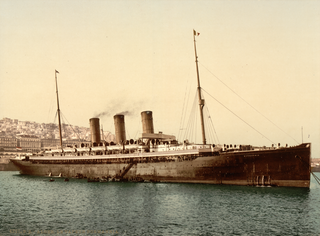
The first SS Fürst Bismarck was an ocean liner built in 1890 by AG Vulcan for the Hamburg America Line. A steamship of 8,430 gross register tons, it was assigned to transatlantic crossings between Hamburg Germany and New York City, United States. Fürst Bismarck and the sister ships were part of an express fleet that usually made the trip in five to six days.

SS Prinz Friedrich Wilhelm was an ocean liner for North German Lloyd (NDL) from her launch in 1907 until the end of World War I. After the war, she briefly served as USS Prinz Friedrich Wilhelm (ID-4063) for the United States Navy returning American troops from France. The vessel was first chartered—and later purchased outright—by Canadian Pacific Steamships (CP) and operated under the names Empress of China, Empress of India, Montlaurier, Monteith, and Montnairn. She was scrapped in 1929.
The SS Lindenwood Victory was a Victory-class cargo ship built during World War II. The Lindenwood Victory was a type VC2-S-AP2 victory ship built by Permanente Metals Corporation, Yard 2, of Richmond, California. The Maritime Administration cargo ship was the 766th ship built. Her keel was laid on May 12, 1945. SS Lindenwood Victory was an armed cargo ship She was built in just 70 days, under the Emergency Shipbuilding program for World War II. SS Lindenwood Victory was an armed cargo ship, named for Lindenwood University in St. Charles, Missouri, one of 150 educational institutions that had Victory ships named after them. The 10,600 ton ship was constructed for the Maritime Commission.

The SS Spartan is a railroad car ferry on Lake Michigan owned by the Chesapeake and Ohio Railway (C&O) from 1952 through 1979. It alternated routes from Ludington, Michigan, to Milwaukee, Kewaunee, and Manitowoc, Wisconsin.
USS Normannia (SP-756) was a United States Navy patrol vessel in commission from 1917 to 1918.

SS Princess Mary was a passenger vessel in the coastal service fleet of the Canadian Pacific Railway (CPR) during the first half of the 20th century.
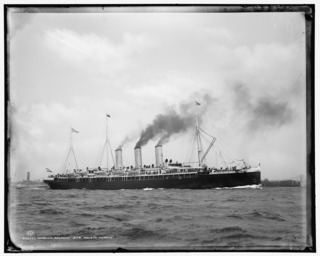
Augusta Victoria, later Auguste Victoria, placed in service in 1889 and named for Empress Augusta Victoria, wife of German Emperor Wilhelm II, was the name ship of the Augusta Victoria series and the first of a new generation of luxury Hamburg America Line ocean liners. She was the first European liner with twin propellers and when first placed in service, the fastest liner in the Atlantic trade. In 1897, the ship was rebuilt and lengthened and in 1904 she was sold to the Imperial Russian Navy, which renamed her Kuban.
TSS Hantonia was a passenger vessel built for the London and South Western Railway in 1911.
SS Patrick B. Whalen was a Liberty ship built in the United States during World War II. She was named after Patrick B. Whalen, who was lost at sea while he was the 1st assistant engineer on SS Illinois, after she was torpedoed by German submarine U-159, on 2 June 1942, in the Caribbean.

The SS Baylor Victory was a cargo Victory ship built during World War II under the Emergency Shipbuilding program. The Baylor Victory (MCV-772) was a type VC2-S-AP2 Victory ship built by California Shipbuilding Corporation in Los Angeles, California. The Maritime Administration cargo ship was the 772rd ship built. Her keel was laid on Jan. 13, 1945. She was launched on March 6, 1945 and completed on March 30, 1945. The 10,600-ton ship was constructed for the Maritime Commission. She operated her under the United States Merchant Marine act for the War Shipping Administration. She was named for Baylor University a private Christian university in Waco, Texas. At her launching Baylor University was represented by 18 graduates and friends. University President Pat M. Neff gave a short speech at the launching and christening ceremony. Los Angeles District Judge Minor L. Moore, a Baylor graduate of 1900 also spoke. Baylor Victory was launched at 1:20am and was lite up by large floodlights.