
The International Maritime Organization is a specialised agency of the United Nations responsible for regulating shipping. The IMO was established following agreement at a UN conference held in Geneva in 1948 and the IMO came into existence ten years later, meeting for the first time in 1959. Headquartered in London, United Kingdom, the IMO currently has 174 member states and three associate members.

A coast guard or coastguard is a maritime security organization of a particular country. The term embraces wide range of responsibilities in different countries, from being a heavily armed military force with customs and security duties to being a volunteer organization tasked with search and rescue without law enforcement authority. In most countries, a typical coast guard's functions are distinct from those of the navy and the transit police, while in certain countries has similarities to both.

The terms international waters or trans-boundary waters apply where any of the following types of bodies of water transcend international boundaries: oceans, large marine ecosystems, enclosed or semi-enclosed regional seas and estuaries, rivers, lakes, groundwater systems (aquifers), and wetlands.

The Convention on the Prevention of Marine Pollution by Dumping of Wastes and Other Matter 1972, commonly called the "London Convention" or "LC '72" and also abbreviated as Marine Dumping, is an agreement to control pollution of the sea by dumping and to encourage regional agreements supplementary to the Convention. It covers the deliberate disposal at sea of wastes or other matter from vessels, aircraft, and platforms. It does not cover discharges from land-based sources such as pipes and outfalls, wastes generated incidental to normal operation of vessels, or placement of materials for purposes other than mere disposal, providing such disposal is not contrary to aims of the Convention. It entered into force in 1975. As of September 2016, there were 89 Parties to the Convention.

The European Maritime Safety Agency (EMSA) is a European Union agency charged with reducing the risk of maritime accidents, marine pollution from ships and the loss of human lives at sea by helping to enforce the pertinent EU legislation. It is headquartered in Lisbon.

Copernicus is the European Union's Earth observation programme coordinated and managed by the European Commission in partnership with the European Space Agency (ESA), the EU Member States and EU agencies.
Maritime security is an umbrella term informed to classify issues in the maritime domain that are often related to national security, marine environment, economic development, and human security. This includes the world's oceans but also regional seas, territorial waters, rivers and ports. The theoretical concept of maritime security has evolved from a narrow perspective of national naval power projection towards a buzzword that incorporates many interconnected sub-fields. The definition of the term maritime security varies and while no internationally agreed definition exists, the term has often been used to describe both existing, and new regional and international challenges to the maritime domain. The buzzword character enables international actors to discuss these new challenges without the need to define every potentially contested aspect of it.
Sector Commander is the position title of the commanding officer of a United States Coast Guard Sector, usually of the rank of Captain (O-6). The Sector Commander's second-in-command is the Deputy Sector Commander. Also reporting directly to the Sector Commander are the Command Master Chief (CMC), the Senior Reserve Officer, and the Sector's Auxiliary Coordinator.

The Convention for the Protection of the Marine Environment and the Coastal Region of the Mediterranean, originally the Convention for Protection of the Mediterranean Sea against Pollution, and often simply referred to as the Barcelona Convention, is a regional convention adopted in 1976 to prevent and abate pollution from ships, aircraft and land based sources in the Mediterranean Sea. This includes but is not limited to dumping, run-off and discharges. Signers agreed to cooperate and assist in dealing with pollution emergencies, monitoring and scientific research. The convention was adopted on 16 February 1976 and amended on 10 June 1995.
CleanSeaNet (CSN) is a satellite-based monitoring system for marine oil spill detection and surveillance in European waters.

MyOcean is a series of projects granted by the European Commission within the GMES Program, whose objective is to define and to set up a concerted and integrated pan-European capacity for ocean monitoring and forecasting. The activities benefit several specified areas of use: Maritime security, oil spill prevention, marine resources management, climate change, seasonal forecasting, coastal activities, ice sheet surveys, water quality and pollution. The series of MyOcean projects ended in 2015, and their services are now continued by the Copernicus Programme.

Partnerships in Environmental Management for the Seas of East Asia or PEMSEA is a regional partnership programme implemented by the United Nations Development Programme (UNDP) and executed by the United Nations Office for Project Services (UNOPS). The project, started in 1994, was originally known as Prevention and Management of Marine Pollution in the East Asian Seas (SDS-SEA).
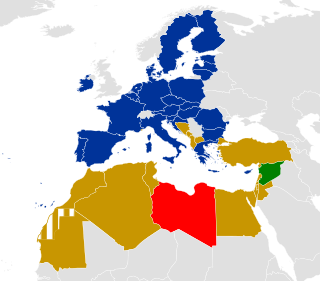
The Union for the Mediterranean is an intergovernmental organization of 42 member states from Europe and the Mediterranean Basin: the 27 EU member states and 15 Mediterranean partner countries from North Africa, Western Asia and Southern Europe. It was founded on 13 July 2008 at the Paris Summit for the Mediterranean, with an aim of reinforcing the Euro-Mediterranean Partnership (Euromed) that was set up in 1995 as the Barcelona Process. Its general secretariat is located in Barcelona, Spain.

Christos Papoutsis is a Greek socialist politician who has served as Minister for Citizen Protection (2010–12), Mercantile Marine Minister (2000–01) Member of the European Parliament (1984–95) and European Commissioner for Energy and Euratom Supply Agency, Small business and Tourism (1995–1999). He has also served as the Secretary of the Parliamentary Group and Parliamentary Spokesman for the Panhellenic Socialist Movement (PASOK), the majority party in Greece (2009–2010). He also was candidate for Mayor of Athens (2002).

Relations between the European Union and the Republic of India are currently defined by the 1994 EU-India Cooperation Agreement. The EU is a significant trade partner for India and the two sides have been attempting to negotiate a free trade deal since 2007. Indo-EU bilateral trade stood at US$104.3 billion in the financial year 2018–19.
The Regional Marine Pollution Emergency Response Centre for the Mediterranean Sea (REMPEC) assists the Mediterranean coastal States in ratifying, transposing, implementing and enforcing international maritime conventions related to the prevention of, preparedness for and response to marine pollution from ships. The Centre also implements activities within the framework of a number of externally funded projects and programmes, such as the EU funded SafeMed II Project and the GEF/UNDP/IMO GloBallast Project.
The Protection of the Arctic Marine Environment Working Group (PAME) is one of six working groups encompassed by The Arctic Council. Founded as part of the 1991 Arctic Environmental Protection Strategy, it assimilated into the structure of the Council following the signing of the 1996 Ottawa Declaration by the 8 Arctic States. The group compiles representatives from each state, as well as its Permanent Participants representing the region's indigenous populations, and a number of observers. The Working Group claims to operate across the domains of Arctic shipping, maritime pollution, marine protected areas, ecosystem approaches to management, resource exploitation and development, and associations with the marine environment. Where necessary, it is tasked with producing guidelines and recommendations for policy improvement, with projects approved every two years by the council. The Secretariat for PAME is located in Akureyri, Iceland.
European Union's scientific collaboration beyond the bloc describes the European Union's frameworks for bilateral cooperation and specific projects in science and technology with countries and regional blocs situated beyond the European Union.
EcoOcean is an Israeli non-profit environmental organization that was founded in 2002, working to preserve the marine and coastal environments, by promoting marine research, education and community engagement.
The European Union Maritime Security Strategy is a maritime security strategy of the European Union. It was unanimously adopted by EU member states in June 2014. The EUMSS provides a framework for the EU's actions within maritime security in order to promote broader and more coherent approaches to identified maritime security challenges. Maritime security strategies have been adopted by a number of countries like France, India, United Kingdom and United States of America, and such strategies are used to organise a country or region's actions within maritime security by identifying maritime security challenges and relevant actors.