
George "Buddy" Guy is an American blues guitarist and singer. He is an exponent of Chicago blues who has influenced generations of guitarists including Eric Clapton, Jimi Hendrix, Jimmy Page, Keith Richards, Stevie Ray Vaughan, Jeff Beck, Gary Clark Jr. and John Mayer. In the 1960s, Guy played with Muddy Waters as a session guitarist at Chess Records and began a musical partnership with blues harp virtuoso Junior Wells.

A guitar solo is a melodic passage, instrumental section, or entire piece of music, pre-written to be played on a classical, electric, or acoustic guitar. In 20th and 21st century traditional music and popular music such as blues, swing, jazz, jazz fusion, rock and heavy metal, guitar solos often contain virtuoso techniques and varying degrees of improvisation. Guitar solos on classical guitar, which are typically written in musical notation, are also used in classical music forms such as chamber music and concertos.

James "Blood" Ulmer is an American jazz, free funk and blues guitarist and singer. Ulmer plays a Gibson Byrdland guitar. His guitar sound has been described as "jagged" and "stinging". His singing has been called "raggedly soulful".
The 17th Annual Australian Recording Industry Association Music Awards were held on 21 October 2003 at the Sydney Superdome. The ceremony aired on Network Ten.
Saffire or Saffire: The Australian Guitar Quartet were an Australian classical music group, which formed in 2002. It consisted of four guitarists Anthony Field, Slava Grigoryan, Gareth Koch and Karin Schaupp. Leonard Grigoryan, Slava's younger brother, replaced Field in 2005. The members also worked as solo performers and in other ensembles. Their debut album, Saffire: The Australian Guitar Quartet, was released in June 2003, which peaked at No. 46 on the ARIA Albums Chart and No. 1 on the related ARIA Classical Chart. At the ARIA Music Awards of 2003 it won the Best Classical Album category. They released two more albums, Nostálgica and Renaissance before disbanding in 2007.

Eric Charles Bibb is a Grammy-nominated American-born blues singer and songwriter.

Joseph Leonard Bonamassa is an American blues rock guitarist, singer and songwriter. He started his career at age twelve, when he opened for B.B. King. Since 2000, Bonamassa has released fifteen solo albums through his independent record label J&R Adventures, of which eleven have reached No. 1 on the Billboard Blues chart.
Saffire – The Uppity Blues Women was a three-woman blues musical ensemble in the Washington, D.C. area. It was founded in 1984 by Ann Rabson, Gaye Adegbalola and Earlene Lewis. Lewis separated from the band in 1992 and was replaced by Andra Faye. The group then featured Rabson on piano, vocals and guitar, Adegbalola on vocals and guitar, and Faye on vocals, bass, mandolin, violin and guitar.
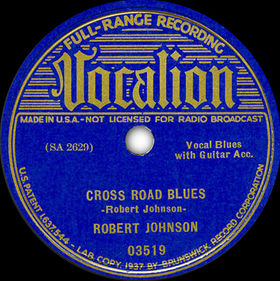
"Cross Road Blues" is a song written by the American blues artist Robert Johnson. He performed it as a solo piece with his vocal and acoustic slide guitar in the Delta blues-style. The song has become part of the Robert Johnson mythology as referring to the place where he supposedly sold his soul to the Devil in exchange for his musical talent. This is based largely on folklore of the American South that identifies a crossroads as the site where such pacts are made, although the lyrics do not contain any references to Satan or a Faustian bargain.
Ann Rabson was an American blues vocalist, pianist and guitar player. She was a solo recording artist signed to Alligator Records and was a member of Saffire - The Uppity Blues Women, an acoustic blues band that disbanded amicably in 2009.

Gaye Adegbalola is an American blues singer and guitarist, teacher, lecturer, activist, and photographer.
The Bajaj Wave is a motor scooter from Bajaj Auto. It is a revised Bajaj Saffire. The Wave offers a 109.7 cc DTS-i engine, CVT transmission and revised body panels. It has a maximum power of 8 bhp. It also offers Bajaj's ExhausTEC technology and a ride control switch.
Saffire was a high end gear-less motor scooter produced in India by Bajaj Auto.

"Nobody Knows You When You're Down and Out" is a blues standard written by pianist Jimmie Cox in 1923 and originally performed in a Vaudeville-blues style. The lyrics in the popular 1929 recording by Bessie Smith are told from the point of view of somebody who was once wealthy during the Prohibition era and reflect on the fleeting nature of material wealth and the friendships that come and go with it. Since her 1929 recording, the song has been interpreted by numerous musicians in a variety of styles.
"Wild Women Don't Have the Blues", "Wild Women Don't Get the Blues", or simply "Wild Women" is a vaudeville-style blues song recorded by American singer Ida Cox with Lovie Austin's Blues Serenaders in 1924. It has a strong feminist message. The song has been performed by numerous classic female blues singers, including Bessie Smith.

Lego Bionicle: Quest for the Toa is a 2001 action-adventure game developed by Saffire and published by Lego Software for the Game Boy Advance. Based on the Lego Group's Bionicle line of constructible action figures, the game follows Takua, a villager on the island of Mata Nui, on a quest to rescue the island's Turaga elders and summon the Toa, heroic elemental warriors destined to defeat the evil Makuta.

E.G. Kight is an American Chicago blues singer, guitarist and songwriter. She has worked with many musicians, including George Jones, Jerry Lee Lewis, Conway Twitty, Merle Haggard, Luther Allison, Hubert Sumlin, Pinetop Perkins, Taj Mahal, B.B. King, and Koko Taylor. Kight has recorded seven albums to date and received several nominations for Blues Music Awards, in the categories Contemporary Female Artist and Song of the Year.
Skeeter Brandon was an American blind blues keyboardist, singer and songwriter.
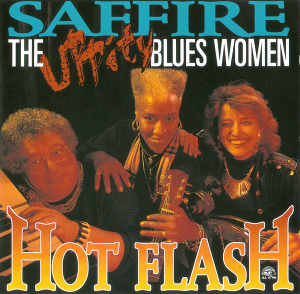
Hot Flash is an album by the American musical trio Saffire – The Uppity Blues Women, released in 1991. It was their second album for Alligator Records and one of the label's best selling titles. The trio supported the album with a North American tour. Hot Flash also served as the title of a 2008 documentary about the trio.
