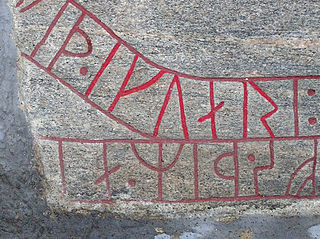
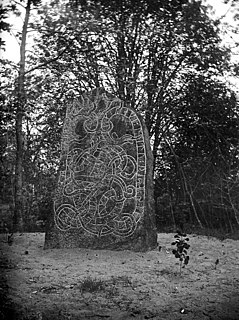
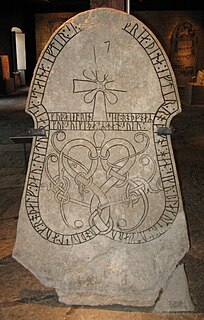
Last updated The Sjusta Runestone commemorates a Varangian who died in Saint Olaf's church in Novgorod.
Saint Olaf's Church in Novgorod was a church for Varangians which existed from the 11th century until the 14th century in the Russian city of Novgorod.
The church was located in the permanent Varangian centre of trade in Novgorod's trading area (torgovaja storona), which was called got'skij dvor ("Gothic court") according to an early tradition.[1] The functions of the church was not merely to provide a place of worship, but it also served as a treasury and as a warehouse, as was generally the case for churches in Varangian and Hanseatic trading colonies.[1] Like other medieval churches it was probably also a defensive structure to which may testify the Sjusta Runestone in Uppland, Sweden, which was raised after a man named Spjallboði who died in the church.[2]Omeljan Pritsak, on the other hand, suggests that Spjallboði may have died in a fire c. 1070–1080, one of several that ravaged the church.[1]
Saint Olaf began to be venerated as a saint almost directly after his death in 1030, and in 1050, the cult had arrived in England.[1] Saint Olaf had special connections with the city of Novgorod since its Grand Prince Yaroslav I the Wise was not only the brother-in-law of Olaf, but he also fostered Olaf's son Magnus I of Norway at his court.[1]
In addition to appearing on the Sjusta Runestone, Saint Olaf's church is also mentioned in two written sources. The Acta Sancti Olavi regis et martyris was written by Trondheim's archbishop Eysteinn Erlendsson in the third quarter of the 12th century.[1] It informs that a Latin priest named Stephan served in Saint Olaf's church in Novgorod (Holmegarder).[3] There is also a draft of a German treaty with Novgorod which dates to c. 1230, and it talks of Curia gotensium cum ecclesia et cimiterium Sancti Olaui, which means "the Gothic court (i.e. Got'skij dvor) with Saint Olaf's church and cemetery".[4]
The Novgorod First Chronicle only talks of the church of the Varangians (cerky ... variaz'skaja na T"rgovišči).[4] The chronicle mentions the church four times because of fires. In 1152, the church burnt down together with eight other churches, in 1181, it burnt down because of lightning.[4] In 1217, the church is mentioned as Varjaz'skaja božnica, the "Varangian shrine" and it reports that considerable amounts of merchandise belonging to the Varangians were completely lost in a fire.[4] The last mention is from 1311, when it burnt down together with seven other churches.[4]
The Acta Sancti Olavi talks of a miracle worked by Saint Olaf during a fire in Novgorod, and Pritsak suggests that it was the fire of 1152.[4]
Jansson, Sven B. (1980). Runstenar. STF, Stockholm. ISBN91-7156-015-7
Pritsak, Omeljan. (1981). The origin of Rus'. Cambridge, Mass.: Distributed by Harvard University Press for the Harvard Ukrainian Research Institute. ISBN0-674-64465-4
Related Research Articles
A runestone is typically a raised stone with a runic inscription, but the term can also be applied to inscriptions on boulders and on bedrock. The tradition began in the 4th century and lasted into the 12th century, but most of the runestones date from the late Viking Age. Most runestones are located in Scandinavia, but there are also scattered runestones in locations that were visited by Norsemen during the Viking Age. Runestones are often memorials to dead men. Runestones were usually brightly coloured when erected, though this is no longer evident as the colour has worn off. Most runestones are found in present-day Sweden.
Garðaríki or Garðaveldi is the Old Norse term used in medieval times for the states of Kievan Rus'.
Ingvar the Far-Travelled was a Swedish Viking who led an expedition that fought in Georgia.
The Hakon Jarl Runestones are Swedish runestones from the time of Canute the Great.
The Greece runestones are about 30 runestones containing information related to voyages made by Norsemen to the Byzantine Empire. They were made during the Viking Age until about 1100 and were engraved in the Old Norse language with Scandinavian runes. All the stones have been found in modern-day Sweden, the majority in Uppland and Södermanland. Most were inscribed in memory of members of the Varangian Guard who never returned home, but a few inscriptions mention men who returned with wealth, and a boulder in Ed was engraved on the orders of a former officer of the Guard.
The Italy runestones are three or four Varangian runestones from 11th-century Sweden that tell of warriors who died in Langbarðaland, the Old Norse name for Italy. On these rune stones it is southern Italy that is referred to (Langobardia), but the Rundata project renders it rather anachronistically as Lombardy.
The England runestones are a group of about 30 runestones in Northern Europe which refer to Viking Age voyages to England. They constitute one of the largest groups of runestones that mention voyages to other countries, and they are comparable in number only to the approximately 30 Greece Runestones and the 26 Ingvar Runestones, of which the latter refer to a Viking expedition near the Caspian Sea. They were engraved in Old Norse with the Younger Futhark.
The Varangian Runestones are runestones in Scandinavia that mention voyages to the East or the Eastern route, or to more specific eastern locations such as Garðaríki.
The Baltic area runestones are Varangian runestones in memory of men who took part in peaceful or warlike expeditions across the Baltic Sea, where Finland and the Baltic states are presently located.
Ragnvaldr was a captain of the Varangian Guard in the first half of the 11th century. He may appear on several runestones, some of which suggest that he was the son of an Ingvar connecting him to the Jarlabanke clan.
The Thingmen was a unit in the service of the Kings of England during the period 1013-51, financed by direct taxation which had its origins in the tribute known as Danegeld. It consisted mostly of men of Scandinavian descent and it had an initial strength of 3,000 housecarls and a fleet of 40 ships, which was subsequently reduced. Its last remnant was disbanded by Edward the Confessor in 1051.
Ulf of Borresta was a runemaster in the eleventh century Uppland, Sweden, and a successful Viking who returned from England three times with a share of the Danegeld. He is named after his estate which in modern Swedish is called Borresta or Bårresta.
Yakun or Jakun, deriving from Old Norse Hákon, was a Varangian (Viking) leader who is mentioned in the Primary Chronicle and in the Cave monastery in Kyiv. The chronicle tells that he arrived in Kievan Rus' in the year 1024 and fought in the Battle of Listven between the half-brothers Yaroslav I the Wise and Mstislav of Chernigov.
The Uppland Runic Inscription 328 stands on a hill in a paddock at the farm Stora Lundby, which is about four kilometers west of Lindholmen, Stockholm County, Sweden, in the historic province of Uppland. The runestone is one of several runestones that have permitted scholars to trace family relations among some powerful Viking clans in Sweden during the 11th century.
Šimon was a Varangian (Viking) whose story is related in the Kievan Patericon and his story concerns the creation of the Kievan cave monastery, where he is reported to have been its most important donor.
The Berezan' Runestone was discovered in 1905 by Ernst von Stern, professor at Odessa, on Berezan' Island where the Dnieper River meets the Black Sea. The runestone is 48 cm (19 in) wide, 47 cm (19 in) high and 12 cm (4.7 in) thick, and kept in the museum of Odesa. It was made by a Varangian (Viking) trader named Grani in memory of his business partner Karl. They were probably from Gotland, Sweden.
The Rus' people were an ethnos in early medieval eastern Europe. The scholarly consensus holds that they were originally Norse people, mainly originating from present-day Sweden, settling and ruling along the river-routes between the Baltic and the Black Seas from around the 8th to 11th centuries AD. They formed a state known in modern historiography as Kievan Rus', which was initially a multiethnic society where the ruling Norsemen merged and assimilated with Slavic, Baltic and Finnic tribes, ending up with Old East Slavic as their common language. The elite of Kievan Rus' was still familiar with Old Norse until their assimilation by the second half of the 11th century, and in rural areas vestiges of Norse culture persisted as late as the 14th and early 15th centuries.
The Varangians, was the name given by Eastern Romans to Viking raiders, conquerors, traders and settlers, who were overwhelmingly ethnic Swedes but also including smaller contingents from Denmark and Norway. Between the 9th and 11th centuries, Varangians ruled the medieval state of Kievan Rus', settled among many territories of modern Belarus, Russia and Ukraine, and formed the Byzantine Varangian Guard which later also included Anglo-Saxons.
Uppland Runic Inscription 1158 or U 1158 is the Rundata catalogue listing for a Viking Age memorial runestone that is located at Stora Salfors, which is one kilometre east of Fjärdhundra, Uppsala County, Sweden, and is in the historic province of Uppland. The stone is a memorial to a man named Freygeirr, and may have been the same Freygeirr who was a Viking chieftain active on the Baltic coast in the 1050s.
Blakumen or Blökumenn were a people mentioned in Scandinavian sources dating from the 11th through 13th centuries. The name of their land, Blokumannaland, has also been preserved. Victor Spinei, Florin Curta, Florin Pintescu and other historians identify them as Romanians, while Omeljan Pritsak argues that they were Cumans. Judith Jesch adds the possibility that the terms meant "black men", the meaning of which is unclear. Historians identify Blokumannaland as the lands south of the Lower Danube which were inhabited by Vlachs in the Middle Ages, adding that the term may refer to either Wallachia or Africa in the modern Icelandic language.
This page is based on this Wikipedia article Text is available under the CC BY-SA 4.0 license; additional terms may apply. Images, videos and audio are available under their respective licenses.