Greenberg is a surname common in North America, with anglicized spelling of the German Grünberg or the Jewish Ashkenazi Yiddish Grinberg, an artificial surname.
Adler is a surname of German origin meaning eagle. and has a frequency in the United Kingdom of less than 0.004%, and of 0.008% in the United States. In Christian iconography, the eagle is the symbol of John the Evangelist, and as such a stylized eagle was commonly used as a house sign/totem in German speaking areas. From the tenement the term easily moved to its inhabitants, particularly to those having only one name. This phenomenon can be easily seen in German and Austrian censuses from the 16th and 17th centuries.

Samuel Adler was a leading German-American Reform rabbi, Talmudist, and author.

Congregation Emanu-El of New York is the first Reform Jewish congregation in New York City. It has served as a flagship congregation in the Reform branch of Judaism since its founding in 1845. The congregation uses Temple Emanu-El of New York, one of the largest synagogues in the world.
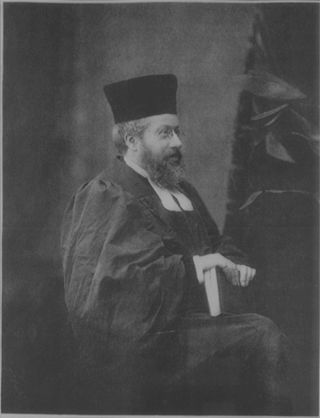
Hermann Adler HaKohen CVO was the Chief Rabbi of the British Empire from 1891 to 1911. The son of Nathan Marcus Adler, the 1911 Encyclopædia Britannica writes that he "raised the position [of Chief Rabbi] to one of much dignity and importance."
Samuel Hans Adler is an American composer, conductor, author, and professor. During the course of a professional career which ranges over six decades he has served as a faculty member at both the University of Rochester's Eastman School of Music and the Juilliard School. In addition, he is credited with founding and conducting the Seventh Army Symphony Orchestra which participated in the cultural diplomacy initiatives of the United States in Germany and throughout Europe in the aftermath of World War II. Adler's musical catalogue includes over 400 published compositions. He has been honored with several awards including Germany's Order of Merit – Officer's Cross.
Löw is a surname of German and Yiddish origin. Another romanization of the Yiddish name לייב is Leib. It may refer to:
Rabinovich or Rabinovitch, is a Russian Ashkenazi Jewish surname, Slavic for "son of the rabbi". The Polish/Lithuanian equivalents are Rabinowitz or Rabinowicz.
Rabin is a Hebrew surname. It originates from the Hebrew word rav meaning Rabbi, or from the name of the specific Rabbi Abin. The most well known bearer of the name was Yitzhak Rabin, prime minister of Israel and Nobel Peace prize Laureate.
Nathan Adler (1741–1800) was a German kabbalist and Rosh yeshiva. He was responsible for training several prominent rabbis of the era.
Hugo Chaim Adler, was a Belgian cantor, composer, and choir conductor. He is primarily recognized for creating and popularizing contemporary versions of 19th-century Jewish cantorial music. He is the father of Samuel Adler, a prominent American composer of contemporary classical music.
Eliezer was the name of at least three biblical personalities.

The Seventh Army Symphony Orchestra was the only symphonic orchestral ensemble ever created under the supervision of the United States Army. Founded by the composer Samuel Adler, its members participated in the cultural diplomacy initiatives of the United States in an effort to demonstrate the shared cultural heritage of the United States, its European allies and the vanquished countries of Europe during the post World War II era.
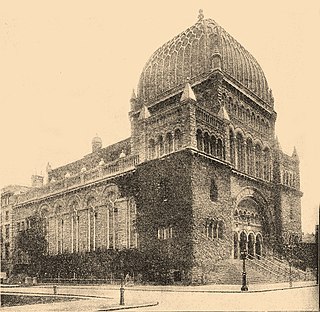
Temple Beth-El was a Reform congregation and Romanesque synagogue located at Fifth Avenue and 76th Street in the Upper East Side of Manhattan in New York City.
Israel of Bamberg was a 13th century Germany Tosafist who served as Chief Rabbi of Bamberg, Germany after succeeding his teacher Rabbi Samuel of Bamberg. Israel's tosafot are quoted by Mordecai ben Hillel who mentions Israel's tosafot on the Talmudic tractates of Shabbat and Avodah Zarah, which though no longer extant, are quoted by a 15th-century Italian codifier. In his tosafot, Israel relies primarily on his teacher.
This page is based on this
Wikipedia article Text is available under the
CC BY-SA 4.0 license; additional terms may apply.
Images, videos and audio are available under their respective licenses.
