
Ghantasala Venkateswararao, known mononymously by his surname as Ghantasala, was an Indian playback singer and film composer known for his works predominantly in Telugu and Kannada cinema and also in Tamil, Malayalam, Tulu and Hindi language films. He is considered one of the greatest singers of Telugu cinema. In 1970, he received the Padma Shri award, India's fourth highest civilian award for his contribution to Indian cinema. According to The Hindu and The Indian Express, Ghantasala was 'such a divine talent and with his songs he could move the hearts of the people'. 'Ghantasala's blending of classical improvisations to the art of light music combined with his virtuosity and sensitivity puts him a class apart, above all others in the field of playback singing'. Gifted with what Indian film historian V. A. K. Ranga Rao called 'the most majestic voice', Ghantasala helped Telugu film music develop its own distinct character which remains unparalleled. He is referred to as the 'Gaana Gandharva' for his mesmerising voice and musical skills.
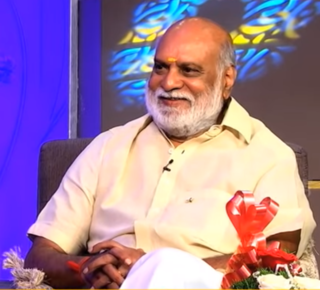
Kovelamudi Raghavendra Rao is an Indian filmmaker known primarily for his work in Telugu cinema, besides a few Hindi films. Over a career spanning more than four decades, he has directed over a hundred films across various genres, including romantic comedies, fantasies, melodramas, action thrillers, biographical dramas, and romances. He has received numerous accolades, including four Nandi Awards and five Filmfare Awards South.
Shanti or Shanthi may refer to:
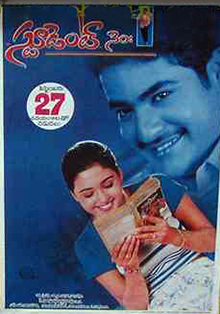
Student No: 1 is a 2001 Indian Telugu-language coming-of-age romantic action film directed by S. S. Rajamouli. K. Raghavendra Rao produced and wrote the screenplay for the film from a story written by Pruthvi Teja and dialogues written by Pruthvi Teja—Viswanth. Student No: 1 marks the directorial debut of Rajamouli in a feature film. The film stars N. T. Rama Rao Jr., Gajala and Rajeev Kanakala. The film was made on a budget of ₹1.85 crore (US$392,000) and earned a distributors' share of ₹12 crore. It was one of the most successful Telugu films of 2001.

Veeramachaneni Madhusudhana Rao was an Indian film director, producer, and screenwriter, known for his works predominantly in Telugu cinema. He is popularly known as 'Victory' Madhusudhana Rao. He directed nearly 70 films, including musical hits such as Annapurna (1960), Aradhana (1962), Aathma Balam (1964), Zamindar (1965), Antastulu (1965), Aatmiyulu (1969), and Krishnaveni (1974). He also produced Swati Kiranam (1992). Six of his films received the Nandi Award for Best Feature Film, and in 1965, he was awarded the National Film Award for Best Feature Film in Telugu for Antastulu. He was honoured with the prestigious Raghupathi Venkaiah Award for lifetime contributions to Telugu cinema by the Government of Andhra Pradesh in 1997.
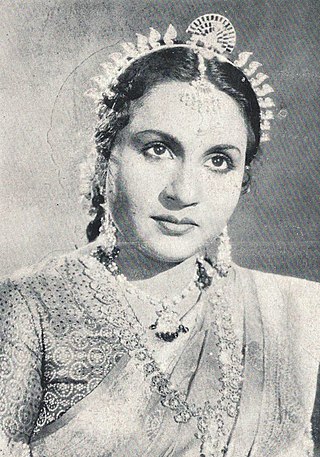
Santha Kumari was an Indian musical artist and actress. She was married to the Telugu film director and producer P. Pullayya.

Gharana (Family) is a 1961 Indian Hindi film that stars Raaj Kumar, Rajendra Kumar and Asha Parekh. It is directed by S. S. Vasan. The film became a box office hit. The film was a remake of the 1960 Telugu film Santhi Nivasam and remade in 1988 as Ghar Ghar Ki Kahani.

Devika Devadoss was an Indian actress who worked in Tamil and Telugu along with a few Malayalam, Kannada, and Hindi films. She was one of the popular lead actresses in the 1960s.
Chittajallu Srinivasa Rao was an Indian actor, writer and director. He was the son of film director Chittajallu Pullayya. He directed around 65 films in the Telugu, Tamil, Malayalam and Oriya languages. He garnered two National Film Awards for directing the films Lava Kusa (1963) and Desamante Manushuloyi (1970). Directors including Muktha V. Srinivasan and K. S. Sethu Madhavan worked as his assistants.
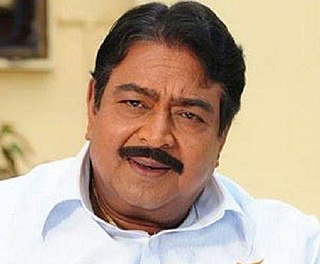
Tirumala Sundara Sri Ranganath was an Indian actor known for his works primarily in Telugu cinema, Telugu Theater, television, and a few Tamil films. In a film career spanning more than forty years, Ranganath starred in more than three hundred feature films in a variety of roles. He made his debut with the 1969 Telugu film Budhimantudu.

Manimekhala Srilekha, known professionally as M. M. Srilekha, is an Indian film playback singer and music composer, known for her works predominantly in Telugu cinema. She is the only female music composer in the Telugu film industry. Her paternal uncle V. Vijayendra Prasad's directorial venture Srivalli (2017) was her 75th film.

Mikkilineni Radhakrishna Murthy was an Indian actor and thespian known for his works predominantly in Telugu cinema. He was the founder of the theater group Praja Natya Mandali. He has received the honorary Kalaprapoorna from Andhra University, for his contributions towards Telugu theater and cinema.

Santhi Nivasam is a 1960 Indian Telugu-language drama film directed by C. S. Rao. The film stars Akkineni Nageswara Rao, Rajasulochana, Kantha Rao, Krishna Kumari and Devika. It is an adaptation of Palagummi Padmaraju's Telugu play of the same name, which itself was based on B. S. Ramiah's Tamil play Malliyam Mangalam.
Malliyam Mangalam is a 1961 Indian Tamil-language film directed by S. Soundararajan. The film stars S. V. Subbaiah, S. V. Sahasranamam, S. N. Lakshmi and Pandari Bai. It is based on the play of the same name by B. S. Ramiah. The film was released in 1961, delayed from July 1960.

Qaidi No. 911 is a 1959 Indian Hindi-language crime film produced and directed by Aspi Irani, and written by C. J. Pavri. The film stars Sheikh Mukhtar, Nanda and Mehmood. It focuses on a man who is arrested for a robbery he never committed. The film was remade in Tamil as Kaithi Kannayiram (1960) and in Telugu as Khaidi Kannayya (1962).

Lakshmi Nivasam is a 1968 Indian Telugu-language drama film directed by V. Madhusudhana Rao and written by Aarudra. It is a remake of the Kannada film Dudde Doddappa (1966). The film stars S. V. Ranga Rao, Anjali Devi, Krishna, Vanisri, Sobhan Babu, Bharathi, V. Nagayya, Ram Mohan, and Padmanabham. It was released on 19 July 1968 and became commercially successful.
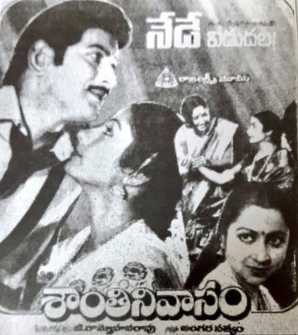
Santhi Nivasam is a 1986 Indian Telugu-language drama film produced by Angara Satyam for Rajalakshmi Movies, directed by Gullapalli Ram Mohan Rao starring Krishna, Suhasini, Radhika Sarathkumar and Kaikala Satyanarayana. Chakravarthi scored and composed the film's soundtrack. The film was declared a flop at the box office.
Chandra Sekhar, known professionally as Chatrapathi Sekhar, is an Indian actor who primarily works in Telugu films. He is known for his frequent collaborations with S. S. Rajamouli.
Hemalatha was an Indian actress of Telugu cinema, of Andhra Pradesh, India. She acted in more than 100 films during the 1950s to 1976. The first movie she acted was Palletooru. She retired from movies in 1976, with Seethamma Santhanam being the film she last appeared. After retiring from movies, she was involved in Brahma Kumaris movement in Hyderabad till her death.

Santhi Nivasam is an Indian Telugu-language television drama series that aired on ETV from 2000 to 2001, spanning 273 episodes. Directed by S. S. Rajamouli in his directorial debut, the series follows Raghavayya, the patriarch of a large family living in a house named Santhi Nivasam, as they navigate familial conflicts, relationships, and societal challenges. Produced by K. Raghavendra Rao under his banner RK Teleshow, the series played a key role in shaping Rajamouli's career, laying the foundation for his transition to feature films.
