
The Sarmatians were a large confederation of ancient Iranian equestrian nomadic peoples who dominated the Pontic steppe from about the 3rd century BC to the 4th century AD.

Poland–Lithuania, formally known as the Kingdom of Poland and the Grand Duchy of Lithuania and also referred to as the Polish–Lithuanian Commonwealth or the First Polish Republic, was a bi-confederal state, sometimes called a federation, of Poland and Lithuania ruled by a common monarch in real union, who was both King of Poland and Grand Duke of Lithuania. It was one of the largest and most populous countries of 16th- to 17th-century Europe. At its largest territorial extent, in the early 17th century, the Commonwealth covered almost 1,000,000 km2 (400,000 sq mi) and as of 1618 sustained a multi-ethnic population of almost 12 million. Polish and Latin were the two co-official languages, and Catholicism served as the state religion.
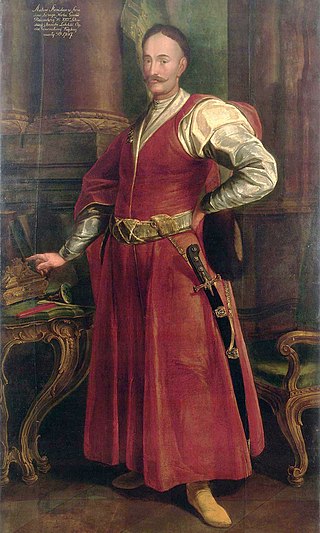
Sarmatism was an ethno-cultural ideology within the Polish–Lithuanian Commonwealth. It was the dominant Baroque culture and ideology of the nobility that existed in times of the Renaissance to the 18th centuries. Together with the concept of "Golden Liberty", it formed a central aspect of the Commonwealth social elites’ culture and society. At its core was the unifying belief that the people of the Polish–Lithuanian Commonwealth descended from the ancient Iranian Sarmatians, the legendary invaders of contemporary Polish lands in antiquity.
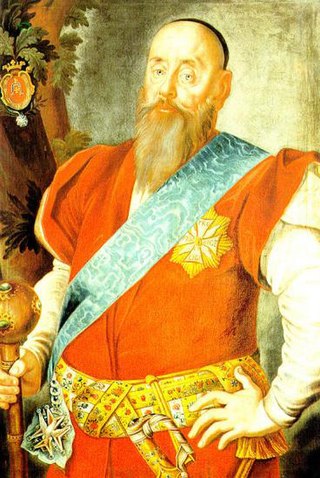
Kontush sash was a cloth sash used for girding a kontusz. It was one of the most distinctive items of male dress of Polish and Lithuanian nobility (szlachta) and is a key component of the Polish national costume. In an earlier period, sometimes narrower sashes of fine cloth or silk net were worn, but the wide kontusz sash is specific to the later period. A variant known in Belarus lands is Slutsk Sash.
The Sarmatian Review was a triannual peer-reviewed academic journal, published from 1981 to 2017 by the nonprofit Polish Institute of Houston, covering Slavistics.

The Polish–Lithuanian–Muscovite Commonwealth was a proposed state that would have been based on a personal union between the Polish–Lithuanian Commonwealth and the Tsardom of Russia. A number of serious attempts by various means to create such a union took place between 1574 and 1658 and in the late 18th century, but it never materialized because of the incompatible demands from both sides.
The Polish Baroque lasted from the early 17th to the mid-18th century. As with Baroque style elsewhere in Europe, Poland's Baroque emphasized the richness and triumphant power of contemporary art forms. In contrast to the previous, Renaissance style which sought to depict the beauty and harmony of nature, Baroque artists strove to create their own vision of the world. The result was manifold, regarded by some critics as grand and dramatic, but sometimes also chaotic and disharmonious and tinged with affectation and religious exaltation, thus reflecting the turbulent times of the 17th-century Europe.

Maciej Miechowita was a Polish Renaissance scholar, professor of Jagiellonian University, historian, chronicler, geographer, medical doctor, alchemist, astrologer and canon in Kraków.
The East European Craton (EEC) is the core of the Baltica proto-plate and consists of three crustal regions/segments: Fennoscandia to the northwest, Volgo-Uralia to the east, and Sarmatia to the south. Fennoscandia includes the Baltic Shield and has a diversified accretionary Archaean and early Proterozoic crust, while Sarmatia has an older Archaean crust. The Volgo-Uralia region has a thick sedimentary cover, however deep drillings have revealed mostly Archaean crust. There are two shields in the East European Craton: the Baltic/Fennoscandian shield and the Ukrainian shield. The Ukrainian Shield and the Voronezh Massif consists of 3.2-3.8 Ga Archaean crust in the southwest and east, and 2.3-2.1 Ga Early Proterozoic orogenic belts.

The Sarmatian Craton or Sarmatia is the southern segment/region of the East European Craton or Baltica, also known as Scythian Plateau. The craton contains Archaean rocks 2.8 to 3.7 billion years old (Ga). During the Carboniferous the craton was rifted apart by the Dnieper-Donets rift. As a result, geomorphologically the cratonic area is split by the Donbas Fold Belt, also known as a part of the large Pripyat-Dniepr-Donets aulacogen, which transects Sarmatia, dividing it into the Ukrainian Massif or shield on the southwest and the Voronezh Massif to the northeast.
Scythia or Scythica, also known as Pontic Scythia, was a kingdom created by the Scythians during the 6th to 3rd centuries BC in the Pontic–Caspian steppe.
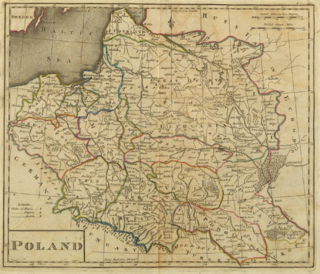
The ethnonyms for the Poles (people) and Poland include endonyms and exonyms. Endonyms and most exonyms for Poles and Poland derive from the name of the West Slavic tribe of Polans (Polanie), while in some languages the exonyms for Poland to derive from the name of another tribe – the Lendians (Lędzianie).

The Serboi or Serbi and Sirbi was a tribe mentioned in Greco-Roman geography as living in the North Caucasus, believed by scholars to have been Sarmatian.
The Iranian peoples or Iranic peoples are a diverse grouping of peoples who are identified by their usage of the Iranian languages and other cultural similarities.

The Polish-Lithuanian identity describes individuals and groups with histories in the Polish–Lithuanian Commonwealth or with close connections to its culture. This federation, formally established by the 1569 Union of Lublin between the Kingdom of Poland and Grand Duchy of Lithuania, created a multi-ethnic and multi-confessional state founded on the binding powers of national identity and shared culture rather than ethnicity or religious affiliation. The term Polish-Lithuanian has been used to describe various groups residing in the Commonwealth, including those that did not share the Polish or Lithuanian ethnicity nor their predominant Roman Catholic faith.

This article summarizes the History of the western steppe, which is the western third of the Eurasian steppe, that is, the grasslands of Ukraine and southern Russia. It is intended as a summary and an index to the more-detailed linked articles. It is a companion to History of the central steppe and History of the eastern steppe. All dates are approximate since there are few exact starting and ending dates. This summary article does not list the uncertainties, which are many. For these, see the linked articles.

Sarmatia was a region of the Eurasian steppe inhabited by the Sarmatians.

Iran–Poland relations are historical and bilateral relationship between the Islamic Republic of Iran and the Republic of Poland. Both nations are members of the United Nations.

