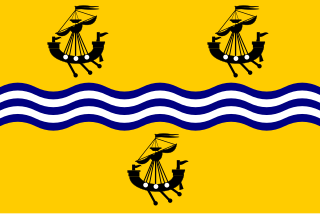
The Outer Hebrides or Western Isles, sometimes known as the Long Isle or Long Island, is an island chain off the west coast of mainland Scotland. The islands form part of the archipelago of the Hebrides, separated from the Scottish mainland and from the Inner Hebrides by the waters of the Minch, the Little Minch, and the Sea of the Hebrides. The Outer Hebrides are considered to be the traditional heartland of the Gaelic language. The islands form one of the 32 council areas of Scotland, which since 1998 has used only the Gaelic form of its name, including in English language contexts. The council area is called Na h-Eileanan an Iar and its council is Comhairle nan Eilean Siar.

Harris is the southern and more mountainous part of Lewis and Harris, the largest island in the Outer Hebrides, Scotland. Although not an island itself, Harris is often referred to in opposition to the Isle of Lewis as the Isle of Harris, which is the former postal county and the current post town for Royal Mail postcodes starting HS3 or HS5.
Scalpay is an inhabited island in the Inner Hebrides of Scotland which has a population of 4.
Scalpay is an island in the Outer Hebrides of Scotland.

Leverburgh is the second largest village, after Tarbert, in Harris in the Outer Hebrides of Scotland. Leverburgh is within the parish of Harris. In 1971 it had a population of 223.
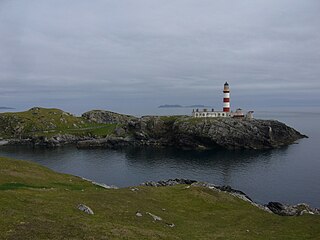
Eilean Glas is a peninsula of Scalpay in the Outer Hebrides, Scotland. Eilean Glas is home to a historic lighthouse. Eilean Glas means Grey/Green Island in Gaelic.
Norman Macleod is a STV North news presenter and journalist for the Northern Scotland edition of STV News at Six.
"Ailein duinn" is a traditional Scottish Gaelic song for solo female voice, a lament that was written for Ailean Moireasdan by his fiancée, Annag Chaimbeul. Ailean Moireasdan was a sea captain from the isle of Lewis. In the spring of 1788, he left Stornoway to go to Scalpay, Harris, where he was to be engaged to Annag Chaimbeul. Unfortunately, they sailed into a storm and all the crew sank with the vessel, off the coast of the Shiant Islands. The broken-hearted Annag wasted away through grief and composed this lament for her lost love. Annag lost her will to live and died a few months afterwards. Because there was not enough soil on the barren island of Scalpay, her father took her in her coffin by boat to a cemetery on the main island of Harris. However, a storm caused the coffin to be blown off her father's boat and it washed up on the same island her fiancé's body had been found.

The Hebrides were settled early on in the settlement of the British Isles, perhaps as early as the Mesolithic era, around 8500–8250 BC, after the climatic conditions improved enough to sustain human settlement. There are examples of structures possibly dating from up to 3000 BC, the finest example being the standing stones at Callanish, but some archaeologists date the site as Bronze Age. Little is known of the people who settled in the Hebrides but they were likely of the same Celtic stock that had settled in the rest of Scotland. Settlements at Northton, Harris, have both Beaker & Neolithic dwelling houses, the oldest in the Western Isles, attesting to the settlement.
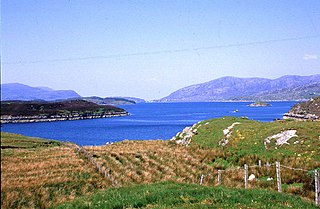
East Loch Tarbert is a sea loch that lies to the east of Harris in the Outer Hebrides of Scotland. The loch contains several small islands including Sgeotasaigh, Stiughiag, Stiughiag na Leum and Rosaigh and the larger bridged island of Scalpay. The Caledonian MacBrayne ferry from the Isle of Skye to Harris reaches Tarbert via this loch.
The Lias Group or Lias is a lithostratigraphic unit found in a large area of western Europe, including the British Isles, the North Sea, the Low Countries and the north of Germany. It consists of marine limestones, shales, marls and clays.

Lewis and Harris, or Lewis with Harris, is a Scottish island in the Outer Hebrides, around 24 miles (39 km) from the Scottish mainland.
MV Lochmor was the David MacBrayne Ltd Outer Isles mail steamer from 1930 until 1964. She was superseded by a new generation of car ferries.

MV Clew Bay Queen is a car ferry at Clare Island. Built in 1972 as MV Kilbrannan for Caledonian MacBrayne, she operated mainly at Scalpay, Outer Hebrides until 1992. As Arainn Mhor, she then operated the Arranmore ferry in County Donegal.
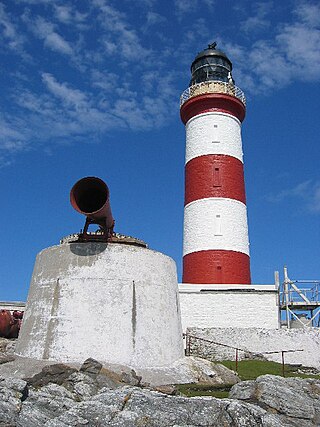
Eilean Glas Lighthouse is on the east coast of the island of Scalpay in the Outer Hebrides of Scotland. It was one of the original four lights commissioned by the Commissioners of the Northern Lights, and the first in the Hebrides. These lighthouses were built by Thomas Smith.
MV Lochalsh was a side-loading turntable ferry, built in 1957 for the Caledonian Steam Packet Company for the Kyle of Lochalsh - Skye crossing. Superseded by larger, drive-through vessels, she was renamed MV Scalpay and moved to Scalpay where she served until 1977.
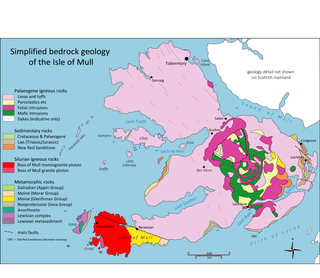
The geology of the Isle of Mull in Scotland is dominated by the development during the early Palaeogene period of a ‘volcanic central complex’ associated with the opening of the Atlantic Ocean. The bedrock of the larger part of the island is formed by basalt lava flows ascribed to the Mull Lava Group erupted onto a succession of Mesozoic sedimentary rocks during the Palaeocene epoch. Precambrian and Palaeozoic rocks occur at the island's margins. A number of distinct deposits and features such as raised beaches were formed during the Quaternary period.
This page is based on this
Wikipedia article Text is available under the
CC BY-SA 4.0 license; additional terms may apply.
Images, videos and audio are available under their respective licenses.
