The Inca Empire was the largest empire in pre-Columbian America.
Phoebe or Phœbe may refer to:
Colon commonly refers to:
Calyx or calyce, from the Latin calix which itself comes from the Ancient Greek κάλυξ (kálux) meaning "husk" or "pod", may refer to:

The rove beetles are a family (Staphylinidae) of beetles, primarily distinguished by their short elytra that typically leave more than half of their abdominal segments exposed. With roughly 63,000 species in thousands of genera, the group is currently recognized as the largest extant family of organisms. It is an ancient group, with fossilized rove beetles known from the Triassic, 200 million years ago, and possibly even earlier if the genus Leehermania proves to be a member of this family. They are an ecologically and morphologically diverse group of beetles, and commonly encountered in terrestrial ecosystems.
Sponsor or sponsorship may refer to a person or organization with some role regarding another person or organisation:

Phyllophaga is a very large genus of New World scarab beetles in the subfamily Melolonthinae. Common names for this genus and many other related genera in the subfamily Melolonthinae are May beetles, June bugs, and July beetles. They range in size from 12 to 35 mm and are blackish or reddish-brown in colour, without prominent markings, and often rather hairy ventrally. These beetles are nocturnal, coming to lights in great numbers.

The term mycangium is used in biology for special structures on the body of an animal that are adapted for the transport of symbiotic fungi. This is seen in many xylophagous insects, which apparently derive much of their nutrition from the digestion of various fungi that are growing amidst the wood fibers. In some cases, as in ambrosia beetles, the fungi are the sole food, and the excavations in the wood are simply to make a suitable microenvironment for the fungus to grow. In other cases, wood tissue is the main food, and fungi weaken the defense response from the host plant.
Scaphium scaphigerum is a deciduous tropical nut-bearing tree of genus Scaphium.

Scaphium is a genus of about eight species of plants in the subfamily Sterculioideae of the family Malvaceae. The name comes from the Greek, skaphion, meaning a small boat like a skiff, and refers to the shape of the fruit.

Sterculioideae is a subfamily of the family Malvaceae containing evergreen and deciduous trees and shrubs.

Byturidae, also known as Fruitworms, is a very small family of beetles, in the suborder Polyphaga, comprising fewer than 20 species worldwide. The larvae of some species develop in fruits. Byturus unicolor affects species of Rubus and Geum.
Scaphium is a genus of shining fungus beetles in the family Staphylinidae. There are at least two described species in Scaphium.
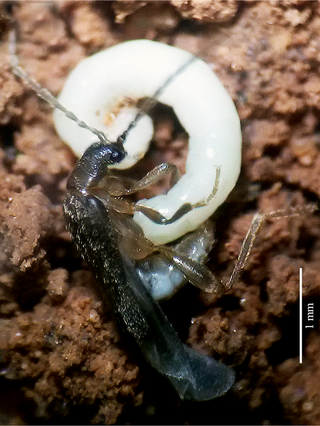
Jurasaidae is a family of elateroid beetles known from around a half-dozen species in two genera found the Brazilian Atlantic rainforest including drier transitional areas bordering the Caatinga. All known species have neotenic larva-like females and normal males, similar to some other elateroids. They occur in the soil horizon immediately under leaf litter, with the larvae likely being fungivorous, consuming the fluids of fungal hyphae.
Drusilla is a given name derived from the ancient Roman cognomen Drusilla, other uses are;
Scaphium was an ancient shallow vessel without a handle. It was called like that because it was shaped like a small boat.
This page is based on this
Wikipedia article Text is available under the
CC BY-SA 4.0 license; additional terms may apply.
Images, videos and audio are available under their respective licenses.
