Related Research Articles
Computer science is the study of the theoretical foundations of information and computation and their implementation and application in computer systems. One well known subject classification system for computer science is the ACM Computing Classification System devised by the Association for Computing Machinery.
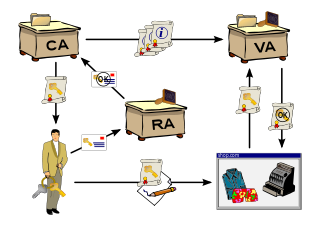
A public key infrastructure (PKI) is a set of roles, policies, hardware, software and procedures needed to create, manage, distribute, use, store and revoke digital certificates and manage public-key encryption. The purpose of a PKI is to facilitate the secure electronic transfer of information for a range of network activities such as e-commerce, internet banking and confidential email. It is required for activities where simple passwords are an inadequate authentication method and more rigorous proof is required to confirm the identity of the parties involved in the communication and to validate the information being transferred.
In cryptography, a public key certificate, also known as a digital certificate or identity certificate, is an electronic document used to prove the validity of a public key. The certificate includes information about the key, information about the identity of its owner, and the digital signature of an entity that has verified the certificate's contents. If the signature is valid, and the software examining the certificate trusts the issuer, then it can use that key to communicate securely with the certificate's subject. In email encryption, code signing, and e-signature systems, a certificate's subject is typically a person or organization. However, in Transport Layer Security (TLS) a certificate's subject is typically a computer or other device, though TLS certificates may identify organizations or individuals in addition to their core role in identifying devices. TLS, sometimes called by its older name Secure Sockets Layer (SSL), is notable for being a part of HTTPS, a protocol for securely browsing the web.
S/MIME is a standard for public-key encryption and signing of MIME data. S/MIME is on an IETF standards track and defined in a number of documents, most importantly RFC 3369, 3370, 3850 and 3851. It was originally developed by RSA Data Security, and the original specification used the IETF MIME specification with the de facto industry standard PKCS #7 secure message format. Change control to S/MIME has since been vested in the IETF, and the specification is now layered on Cryptographic Message Syntax (CMS), an IETF specification that is identical in most respects with PKCS #7. S/MIME functionality is built into the majority of modern email software and interoperates between them. Since it is built on CMS, MIME can also hold an advanced digital signature.
Key management refers to management of cryptographic keys in a cryptosystem. This includes dealing with the generation, exchange, storage, use, crypto-shredding (destruction) and replacement of keys. It includes cryptographic protocol design, key servers, user procedures, and other relevant protocols.
Proof of work (PoW) is a form of cryptographic proof in which one party proves to others that a certain amount of a specific computational effort has been expended. Verifiers can subsequently confirm this expenditure with minimal effort on their part. The concept was invented by Moni Naor and Cynthia Dwork in 1993 as a way to deter denial-of-service attacks and other service abuses such as spam on a network by requiring some work from a service requester, usually meaning processing time by a computer. The term "proof of work" was first coined and formalized in a 1999 paper by Markus Jakobsson and Ari Juels.
A remote, online, or managed backup service, sometimes marketed as cloud backup or backup-as-a-service, is a service that provides users with a system for the backup, storage, and recovery of computer files. Online backup providers are companies that provide this type of service to end users. Such backup services are considered a form of cloud computing.

LogMeIn Hamachi is a virtual private network (VPN) application developed and released in 2004 by Alex Pankratov. It is capable of establishing direct links between computers that are behind network address translation (NAT) firewalls without requiring reconfiguration. Like other VPNs, it establishes a connection over the Internet that emulates the connection that would exist if the computers were connected over a local area network (LAN).

A hardware security module (HSM) is a physical computing device that safeguards and manages secrets, performs encryption and decryption functions for digital signatures, strong authentication and other cryptographic functions. These modules traditionally come in the form of a plug-in card or an external device that attaches directly to a computer or network server. A hardware security module contains one or more secure cryptoprocessor chips.
Bigtable is a fully managed wide-column and key-value NoSQL database service for large analytical and operational workloads as part of the Google Cloud portfolio.
A mobile signature is a digital signature generated either on a mobile phone or on a SIM card on a mobile phone.
There are a number of security and safety features new to Windows Vista, most of which are not available in any prior Microsoft Windows operating system release.
A Digital Postmark (DPM) is a technology that applies a trusted time stamp issued by a postal operator to an electronic document, validates electronic signatures, and stores and archives all non-repudiation data needed to support a potential court challenge. It guarantees the certainty of date and time of the postmarking. This global standard was renamed the Electronic Postal Certification Mark (EPCM) in 2007 shortly after a new iteration of the technology was developed by Microsoft and Poste Italiane. The key addition to the traditional postmarking technology was integrity of the electronically postmarked item, meaning any kind of falsification and tampering will be easily and definitely detected. Additionally, content confidentiality is guaranteed since document certification is carried out without access or reading by the postal operator. The EPCM will eventually be available through the UPU to all international postal operators in the 191 member countries willing to be compliant with this standard, thus granting interoperability in certified communications between postal operators. In the United States, the US Postal Service operates a non-global standard called the Electronic Postmark, although it is soon expected to provide services utilizing the EPCM.
Mobile device management (MDM) is the administration of mobile devices, such as smartphones, tablet computers, and laptops. MDM is usually implemented with the use of a third-party product that has management features for particular vendors of mobile devices. Though closely related to Enterprise Mobility Management and Unified Endpoint Management, MDM differs slightly from both: unlike MDM, EMM includes mobile information management, BYOD, mobile application management and mobile content management, whereas UEM provides device management for endpoints like desktops, printers, IoT devices, and wearables as well.
The ANSI X9.95 standard for trusted timestamps expands on the widely used RFC 3161 - Internet X.509 Public Key Infrastructure Time-Stamp Protocol by adding data-level security requirements that can ensure data integrity against a reliable time source that is provable to any third party. Applicable to both unsigned and digitally signed data, this newer standard has been used by financial institutions and regulatory bodies to create trustworthy timestamps that cannot be altered without detection and to sustain an evidentiary trail of authenticity. Timestamps based on the X9.95 standard can be used to provide:
Trusted timestamping is the process of securely keeping track of the creation and modification time of a document. Security here means that no one—not even the owner of the document—should be able to change it once it has been recorded provided that the timestamper's integrity is never compromised.
Privacy-enhancing technologies (PET) are technologies that embody fundamental data protection principles by minimizing personal data use, maximizing data security, and empowering individuals. PETs allow online users to protect the privacy of their personally identifiable information (PII), which is often provided to and handled by services or applications. PETs use techniques to minimize an information system's possession of personal data without losing functionality. Generally speaking, PETs can be categorized as hard and soft privacy technologies.
PAdES is a set of restrictions and extensions to PDF and ISO 32000-1 making it suitable for advanced electronic signatures (AdES). This is published by ETSI as EN 319 142.
Cloud computing security or, more simply, cloud security refers to a broad set of policies, technologies, applications, and controls utilized to protect virtualized IP, data, applications, services, and the associated infrastructure of cloud computing. It is a sub-domain of computer security, network security, and, more broadly, information security.
Datain use is an information technology term referring to active data which is stored in a non-persistent digital state typically in computer random-access memory (RAM), CPU caches, or CPU registers.
References
- Directive 2006/24/EC of the European Parliament
- Weatech
- USPTO patent 20060053294