
The Kosovo War was an armed conflict in Kosovo that lasted from 28 February 1998 until 11 June 1999. It was fought between the forces of the Federal Republic of Yugoslavia, which controlled Kosovo before the war, and the Kosovo Albanian rebel group known as the Kosovo Liberation Army (KLA). The conflict ended when the North Atlantic Treaty Organization (NATO) intervened by beginning air strikes in March 1999 which resulted in Yugoslav forces withdrawing from Kosovo.
The United Nations Interim Administration Mission in Kosovo (UNMIK) is the officially mandated mission of the United Nations in Kosovo. The UNMIK describes its mandate as being to "help the United Nations Security Council achieve an overall objective, namely, to ensure conditions for a peaceful and normal life for all inhabitants of Kosovo and advance regional stability in the Western Balkans."
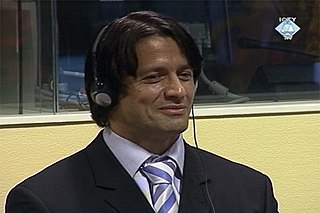
Naser Orić is a former Bosnian military officer who commanded Army of the Republic of Bosnia and Herzegovina (ARBiH) forces in the Srebrenica enclave in eastern Bosnia surrounded by Bosnian Serb forces, during the Bosnian War.

The Republic of Serbian Krajina or Serb Republic of Krajina, known as the Serbian Krajina or simply Krajina, was a self-proclaimed Serb proto-state, a territory within the newly independent Republic of Croatia, which it defied, and which was active during the Croatian War of Independence (1991–95). It was not recognized internationally. The name Krajina ("Frontier") was adopted from the historical Military Frontier of the Habsburg monarchy (Austria-Hungary), which had a substantial Serb population and existed up to the late 19th century. The RSK government waged a war for ethnic Serb independence from Croatia and unification with the Federal Republic of Yugoslavia and Republika Srpska.
The Battle of Borovo Selo of 2 May 1991, known in Croatia as the Borovo Selo massacre and in Serbia as the Borovo Selo incident, was one of the first armed clashes in the conflict which became known as the Croatian War of Independence. The clash was precipitated by months of rising ethnic tensions, violence, and armed combat in Pakrac and at the Plitvice Lakes in March. The immediate cause for the confrontation in the heavily ethnic Serb village of Borovo Selo, just north of Vukovar, was a failed attempt to replace the Yugoslav flag in the village with the flag of Croatia. The unauthorised effort by four Croatian policemen resulted in the capture of two by a Croatian Serb militia in the village. To retrieve the captives, the Croatian authorities deployed additional police, who drove into an ambush. Twelve Croatian policemen and one Serb paramilitary were killed before the Yugoslav People's Army (JNA) intervened and put an end to the clashes.

The 1991 protests in Belgrade happened on the streets of Belgrade, the capital of Serbia and Yugoslavia when a protest rally turned into a riot featuring vicious clashes between the protesters and police.
Serbian organized crime or Serbian mafia are various criminal organizations based in Serbia or composed of ethnic Serbs in the former Yugoslavia and Serbian diaspora. The organizations are primarily involved in smuggling, arms trafficking, drug trafficking, human trafficking, assassinations, heists, assault, protection rackets, murder, money laundering and illegal gambling. The mafia is composed of several major organized groups, which in turn have wider networks throughout Europe and across the world.

The Insurgency in the Preševo Valley was an approximately two year-long armed conflict between the Federal Republic of Yugoslavia and the ethnic Albanian separatists of the Liberation Army of Preševo, Medveđa and Bujanovac (UÇPMB). There were instances during the conflict in which the Yugoslav government requested KFOR support in suppressing UÇPMB attacks since they could only use lightly armed military forces as part of the Kumanovo Treaty that ended the Kosovo War, which created a buffer zone between FR Yugoslavia and Kosovo.

The assassination of Archduke Franz Ferdinand was one of the key events that led to World War I. Archduke Franz Ferdinand of Austria, heir presumptive to the Austro-Hungarian throne, and his wife, Sophie, Duchess of Hohenberg, were assassinated on 28 June 1914 by Bosnian Serb student Gavrilo Princip. They were shot at close range while being driven through Sarajevo, the provincial capital of Bosnia-Herzegovina, formally annexed by Austria-Hungary in 1908.

In the winter of 1996–1997, university students and Serbian opposition parties organized a series of peaceful protests in the Republic of Serbia in response to electoral fraud attempted by the Socialist Party of Serbia of President Slobodan Milošević after the 1996 local elections.
The breakup of Yugoslavia was a process in which the Socialist Federal Republic of Yugoslavia was broken up into constituent republics, and over the course of which the Yugoslav wars started. The process generally began with the death of Josip Broz Tito on 4 May 1980 and formally ended when the last two remaining republics proclaimed the Federal Republic of Yugoslavia on 27 April 1992. At that time the Yugoslav wars were still ongoing, and FR Yugoslavia continued to exist until 2003, when it was renamed and reformed as the state union of Serbia and Montenegro. This union lasted until 5 June 2006 when Montenegro proclaimed independence. The former Yugoslav autonomous province of Kosovo subsequently proclaimed independence from Serbia in February 2008.

Slobodan Milošević was a Serbian–Yugoslav politician who was the president of Serbia from 1989 to 1997 and president of the Federal Republic of Yugoslavia from 1997 until his оverthrow in 2000. Formerly a high-ranking member of the League of Communists of Serbia (SKS) during the 1980s, he led the Socialist Party of Serbia from its foundation in 1990 until his death in 2006. Milošević played a major role in the Yugoslav Wars. During his reign, numerous anti-government and anti-war protests took place, and hundreds of thousands deserted the Milošević-controlled Yugoslav People's Army, leading to mass emigration from Serbia. During the NATO bombing of Yugoslavia in 1999, Milošević was charged by the International Criminal Tribunal for the former Yugoslavia (ICTY) for war crimes in connection with the Bosnian War, the Croatian War of Independence, and the Kosovo War. He became the first sitting head of state to be charged with war crimes.

Crime in Serbia includes murder, organised crime, corruption, piracy, false bomb threats and mass shootings among others. It is combated by the Serbian police and other government agencies.
Veljko Radenović was a Serbian police lieutenant colonel, popularly known as "General" for his courage and capability. During the war in Kosovo he was commander of a special police unit from Prizren until the withdrawal of the Yugoslav Army from Kosovo in June 1999.

Liberland, also known as the Free Republic of Liberland, is an unrecognised micronation in Southeast Europe claiming an uninhabited parcel of disputed land on the western bank of the Danube, between Croatia and Serbia. It was proclaimed on 13 April 2015 by the Czech right-libertarian politician and activist Vít Jedlička.
The Border Police is a legal police unit that monitors and protects the borders of North Macedonia. It faced off against 40 armed men on 21 April 2015 with NLA patches. 4 policemen were captured, but were later released.
Vučetić is a Slavic Serbian and Croatian surname derived from the masculine given name Vučeta. It may refer to:

The 2000 unrest in Kosovo was the result of the United Nations Interim Administration adopting Resolution 1244 on 10 June 1999. The unrest was fought between the Kosovo Force (KFOR), Kosovo Albanians, and Kosovo Serbs. It lasted somewhere from 16 February - 6 June 2000. An unknown number of Kosovo Albanians and Kosovo Serbs died along with an unknown number injured, while 1 Russian KFOR soldier died from shot wounds and UNMIK vehicles were burned during the unrest.

On 7 July 2020, a series of protests and riots began over the government announcement of the reimplementation of the curfew and the government's allegedly poor handling of the COVID-19 situation, as well as being a partial continuation of the "One of Five Million" movement. The initial demand of the protesters had been to cancel the planned reintroduction of curfew in Serbia during July, which was successfully achieved in less than 48 hours of the protest. The protesters also demanded a more technical response to the COVID-19 crisis and more factual and constructive information about the ongoing medical situation. Among other causes, the protests were driven by the crisis of democratic institutions under Aleksandar Vučić's rule and the growing concern that the President is concentrating all powers in his hands at the expense of the parliament.
