
Tehran province is one of the 31 provinces of Iran. Its capital is the city of Tehran.

Isfahan or Esfahan/Espahan is a major city in the Central District of Isfahan County, Isfahan province, Iran. It is the capital of the province, the county, and the district. It is located 440 kilometres south of Tehran. The city has a population of approximately 2,220,000, making it the third-most populous city in Iran, after Tehran and Mashhad, and the second-largest metropolitan area.

Mashhad is the second-most-populous city in Iran, located in the relatively remote north-east of the country about 900 kilometres from Tehran. In the Central District of Mashhad County, it serves as the capital of Razavi Khorasan province, the county, and the district. It has a population of about 3,400,000, which includes the areas of Mashhad Taman and Torqabeh.

Agha Mohammad Khan Qajar, also known by his regnal name of Agha Mohammad Shah, was the founder of the Qajar dynasty of Iran, ruling from 1789 to 1797 as Shah. Originally a chieftain of the Quwanlu branch of the Qajar tribe, Agha Mohammad Khan was enthroned as the king of Iran in 1789, but was not officially crowned until March 1796, having deposed Lotf Ali Khan of the Zand dynasty in 1794. Agha Mohammad Khan Qajar was famously the eunuch Monarch, being castrated as a toddler upon his capture by Adel Shah Afshar, and hence was childless. He was assassinated on 17 June 1797, and was succeeded by his nephew, Fath-Ali Shah Qajar.

Kashan is a city in the Central District of Kashan County, in the northern part of Isfahan province, Iran, serving as capital of both the county and the district.

Iranian architecture or Persian architecture is the architecture of Iran and parts of the rest of West Asia, the Caucasus and Central Asia. Its history dates back to at least 5,000 BC with characteristic examples distributed over a vast area from Turkey and Iraq to Uzbekistan and Tajikistan, and from the Caucasus to Zanzibar. Persian buildings vary greatly in scale and function, from vernacular architecture to monumental complexes. In addition to historic gates, palaces, and mosques, the rapid growth of cities such as the capital Tehran has brought about a wave of demolition and new construction.

Mullá Husayn, also known by the honorific Jináb-i Bábu'l-Báb, was a Persian religious figure in 19th century Persia and the first Letter of the Living of the Bábí religion. He was the first person to profess belief in the Báb as the promised Mahdi of Islam and a Manifestation of God, founding a new independent religion. The title of Bábu'l-Báb was bestowed upon him by the Báb in recognition of his status as the first Bábí.

An Iranian architect is traditionally called a mi'mar.
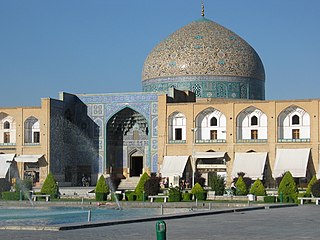
Sheikh Lotfollah Mosque is one of the masterpieces of Iranian architecture that was built during the Safavid Empire, standing on the eastern side of Naqsh-i Jahan Square, Esfahan, Iran. Construction of the mosque started in 1603 and was finished in 1619. It was built by the chief architect Mohammadreza Isfahani, during the reign of Shah Abbas I of Persia. On the advice of Arthur Upham Pope, Reza Shah Pahlavi had the mosque rebuilt and repaired in the 1920s.

Mohammad Ali Foroughi, also known as Zoka-ol-Molk, was an Iranian politician, writer, freemason, Azali, and diplomat who served as the Prime Minister of Iran for three terms. He wrote numerous books on ancient Iranian history and is known for founding the Academy of Iran.
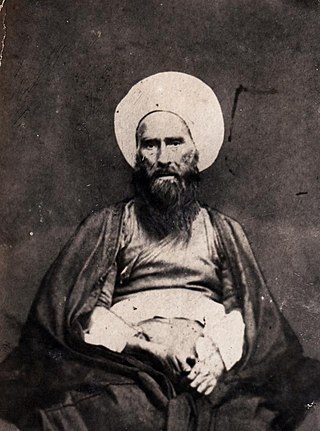
Hadi Sabzavari or Hajj Molla Hadi Sabzavari was an Iranian philosopher, mystic theologian and poet.
Shohada Metro Station may refer to:
Malvajerd is a village in jargaviyeh Olya Rural District, Jargaviyeh Olya District, Isfahan County, Isfahan Province, Iran. At the 2006 census, its population was 904, in 280 families. at the 2018 census, this village population is 815, in 260 families.
The 2013–14 Iranian Futsal Hazfi Cup were the 1st season of the Iranian futsal knockout competition. Mahan Tandis Qom won the title with defeating Misagh Tehran in the final.

The Sepahsālār Mosque is a famous historic mosque in Tehran, Iran. The construction project of the mosque was started in 1879 upon the order of Mirza Hosein Sepahsalar, the Grand Vizir of Iran during Naser al-Din Shah Qajar, and the first phase of construction was finished after five years since it was started. The mosque was renamed the Shahid Motahhari, after the 1979 Iranian Revolution, but it is commonly known as its initial name of Sepahsalar Mosque.

Soltan Mohammad Mirza better known by his honorific title Sayf ol-Dowleh was an Iranian prince of the Qajar dynasty and thirty-ninth son of Fath-Ali Shah, king of Qajar Iran. He was the governor of Isfahan between 1820 and 1835 and contributed to its restoration after the damage it suffered in the civil war between Zand sovereigns and Agha Mohammad Khan, rebuilding several of the Safavid pavilions and designing his own palace.
