Ali Hakemi, M.E. Bayani, Sandro Salvatori, Massimo Vidale, Mir Abedin Kaboli, Nasir Eskandari
Condition
Ruined
Ownership
Public
Publicaccess
Yes
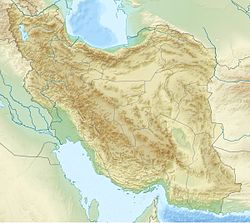
The Shahdad ancient Near East archeological site lies in the north-western edge of the Lut Desert of Kerman Province of southeastern Iran roughly 65 kilometers east of modern Kerman. Initially called "Chale Takab" it has come to be generally known as Shahdad due to the proximity, about five kilometers to the west, of the modern town of Shahdad. Begun on a small scale in the 5th millennium BC the site was primarily occupied in the 3rd millennium BC, Early Bronze Age, and included a large cemetery from the second half of the 3rd millennium BC. Some occupation at the site continued into the early 2nd millennium BC. A single pottery sherd excavated from Shahdad in 1971 had what is thought to be a 6 sign Linear Elamite inscription.[1][2] The site was a major center of metal extraction and processing in the 3rd millennium BC over a peripheral area covering about 9 square kilometers.[3] A single hollow clay envelope containing clay tokens was found at the site.[4] It has been suggested that the Mesopotamian water god Enki was worshiped at the site.[5] Early on it was suggested that Shahdad was the location of 3rd millennium BC city of Šimaški.[6]
Two other sites on the Shahdad Plain, Tepe Dehno and Tepe East Dehno, have also been excavated.[7]
Archaeology
Serpent on a jewelry box from Shahdad, Iran, 2700 BCShahdad bronze flag
The site was first noticed due to erosion revealing graves. It was excavated from 1669 until 1974 by a team led by Ali Hakemi of the Archaeological Service of Iran. One main 100 meters by 50 meters trench (Trench A) and five smaller trenches were opened. This work focused on the graveyard (made up of Cemetery A and Cemetery B), clearing 383 graves, one a chamber tomb with painted walls.[8] Finds, in the cemeteries, included a number of near life sized painted clay statues and over 200 chlorite (soapstone) objects as well as 348 potter's marks on vessels. One important find was the "Standard of Shahdad", a square metal plague. Though a number of cylinder seals ("silver and stone with human, vegetal and animal motifs") and stamp seals were found there were no actual clay sealings at the site.[9][10][11][12] A grave (Grave 30), mudbrick and oriented east/west, excavated from Cemetery A produced a vessel containing "white cosmetic preparation" having a radiocarbon date (calibration method - INTCAL20) of 2923–2667 BC. This is in a portion of the calibration curve considered "unfavorable". Other grave goods included copper/bronze vessels and a copper/bronze pin. One of the jars in the gave had a short (6 signs) possible Linear Elamite inscription. A similar sample in Grave 338, also mudbrick and oriented east/west, produced a more reasonable radiocarbon date of 2500–2300 BC (INTCAL20). Grave goods included a necklace of lapis lazuli, agate, white stone, and copper beads. Metal finds included 10 axes with chased designs, and long pins with geometric designs.[13][14]
A brief surface survey was conducted in 1977.[15] During the survey a 300 foot by 300 foot hill covered with copper smelting debris. Copper being produced contained a small amount of arsenic to strengthen it.[16] A group of 5 mudbrick buildings (site D) was identified in this survey and excavated by A. Hakemi and M.E. Bayani in 1978. It was considered by the excavators to be a metallurgical workshop that had been destroyed in a catastrophic flood. Elaborate ovens found in them were deemed copper-processing furnaces by the excavators. A much later analysis indicated those ovens were actually domestic fireplaces.[17][18]
Bronze Age stone bowl. Ca. 2600-2400 BC. Provenance: Cemetery A tomb 263, in Shahdad, Iran
Excavations were conducted by Mir Abedin Kaboli in four seasons from 1991 until 1995.[19][20][21][22] Work focused on residential areas as well as a "Jewelry area" with "agate and carnelian flakes dumps, with hundreds of unfinished bead and flint drill-heads". A 1970 Corona satellite image taken in 1970 and a 1993 aerial photograph were used to determine the extent and delineation of the site.[23][24]
In January 2009 dark green-grey chlorite cylindrical vessel (15.5 centimeters long and 3.6 centimeters wide) dated to the middle of the 3rd millennium BC was found on the surface at the site. The vessel had traces of a lead carbonate based cosmetic.[25]
In 2016 a team of archaeologists with a topographer, led by Nasir Eskandari, did a 2 week walking surface survey of the site which produced a new high resolution topographic map. Thirty test trenches were excavated on the peripheries of areas identified in the surface survey. Results indicated that the 170 hectare occupation area was actually made up of 18 settled areas separated by unsettled spaces forming a distributed occupation.[18]
History
Shahdad ware bronze fish
First occupied on a small scale in the 5th millennium BC with a small mound then at a small mound further westward in the 4th millennium BC. The site was primarily occupied in the later half of the 3rd millennium BC (between 2500 and c. 1900 BC) further to the west and included a large cemetery from that period. In that period it reached its maximum area of 80 to 100 hectares. After some modest occupation in the 2nd millennium BC the settlement was then abandoned. There is surface evidence of an Islamic period settlement and a small oasis village currently exists.[25][26]
Based largely on pottery but also due to mistaking the Linear Elamite (late 3rd millennium BC) inscription as being Proto-Elamite (early 3rd millennium BC) the first excavator proposed a phasing of cultural periods and subperiods, a chronology which is now largely discounted.[5]
TAK IV2 - 3300–2700 BC, TAK IV1 - 2700–2500 BC
TAK III2 - 2500–2200 BC, TAK III1 - 2200–1900 BC
TAK II2 - 1900–1700 BC, TAK II1 - 1700–1500 BC
TAK I - 1500 BC–?
Current thinking places the stratigraphy of the site somewhat later.[27]
↑Hinz, W., "Eine altelamische Tonkrug-Aufschrift vom Rande der Lut", Archäologische Mitteilungen aus Iran IV, pp. 21-24, 1971
↑Klochkov, I.S., "Signs On a Potsherd From Gonur (On the Question of the Script Used in Margiana)", Ancient Civilizations from Scythia to Siberia, 5(3), pp. 165-177, 1999
↑Emami, Mohammadamin, et al., "Tracing the pyro-technological evidence during the 3rd millennium bc in “Shahdad” through archaeometallurgical remains= Shahdad Kr. e. 3. évezredi pirotechnológiai bizonyítékainak nyomon követése az archeometallurgiai maradványok által", Archeometriai Műhely 21.3, pp. 253-264, 2024
↑Schmandt-Besserat, Denise, "The Envelopes That Bear the First Writing", Technology and Culture, vol. 21, no. 3, pp. 357–85, 1980
12Negari, Fariba Mosapour, "From Drought to Deity: Borrowing Freshwater Worship in Third Millennium BCE Shahdad", Studia mythologica Slavica 27, pp. 147-171, 2024
↑Potts, Daniel, "Puzur-Inšušinak and the Oxus Civilization (BMAC): Reflections on Šimaški and the geo-political landscape of Iran and Central Asia in the Ur III period", Zeitschrift für Assyriologie und Vorderasiatische Archäologie, vol. 98, no. 2, pp. 165-194, 2008
↑Eskandari, Nasir, "Excavations at the Prehistoric Sites of Tepe Dehno and Tepe East Dehno, Shahdad, South-eastern Iran", Iranian Journal of Archaeological Studies 7.1, pp. 16-33, 2017
↑Kleiss, Wolfram, et al., "Survey of Excavations in Iran 1971-72", Iran, vol. 11, pp. 185–214, 1973
↑Hakemi, A., "Kavosh-ha-ye Hashiye Dasht-e-Lut: Kashf-e- Tamadon-e- Pish az Tarikh dar Khabis, Shahdad. Journal of Art and People 126, 75–83,
↑Hakemi, A., Shahdad, "Archaeological Excavations of a Bronze Age Center in Iran. Translated and edited by S. M. S. Sajjadi. With an Introduction by Pierre Amiet and a Postscriptum by Sandro Salvatori and Maurizio Tosi", Istituto Italiano per il Medio ed Estremo Oriente, Centro Scavi e Ricerche Archeologiche. Reports and Memoirs Vol. XXVII, New Delhi, 1997
↑Hakemi, A., "Kerman: the original place of production of chlorite stone objects in the third millennium BC", East and West 47/1-4, pp. 11–40, 1997
↑Hakemi, A., "Report of Eight Seasons of Survey and Excavation at Shahdad (Dasht-i- Lut) 1969–1976", Tehran: Cultural Heritage, Handicrafts and Tourism Organization Research Institute, 2006
↑Eskandari, Nasir, et al., "New Radiocarbon Evidence from Shahdad and the Earliest Datable Linear Elamite Text", Zeitschrift für Assyriologie und vorderasiatische Archäologie 115.2, pp. 123-136, 2025
↑Karlovsky, CC Lamberg, "The relation of the finds from Shahdad to those of sites in Central Asia", Journal of the Ancient Near Eastern Society 21.1, pp. 135-140, 1992
↑Salvatori, S. & M. Vidale, "A brief surface survey of the proto-historic site of Shahdad (Kerman, Iran): preliminary report", Rivista di Archeologia VI, pp. 5-10, 1982
↑Lawler, Andrew, "The World in Between.” Archaeology, vol. 64, no. 6, pp. 24–31, 2011
↑Hakemi, A., The Copper Smelting Furnaces of the Bronze Age in Shahdad", in C. Jarrige, ed. (1992) South Asian Archaeology 1989. Papers from the Tenth International Conference of South Asia Archaeologists in Western Europe, Musée national des Arts asiatiques, Guimet, Paris, France, 3-7 July 1989, Madison, WI, pp. 119-132, 1992
12Eskandari, Nasir, Kamal Aldin Niknami, and Massimo Vidale, "The Bronze Age Center of Shahdad, SE Iran:" hollow" vs. nucleated early urban models in the light of site formation processes", East and West, pp. 31-46, 2021
↑Kaboli, M. A., "Shahdad", in Cities of Iran edited by M. Y. Kiani, Tehran, pp. 66-106, 1989 (in Persian)
↑Kaboli, M. A., "Dasht-e Lut Archaeological Expedition: Excavations at the Ancient Site of Shahdad, Preliminary Report on the Tenth Campaign", Archaeological Reports, Iranian Archaeological Research Center, Tehran, pp. 89-124, 1997 (in Persian)
↑1/Kaboli, M. A., "Dasht-e Lut Archaeological Expedition: Excavations at the Ancient Site of Shahdad, Preliminary Report on the Eleventh Campaign 1994/1373", azhouhesh nameh 2, pp. 239-266, 2001 (in Persian)
↑Kaboli, M. A., "Dasht-e Lut Archaeological Expedition: Excavations at the Ancient Site of Shahdad, Preliminary Report on the Twelfth Campaign 1995/1374," azhouhesh nameh 4, pp. 141-181, 2002 (in Persian)
↑Curtis, Vesta Sarkhosh, and St. John Simpson, "Archaeological News from Iran: Second Report", Iran, vol. 36, pp. 185–94, 1998
↑Curtis, Vesta Sarkhosh, and St. John Simpson, "Archaeological News from Iran", Iran, vol. 35, pp. 137–44, 1997
12Vidale, Massimo, et al., "A chlorite container found on the surface of shahdad (Kerman, Iran) and its cosmetic content", Iran 50.1, pp. 27-44, 2012
↑Vidale, Massimo, and Nasir Eskandari, "The Bronze age center of Shahdad, SE Iran:" hollow" vs. nucleated early urban processes", EAST AND WEST, pp. 31-46, 2021
↑Eskandaridamne, Nasir, "A Landscape Archaeology in Shahdad Plain (Dasht-e Lut) from the 5th to the 2nd Millennium BC", Dissertation, Université de Lyon; University of Teheran, 2021
Further reading
Amiet, Pierre, "Antiquités du désert de Lut. — II", Revue d’Assyriologie et d’archéologie Orientale, vol. 70, no. 1, pp. 1–8, 1976
Amiet, Pierre, "Antiquités du désert de Lut: A Propos d’objets de La Collection Foroughi", Revue d’Assyriologie et d’archéologie Orientale, vol. 68, no. 2, pp. 97–110, 1974
Basafa, Hassan, Mohammad Sadegh Davari, and Nasir Eskandari, "Analytical Study of the Cenotaph Burial Tradition in Eastern Iran: Case Study of the Sites of Shahr-i Sokhta, Shahdad (Khabis), and Khunaman", pp. 129-144, 2025
Dehno, Soraya Elikay, et al., "Unveiling Shahdad: Exploring ancient copper reserves and metallurgical practices on Iran's Southeast Plateau", L'Anthropologie 129.1, 103343, 2025
Entezarian, Mohsen, and Mohammad Ghamari Fatideh, "Shahdad and Tepe Yahya: Dual Perspectives on Trade and Cultural Interaction in the Third Millennium BCE in Eastern Iran; A Study of Economic and Cultural Structures Based on Archaeological Evidence", Parseh Journal of Archaeological Studies 9.33, pp. 83-113, 2025
Eskandari, N., "Regional Patterns of Early Bronze Age Urbanization in the Southeastern Iran. New Discoveries on the Western Fringe of Dasht-e Lut", in J.W. Meyer, E. Vila, M. Mashkour, M. Casanova, R. Vallet, eds. The Iranian Plateau during the Bronze Age. Development of Urbanisation, Production and Trade, pp. 201-216. Lyon, 2019
Hakemi, A., "Decouverte d'une civilization Prehistorique a Shahdad au bord ouest du Lut, Kerman", in M. Kiani, ed., The Memorial Volume of the 6th International Congress of Iranian Art and Archaeology, Oxford 1972, Tehran, pp. 135-50, 1976
Meier, David, and Massimo Vidale, "The “Man with Serpents” revisited. On a Figurated Pin from the Bronze Age Site of Shahdad (Kerman, Iran)", Iranian journal of archaeological studies 3.1, pp. 1-9, 2013
Meier, David Mathias Philip, "Preliminary archaeometallurgical investigations of Bronze Age metal finds from Shahdad and Tepe Yahya", Iranian Journal of Archaeological Studies 1.2, pp. 25-34, 2011
Nashli, Hassan Fazeli, Fariba Mosapour Negari, and Bahman Firoozmandi Shirejin, "Craft Specialization at Shahdad: Pottery Production during the third millennium BC", Iran Journal of Archaeological Studies 2.2, pp. 83-93, 2012
Razani, Mehdi, "Introduction and Critique of the Book: Anthropomorphic Clay Statues from Shahdad: Searching for Art, Ritual and Symbolism in Bronze Age Iran", Heritage of Southwest Asia 2.2: e6, 2025
Sajjadi, Seyed, and Seyed Mansour, "Shahdad Chlorites, Iran", Sinus Persicus 2.4, pp. 3-35, 2025
Salvatori, S., "Problemi di Protostoria iranica: note ulteriori su di una ricognizione di superficie a Shahdad (Kerman Iran)", Rivista di Archeologia, II, 1978
Sarhaddi-Dadian, Hossein, et al., "Structure and Architecture of Graves in South East Iran: Ethnic Diversity and Migration in the 3rd Millennium BCE", Central Asiatic Journal, vol. 62, no. 2, pp. 175–92, 2019
This page is based on this Wikipedia article Text is available under the CC BY-SA 4.0 license; additional terms may apply. Images, videos and audio are available under their respective licenses.