
Cell biology is a branch of biology that studies the structure and function of the cell, which is the basic unit of life. Cell biology is concerned with the physiological properties, metabolic processes, signaling pathways, life cycle, chemical composition and interactions of the cell with their environment. This is done both on a microscopic and molecular level as it encompasses prokaryotic cells and eukaryotic cells. Knowing the components of cells and how cells work is fundamental to all biological sciences; it is also essential for research in bio-medical fields such as cancer, and other diseases. Research in cell biology is closely related to genetics, biochemistry, molecular biology, immunology and cytochemistry.
Morphology, from the Greek and meaning "study of shape", may refer to:
Platonic realism is a philosophical term usually used to refer to the idea of realism regarding the existence of universals or abstract objects after the Greek philosopher Plato. As universals were considered by Plato to be ideal forms, this stance is ambiguously also called Platonic idealism. This should not be confused with idealism as presented by philosophers such as George Berkeley: as Platonic abstractions are not spatial, temporal, or mental, they are not compatible with the later idealism's emphasis on mental existence. Plato's Forms include numbers and geometrical figures, making them a theory of mathematical realism; they also include the Form of the Good, making them in addition a theory of ethical realism.

Theoretical chemistry is a branch of chemistry, which develops theoretical generalizations that are part of the theoretical arsenal of modern chemistry, for example, the concept of chemical bonding, chemical reaction, valence, the surface of potential energy, molecular orbitals, orbital interactions, molecule activation etc.

In the mathematical theory of tessellations, a prototile is one of the shapes of a tile in a tessellation.

Symmetry in everyday language refers to a sense of harmonious and beautiful proportion and balance. In mathematics, "symmetry" has a more precise definition, that an object is invariant to any of various transformations; including reflection, rotation or scaling. Although these two meanings of "symmetry" can sometimes be told apart, they are related, so in this article they are discussed together.

A pattern is a regularity in the world, man-made design, or abstract ideas. As such, the elements of a pattern repeat in a predictable manner. A geometric pattern is a kind of pattern formed of geometric shapes and typically repeated like a wallpaper design.
Gestalt psychology or gestaltism is a philosophy of mind of the Berlin School of experimental psychology. Gestalt psychology is an attempt to understand the laws behind the ability to acquire and maintain meaningful perceptions in an apparently chaotic world. The central principle of gestalt psychology is that the mind forms a global whole with self-organizing tendencies.
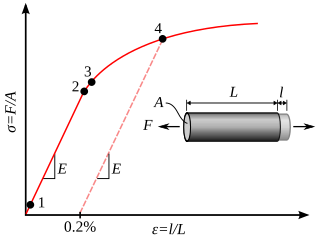
In physics and materials science, plasticity describes the deformation of a (solid) material undergoing non-reversible changes of shape in response to applied forces. For example, a solid piece of metal being bent or pounded into a new shape displays plasticity as permanent changes occur within the material itself. In engineering, the transition from elastic behavior to plastic behavior is called yield.
In physics, elasticity is the ability of a body to resist a distorting influence and to return to its original size and shape when that influence or force is removed. Solid objects will deform when adequate forces are applied to them. If the material is elastic, the object will return to its initial shape and size when these forces are removed.

An airfoil or aerofoil is the cross-sectional shape of a wing, blade, or sail.
An approximation is anything that is similar but not exactly equal to something else.
Solid mechanics is the branch of continuum mechanics that studies the behavior of solid materials, especially their motion and deformation under the action of forces, temperature changes, phase changes, and other external or internal agents.

An afterimage is an image that continues to appear in one's vision after the exposure to the original image has ceased. An afterimage may be a normal phenomenon or may be pathological (palinopsia). Illusory palinopsia may be a pathological exaggeration of physiological afterimages. Afterimages occur because photochemical activity in the retina continues even when the subject is no longer experiencing the original stimulus.
Visual design elements and principles describe fundamental ideas about the practice of visual design.
The best designers sometimes disregard the principles of design. When they do so, however, there is usually some compensating merit attained at the cost of the violation. Unless you are certain of doing as well, it is best to abide by the principles.
In probability theory and statistics, a shape parameter is a kind of numerical parameter of a parametric family of probability distributions.

A pedicel is a stem that attaches a single flower to the inflorescence. In the absence of a pedicel, the flowers are described as sessile. Pedicel is also applied to the stem of the infructescence. The word "pedicel" is derived from the latin pediculus, meaning "little foot".
The Nelson–Aalen estimator is a non-parametric estimator of the cumulative hazard rate function in case of censored data or incomplete data. It is used in survival theory, reliability engineering and life insurance to estimate the cumulative number of expected events. An "event" can be the failure of a non-repairable component, the death of a human being, or any occurrence for which the experimental unit remains in the "failed" state from the point at which it changed on. The estimator is given by
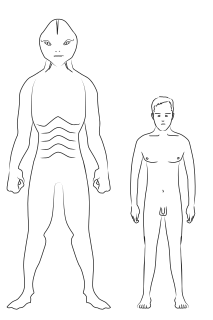
Reptilian humanoids or simply, reptilians are purported humanoids with the characteristics of reptiles that play a prominent role in fantasy, science fiction, ufology, and conspiracy theories. The idea of reptilians was popularised by David Icke, a conspiracy theorist who claims shape-shifting reptilian aliens control Earth by taking on human form and gaining political power to manipulate human societies. Icke has stated on multiple occasions that many world leaders are, or are possessed by, so-called reptilians.

