
A trust is a legal relationship in which the holder of a right gives it to another person or entity who must keep and use it solely for another's benefit. In the Anglo-American common law, the party who entrusts the right is known as the "settlor", the party to whom the right is entrusted is known as the "trustee", the party for whose benefit the property is entrusted is known as the "beneficiary", and the entrusted property itself is known as the "corpus" or "trust property". A testamentary trust is created by a will and arises after the death of the settlor. An inter vivos trust is created during the settlor's lifetime by a trust instrument. A trust may be revocable or irrevocable; an irrevocable trust can be "broken" (revoked) only by a judicial proceeding.
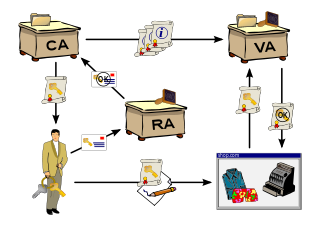
A public key infrastructure (PKI) is a set of roles, policies, hardware, software and procedures needed to create, manage, distribute, use, store and revoke digital certificates and manage public-key encryption. The purpose of a PKI is to facilitate the secure electronic transfer of information for a range of network activities such as e-commerce, internet banking and confidential email. It is required for activities where simple passwords are an inadequate authentication method and more rigorous proof is required to confirm the identity of the parties involved in the communication and to validate the information being transferred.
In property law, title is an intangible construct representing a bundle of rights in (to) a piece of property in which a party may own either a legal interest or equitable interest. The rights in the bundle may be separated and held by different parties. It may also refer to a formal document, such as a deed, that serves as evidence of ownership. Conveyance of the document may be required in order to transfer ownership in the property to another person. Title is distinct from possession, a right that often accompanies ownership but is not necessarily sufficient to prove it. In many cases, possession and title may each be transferred independently of the other. For real property, land registration and recording provide public notice of ownership information.
In English law, a fee simple or fee simple absolute is an estate in land, a form of freehold ownership. A "fee" is a vested, inheritable, present possessory interest in land. A "fee simple" is real property held without limit of time under common law, whereas the highest possible form of ownership is a "fee simple absolute," which is without limitations on the land's use.
In English common law, fee tail or entail is a form of trust, established by deed or settlement, that restricts the sale or inheritance of an estate in real property and prevents that property from being sold, devised by will, or otherwise alienated by the tenant-in-possession, and instead causes it to pass automatically, by operation of law, to an heir determined by the settlement deed. The term fee tail is from Medieval Latin feodum talliatum, which means "cut(-short) fee". Fee tail deeds are in contrast to "fee simple" deeds, possessors of which have an unrestricted title to the property, and are empowered to bequeath or dispose of it as they wish. Equivalent legal concepts exist or formerly existed in many other European countries and elsewhere.
In common law and statutory law, a life estate is the ownership of immovable property for the duration of a person's life. In legal terms, it is an estate in real property that ends at death when ownership of the property may revert to the original owner, or it may pass to another person. The owner of a life estate is called a "life tenant".
A mortgage is a legal instrument of the common law which is used to create a security interest in real property held by a lender as a security for a debt, usually a mortgage loan. Hypothec is the corresponding term in civil law jurisdictions, albeit with a wider sense, as it also covers non-possessory lien.
An estate in land is, in the law of England and Wales, an interest in real property that is or may become possessory. It is a type of personal property and encompasses land ownership, rental and other arrangements that give people the right to use land. This is distinct from sovereignty over the land, which includes the right to government and taxation.
An estate, in common law, is the net worth of a person at any point in time, alive or dead. It is the sum of a person's assets – legal rights, interests and entitlements to property of any kind – less all liabilities at that time. The issue is of special legal significance on a question of bankruptcy and death of the person.

A portable or mobile toilet is any type of toilet that can be moved around, some by one person, some by mechanical equipment such as a truck and crane. Most types do not require any pre-existing services or infrastructure, such as sewerage, but are completely self-contained. The portable toilet is used in a variety of situations, for example in urban slums of developing countries, at festivals, for camping, on boats, on construction sites, and at film locations and large outdoor gatherings where there are no other facilities. Most portable toilets are unisex single units with privacy ensured by a simple lock on the door. Some portable toilets are small molded plastic or fiberglass portable rooms with a lockable door and a receptacle to catch the human excreta in a container.

Undue influence (UI) is a psychological process by which a person's free will and judgement is supplanted by that of another. It is a legal term and the strict definition varies by jurisdiction. Generally speaking, it is a means by which a person gains control over their victims' decision making through manipulation tactics and unfair pressure, typically for financial gain. Historically, UI has been poorly understood, even in some legal circles.

A Massachusetts Business Trust (MBT) is a legal trust set up for the purposes of business, but not necessarily one that is operated in the Commonwealth of Massachusetts. They may also be referred to as an unincorporated business organization or UBO. Business trusts may be established under the laws of other U.S. states.
Breach of trust is a type of civil wrong in English trust law.

The President of Cantabria, according to the Autonomy Statute of Cantabria, presides over the Government of Cantabria, directs its activities, coordinates the Administration of the autonomous community, designates and separates the regional ministers, and holds the supreme representation of the autonomous community and ordinary representation of the State in Cantabria. The president is elected by the Parliament of Cantabria among its members, and is appointed by the King of Spain.
In common law jurisdictions such as England and Wales, Australia, Canada, and Ireland, a freehold is the common mode of ownership of real property, or land, and all immovable structures attached to such land. It is in contrast to a leasehold, in which the property reverts to the owner of the land after the lease period expires or otherwise lawfully terminates. For an estate to be a freehold, it must possess two qualities: immobility and ownership of it must be forever. If the time of ownership can be fixed and determined, it cannot be a freehold. It is "An estate in land held in fee simple, fee tail or for term of life."

Expedition Engineering is a London-based consulting firm, delivering structural engineering services.
Crime & Punishment is a police drama television program created by Dick Wolf that ran for 6 episodes on NBC from March 3, 1993, to April 7, 1993. With the exceptions of the first and last episodes, which aired on Wednesdays, the show occupied the 10 p.m. slot of the network's Thursday-night "The Best Night of Television on Television" programming block, a timeslot occupied for the rest of the 1992-1993 season by the 7th season of L.A. Law.
