
Mabo v Queensland is a landmark decision of the High Court of Australia that recognised the existence of Native Title in Australia. It was brought by Eddie Mabo against the State of Queensland and decided on 3 June 1992. The case is notable for being the first in Australia to recognise pre-colonial land interests of Indigenous Australians within the common law of Australia.

Thurgood Marshall was an American civil rights lawyer and jurist who served as an associate justice of the Supreme Court of the United States from 1967 until 1991. He was the Supreme Court's first African-American justice. Prior to his judicial service, he was an attorney who fought for civil rights, leading the NAACP Legal Defense and Educational Fund. Marshall was a prominent figure in the movement to end racial segregation in American public schools. He won 29 of the 32 civil rights cases he argued before the Supreme Court, culminating in the Court's landmark 1954 decision in Brown v. Board of Education, which rejected the separate but equal doctrine and held segregation in public education to be unconstitutional. President Lyndon B. Johnson appointed Marshall to the Supreme Court in 1967. A staunch liberal, he frequently dissented as the Court became increasingly conservative.
The High Court of Australia is Australia's apex court. It exercises original and appellate jurisdiction on matters specified within Australia's Constitution.
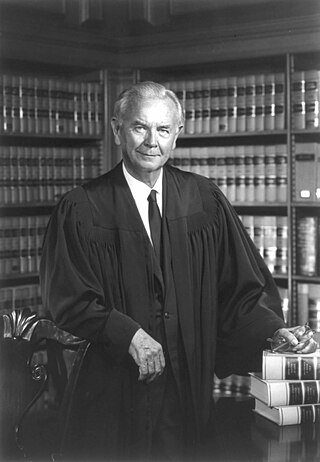
William Joseph Brennan Jr. was an American lawyer and jurist who served as an Associate Justice of the Supreme Court of the United States from 1956 to 1990. He was the seventh-longest serving justice in Supreme Court history, and known for being a leader of the U.S. Supreme Court's liberal wing.

Sir Ninian Martin Stephen was an English-born Australian judge who served as the 20th governor-general of Australia, in office from 1982 to 1989. He was previously a justice of the High Court of Australia from 1972 to 1982.
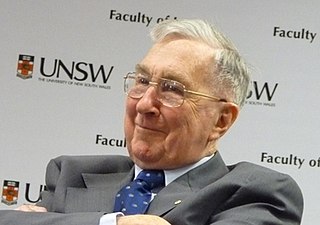
Sir Francis Gerard Brennan was an Australian lawyer and jurist who served as the 10th Chief Justice of Australia. As a judge in the High Court of Australia, he wrote the lead judgement on the Mabo decision, which gave rise to the Native Title Act.
Native title is the designation given to the common law doctrine of Aboriginal title in Australia, which is the recognition by Australian law that Indigenous Australians have rights and interests to their land that derive from their traditional laws and customs. The concept recognises that in certain cases there was and is a continued beneficial legal interest in land held by Indigenous peoples which survived the acquisition of radical title to the land by the Crown at the time of sovereignty. Native title can co-exist with non-Aboriginal proprietary rights and in some cases different Aboriginal groups can exercise their native title over the same land.
Sir Harry Talbot Gibbs, was Chief Justice of the High Court of Australia from 1981 to 1987 after serving as a member of the High Court between 1970 and 1981. He was known as one of Australia's leading federalist judges although he presided over the High Court when decisions such as Koowarta v Bjelke-Petersen in 1982 and Commonwealth v Tasmania expanded the powers of the Commonwealth at the expense of the states. Gibbs dissented from the majority verdict in both cases. On 3 August 2012, the Supreme Court of Queensland Library opened the Sir Harry Gibbs Legal Heritage Centre. It is the only legal heritage museum of its kind in Queensland and features a permanent exhibition dedicated to the life and legacy of Sir Harry Gibbs.

Sir Anthony Frank MasonHonFAIB DistFRSN is an Australian judge who served as the ninth Chief Justice of Australia, in office from 1987 to 1995. He was first appointed to the High Court in 1972, having previously served on the Supreme Court of New South Wales.

The Chief Justice of South Africa is the most senior judge of the Constitutional Court and head of the judiciary of South Africa, who exercises final authority over the functioning and management of all the courts.
Frank Tenison Brennan SJ AO is an Australian Jesuit priest, human rights lawyer and academic. He is known for his 1998 involvement in the Wik debate when Paul Keating called him "the meddling priest" and the National Trust classified him as a Living National Treasure. Brennan has a longstanding reputation of advocacy in the areas of law, social justice, refugee protection, Aboriginal reconciliation and human rights activism.
Sir Keith Arthur Aickin, was an Australian judge who served on the High Court of Australia from 1976 until his death in 1982. He had previously been a prominent barrister.
Elizabeth Andreas Evatt, an eminent Australian reformist lawyer and jurist who sat on numerous national and international tribunals and commissions, was the first Chief Justice of the Family Court of Australia, the first female judge of an Australian federal court, and the first Australian to be elected to the United Nations Human Rights Committee.

The Yorta Yorta, also known as Jotijota, are an Aboriginal Australian people who have traditionally inhabited the area surrounding the junction of the Goulburn and Murray Rivers in present-day north-eastern Victoria and southern New South Wales.
Margaret Mary Cunneen is an Australian barrister, prosecutor and commissioner of a government inquiry.

Catherine Margaret Branson is a former Australian judge and public servant. She was a judge of the Federal Court of Australia from 1994 to 2008, and then President of the Australian Human Rights Commission from 2008 to 2012.

Sir Richard Arthur Blackburn, was an Australian judge, prominent legal academic and military officer. He became a judge of three courts in Australia, and eventually became chief justice of the Australian Capital Territory. In the 1970s he decided one of Australia's earliest Aboriginal Land rights cases. His service to the Australian legal community is commemorated by the annual Sir Richard Blackburn Memorial lectures in Canberra.
Sir Maurice Hearne Byers was a noted Australian jurist and constitutional expert. He was the Commonwealth Solicitor-General from 1973 to 1983, in which capacity he played a role in the Gair Affair and the 1975 Australian constitutional crisis. He had an unmatched record of success in his appearances before the High Court of Australia, and he has been characterised as the finest lawyer never to have been appointed to the High Court.
Michael H. v. Gerald D., 491 U.S. 110 (1989), was a case decided by the Supreme Court of the United States involving substantive due process in the context of paternity law. Splitting five to four, the Court rejected a challenge to a California law that presumed that a married woman's child was a product of that marriage, holding that the due-process rights of a man who claimed to be a child's biological father had not been violated.
