
SMS Zrínyi was a Radetzky-class semi-dreadnought battleship (Schlachtschiff) of the Austro-Hungarian Navy, named for the Zrinski, a Croatian-Hungarian noble family. Zrínyi and her sisters, Erzherzog Franz Ferdinand and Radetzky, were the last pre-dreadnoughts built for the Austro-Hungarian Navy.

The provinces of Italy are the second-level administrative divisions of the Italian Republic, on an intermediate level between a municipality and a region. Since 2015, provinces have been classified as "institutional bodies of second level".
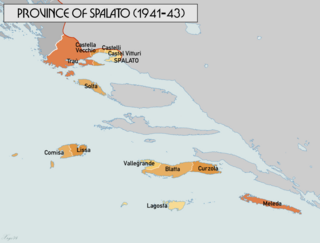
Province of Spalato was a province of the Italian Governorate of Dalmatia, created in May 1941 during World War II. It lasted until September 1943.

The first USS Israel (DD-98) was a Wickes-class destroyer in the United States Navy during World War I and the years following.

The first USS Lansdale (DD-101) was a Wickes-class destroyer in the United States Navy during World War I and later designated, DM-6 in the years following. She was named in honor of Philip Van Horne Lansdale.

Krbava is a historical region located in Mountainous Croatia and a former Catholic bishopric (1185–1460), precursor of the diocese of Modruš and present Latin titular see.

The Governorate of Dalmatia was an administrative division of the Kingdom of Italy, established in 1941, following the military conquest of Yugoslavian Dalmatia by General Vittorio Ambrosio, during World War II. It had the provisional purpose of progressively importing Italian national legislation in Dalmatia in place of the previous one, thus fully integrating it into the Kingdom of Italy.

Angelo Antonio Frari was a Dalmatian Italian physician, who served as the municipal physician and the head of the lazaretto of Split, province of Spalato (1806–1821), the protomedicus, and the president of the Maritime Health Magistrate of Venice (1835–1843), famous epidemiologist and historian of medicine.

Split ; Italian: Spalato: pronounced[ˈspalato] see other names), is the second-largest city of Croatia after the capital Zagreb, the largest city in Dalmatia and the largest city on the Croatian coast. It lies on the eastern shore of the Adriatic Sea and is spread over a central peninsula and its surroundings. An intraregional transport hub and popular tourist destination, the city is linked to the Adriatic islands and the Apennine Peninsula. More than 900,000 tourists visit Split each year.
The Yugoslav destroyer Split was a large destroyer designed for the Royal Yugoslav Navy in the late 1930s. Construction began in 1939, but she was captured incomplete by the Italians during the invasion of Yugoslavia in April 1941. They continued to build the ship, barring a brief hiatus, but she was not completed before she was scuttled after the Italian surrender in September 1943. The Germans occupied Split and refloated the destroyer later that year, but made no efforts to continue work. The ship was scuttled again before the city was taken over by the Yugoslav Partisans in late 1944. Split was refloated once more, but the new Socialist Federal Republic of Yugoslavia was able to do little with her before the Tito–Stalin Split in 1948 halted most work. Aid and equipment from the United States and the United Kingdom finally allowed her to be completed 20 years after construction began. She was commissioned in July 1958 and served as the navy's flagship for most of her career. Split became a training ship in the late 1970s after a boiler explosion. She was decommissioned in 1980, and scrapped six years later.

The Bombardment of Ancona was a naval engagement of the Adriatic Campaign of World War I between the navies of Italy and Austria-Hungary. Forces of the Imperial and Royal Navy attacked and bombarded military and civilian targets all across Ancona in central Italy and several other nearby islands and communities in response to Italy's declaration of war on Austria-Hungary.

In 1918–1920, a series of violent fights took place in the city of Split between Croats and Italians, culminating in a struggle on 11 July 1920 that resulted in the deaths of Captain Tommaso Gulli of the Italian protected cruiser Puglia, Croat civilian Matej Miš, and Italian sailor Aldo Rossi. The incidents were the cause of the destruction in Trieste of the Slovenian Cultural Centre by Italian Fascists.

Antonio Tacconi was a Dalmatian Italian politician.

The Province of Zara was a province of the Kingdom of Italy, officially from 1918 to 1947. In 1941 it was enlarged and made part of the Italian Governorate of Dalmatia, during World War II, until 1943.
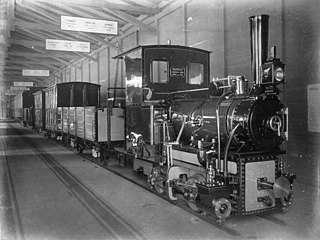
Most Bosnian-gauge railway lines were built during the Austro-Hungarian Empire. Several 760 mm gauge railways were planned in order to link the extensive narrow-gauge railways in the Austro-Hungarian Empire with those in Bosnia and Herzegovina. Until the outbreak of the Balkan Wars in 1912 several were constructed.
The following is a timeline of the history of the city of Split, Croatia.

SMS Spalato was a torpedo cruiser of the Austro-Hungarian Navy, the second member of the Zara class. She was laid down in September 1878, launched in August 1879, and commissioned in September 1881. Too slow to be used in her intended roles as a fleet scout and a flotilla leader, she was immediately taken ashore for several modifications to her propulsion system in an unsuccessful attempt to rectify the problem. As a result, she saw little active service, being used primarily for training purposes. She served in the artillery training school for most of the period between 1897 and 1914. During World War I, she served as a guard ship in Pola, and after the war was ceded to Italy as a war prize. She was broken up for scrap sometime thereafter.
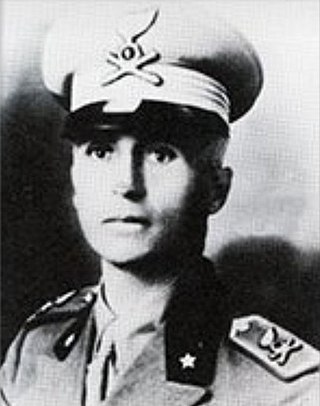
Salvatore Pelligra was an Italian general during World War II. He was brother of General Raffaele Pelligra, who commanded the Guardia di Finanza from 1947 to 1953.
This page is based on this
Wikipedia article Text is available under the
CC BY-SA 4.0 license; additional terms may apply.
Images, videos and audio are available under their respective licenses.

