
The family Psittacidae or parrots is one of three families of true parrots. It comprises the roughly 10 species of subfamily Psittacinae and 157 of subfamily Arinae, as well as several species that have gone extinct in recent centuries. Some of the most iconic birds in the world are represented here, such as the blue-and-gold macaw among the New World parrots and the grey parrot among the Old World parrots.

Pionus is a genus of medium-sized parrots native to Mexico, and Central and South America. Characteristic of the genus are the chunky body, bare eye ring, and short square tail. They are superficially similar to Amazon parrots, but smaller and in flight their wing-strokes are far deeper. Coloration is generally subdued yet complex compared to member species of the genus Amazona; under bright lighting, their feathers shimmer with iridescent brilliance. All species share bright red undertail coverts; the scientific name of one species, the blue-headed parrot, refers to this. Males and females are similar, with no notable sexual dimorphism.
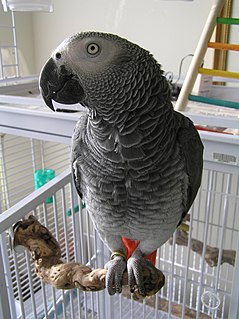
A companion parrot is a parrot kept as a pet that interacts abundantly with their human counterpart. Generally, most species of parrot can make excellent companions.

The orange-winged amazon, also known locally as orange-winged parrot and loro guaro, is a large amazon parrot. It is a resident breeding bird in tropical South America, from Colombia, Trinidad and Tobago south to Peru, Bolivia and central Brazil. Its habitat is forest and semi-open country. Although common, it is persecuted as an agricultural pest and by capture for the pet trade. It is also hunted as a food source. Introduced breeding populations have been reported in Puerto Rico and Tenerife in the Canary Islands.

The blue-headed parrot, also known as the blue-headed pionus is a medium-sized parrot of about 27 cm in length. The body is mostly green, with a blue head and neck, and red undertail coverts. It is a resident in tropical and subtropical South America and southern Central America, from Costa Rica, Venezuela and Trinidad south to Bolivia and Brazil.

The yellow-faced parrot, formerly also known as the yellow-faced amazon, is the only species of the genus Alipiopsitta. It is a Neotropical parrot, and was classified in the genus Amazona for many years. It is a predominantly green and yellow-plumaged bird with a yellow head. It is a semi-nomadic species found in the cerrado region of Brazil and adjacent Bolivia. As the yellow-faced parrot has disappeared from parts of its former range due to habitat destruction and generally occurs in low densities, it was considered vulnerable by the IUCN, but it remains locally fairly common, occurs in several protected areas and can survive in fragmented habitats, leading to its downlisting to near-threatened.

The short-tailed parrot is the only species of the genus Graydidascalus. It is found along both banks of the Amazon river and other major Amazonian rivers in Brazil, Colombia, Bolivia, Ecuador and Peru. As suggested by its range, it is associated with the specific forest and woodland types growing near major rivers, although it also extends into the coastal deltas of French Guiana and Amapá, Brazil.

The neotropical parrots or New World parrots comprise about 150 species in 32 genera found throughout South and Central America, Mexico, and the Caribbean islands. They are also present on a few Pacific islands such as the Galápagos. Among them are some of the most familiar and iconic parrots, including the blue and gold macaw, sun conure, and yellow-headed amazon.

The white-crowned parrot, also known as the white-crowned pionus in aviculture, is a small parrot which is a resident breeding species from eastern Mexico to western Panama.

The red-fronted parrot, also known as Jardine's parrot, is a medium-sized mainly green parrot distributed across wide areas of Africa. It has three subspecies. The extent and shade of the red or orange plumage on its head, thighs, and bend of wings vary depending on the subspecies.

A feral parrot is a parrot that has adapted to life in an ecosystem to which it is not native. The birds are often descended from pets that have escaped or been deliberately released. Many species of parrots are highly social, and like to gather in large flocks. Not all feral parrots are able to adapt to life outside of captivity, although having a pre-existing nearby parrot colony can assist with the adaptation process.
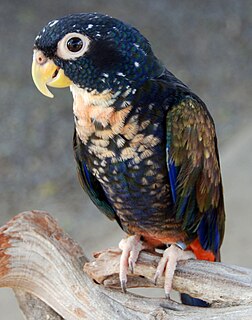
The bronze-winged parrot is a medium-sized pionus parrot 28 cm (11 in) long. It is a short-tailed stocky parrot found in forest and woodland in north-western South America.

Cyanoliseus is a genus of parrot that contains a single living species, the burrowing parrot (Cyanoliseus patagonus).

The dusky parrot or dusky pionus is a medium-sized mainly dark brownish-gray parrot of the genus Pionus in the true parrot family.
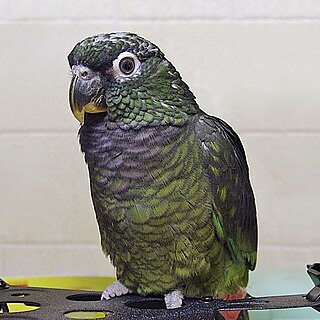
The scaly-headed parrot is a species of bird in the family Psittacidae, the true parrots. It is also called scaly-headed pionus, Maximilian pionus, Maximilian parrot, Maximilian's pionus, or Maximilian's parrot.

The red-billed parrot also known as coral-billed pionus or red-billed pionus is a species of parrot in the family Psittacidae. It is found in humid subtropical forests in the Venezuelan Coastal Range, Sierra Nevada de Santa Marta, and in the Andes from Colombia in north to Bolivia in south. Uniquely for a member of the genus Pionus, its bill is almost entirely bright red. The plumage is greenish with a dull blue chest and red undertail coverts.

The plum-crowned parrot is a South American species of parrot from the humid Andean forests from centra Peru, to Bolivia. It was formerly considered to be conspecific with the white-capped parrot. Before the split the common name of the combined taxa was "speckle-faced parrot". The two were originally described as separate species, are morphologically distinctive, and there is no evidence of intergradation, but this in itself is not remarkable, as their distributions are separated by a gap of approx. 150 km.

Parrots, also known as psittacines, are birds of the roughly 398 species in 92 genera comprising the order Psittaciformes, found mostly in tropical and subtropical regions. The order is subdivided into three superfamilies: the Psittacoidea, the Cacatuoidea (cockatoos), and the Strigopoidea. One-third of all parrot species are threatened by extinction, with higher aggregate extinction risk than any other comparable bird group. Parrots have a generally pantropical distribution with several species inhabiting temperate regions in the Southern Hemisphere, as well. The greatest diversity of parrots is in South America and Australasia.

Birds of Eden is the world's largest free flight aviary and bird sanctuary, located in Kurland village near Plettenberg Bay in the Western Cape, South Africa. The mesh dome of the sanctuary was built over 2.3 hectares of indigenous forest, and is up to 55 metres (180 ft) above ground level. 1.2 kilometres (0.75 mi) of walkways, about 75% of which are elevated, let visitors see the birds at all levels of the aviary.
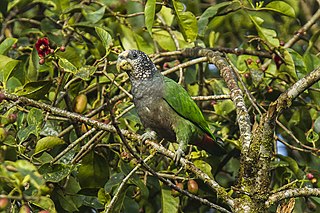
The white-capped parrot is a bird in the family Psittacidae formerly considered conspecific with the speckle-faced parrot . The species is found in the Andes mountains from northwestern Venezuela, through Colombia and Ecuador, to northern Peru.
