
Trout is the common name for a number of species of freshwater fish belonging to the genera Oncorhynchus, Salmo and Salvelinus, all of the subfamily Salmoninae of the family Salmonidae. The word trout is also used as part of the name of some non-salmonid fish such as Cynoscion nebulosus, the spotted seatrout or speckled trout.

Salmonidae is a family of ray-finned fish, the only living family currently placed in the order Salmoniformes. It includes salmon, trout, chars, freshwater whitefishes, and graylings, which collectively are known as the salmonids. The Atlantic salmon and trout of the genus Salmo give the family and order their names.
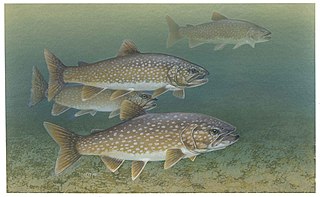
Lake trout is a freshwater char living mainly in lakes in northern North America. Other names for it include mackinaw, namaycush, lake char (or charr), touladi, togue, and grey trout. In Lake Superior, it can also be variously known as siscowet, paperbelly and lean. The lake trout is prized both as a game fish and as a food fish. Those caught with dark coloration may be called mud hens.
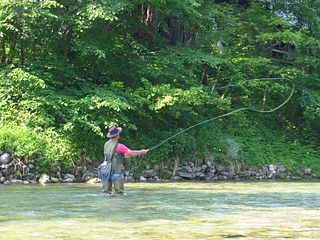
Fly fishing is an angling method in which an artificial "fly" is used to catch fish. The fly is cast using a fly rod, reel, and specialized weighted line. Casting a nearly weightless fly or "lure" requires casting techniques significantly different from other forms of casting. Fly fishermen use hand tied flies that resemble natural invertebrates, baitfish, other food organisms, or "lures" to provoke the fish to strike.

The brown trout is a European species of salmonid fish that has been widely introduced into suitable environments globally. It includes both purely freshwater populations, referred to as the riverine ecotype, Salmo trutta morpha fario, and a lacustrine ecotype, S. trutta morpha lacustris, also called the lake trout, as well as anadromous forms known as the sea trout, S. trutta morpha trutta. The latter migrates to the oceans for much of its life and returns to fresh water only to spawn. Sea trout in the Ireland and Britain have many regional names: sewin in Wales, finnock in Scotland, peal in the West Country, mort in North West England, and white trout in Ireland.
The bull trout is a char of the family Salmonidae native to northwestern North America. Historically, S. confluentus has been known as the "Dolly Varden", but was reclassified as a separate species in 1980. Bull trout are listed as a threatened species under the U.S. Endangered Species Act (1998) and as vulnerable on the IUCN Red List of Threatened Species.

The rainbow trout is a trout and species of salmonid native to cold-water tributaries of the Pacific Ocean in Asia and North America. The steelhead is an anadromous (sea-run) form of the coastal rainbow trout (O. m. irideus) or Columbia River redband trout (O. m. gairdneri) that usually returns to fresh water to spawn after living two to three years in the ocean. Freshwater forms that have been introduced into the Great Lakes and migrate into tributaries to spawn are also called steelhead.

The cutthroat trout (Oncorhynchus clarkii) is a fish species of the family Salmonidae native to cold-water tributaries of the Pacific Ocean, Rocky Mountains, and Great Basin in North America. As a member of the genus Oncorhynchus, it is one of the Pacific trout, a group that includes the widely distributed rainbow trout. Cutthroat trout are popular gamefish, especially among anglers who enjoy fly fishing. The common name "cutthroat" refers to the distinctive red coloration on the underside of the lower jaw. The specific name clarkii was given to honor explorer William Clark, coleader of the Lewis and Clark Expedition.

The Apache trout, Oncorhynchus apache, is a species of freshwater fish in the salmon family of order Salmoniformes. It is one of the Pacific trouts.

Sea trout is the common name usually applied to anadromous forms of brown trout, and is often referred to as Salmo trutta morpha trutta. Other names for anadromous brown trout are sewin (Wales), peel or peal, mort, finnock (Scotland), white trout (Ireland) and salmon trout (culinary). The term sea trout is also used to describe other anadromous salmonids—coho salmon, brook trout, Arctic char, cutthroat trout and Dolly Varden. Even some non-salmonid species are also commonly known as sea trout—Northern pikeminnow and members of the weakfish family (Cynoscion).
Salmo trutta fario, sometimes called the river trout, and also known by the name of its parent species, the brown trout, is a predatory fish of the Salmonidae family and a subspecies or morph of the brown trout species, Salmo trutta, which also includes sea trout and a lacustrine trout. Depending on the supply of food, river trout measure 20 to 80 cm (0.7–2.6 ft) in length; exceptionally they may be up to 1 m (3.3 ft) long and weigh up to over 13 kg (29 lb). Their back is olive-dark brown and silvery blue, red spots with light edges occur towards the belly, the belly itself is whitish yellow. River trout usually attains a weight of up to 2 kg (4.4 lb). They can live for up to 18 years.
Trout Fishing in America is a musical duo which performs folk rock and children's music. The duo is composed of Keith Grimwood and Ezra Idlet. They took their name from the novel Trout Fishing in America by Richard Brautigan.

The Yellowstone cutthroat trout
is a subspecies of the cutthroat trout. It is a freshwater fish in the salmon family. Native only to a few U.S. states, their original range was upstream of Shoshone Falls on the Snake River and tributaries in Wyoming, also across the Continental Divide in Yellowstone Lake and in the Yellowstone River as well as its tributaries downstream to the Tongue River in Montana. The species is also found in Idaho, Utah and Nevada.

Freshwater fish are those that spend some or all of their lives in fresh water, such as rivers and lakes, with a salinity of less than 0.05%. These environments differ from marine conditions in many ways, the most obvious being the difference in levels of salinity. To survive fresh water, the fish need a range of physiological adaptations.

The westslope cutthroat trout, also known as the black-spotted trout, common cutthroat trout and red-throated trout is a subspecies of the cutthroat trout and is a freshwater fish in the salmon family of order Salmoniformes. The cutthroat is the Montana state fish. This subspecies is a species of concern in its Montana and British Columbia ranges and is considered threatened in its native range in Alberta.

The coral trout, leopard coral grouper, or leopard coral trout is a species of fish in the Serranidae family. Native to the western Pacific Ocean, its natural habitat includes open seas and coral reefs. Coral trout are piscivorous; juveniles mostly eat crustaceans, especially prawns, and adults feed upon a variety of reef fish, particularly damselfish.
Salmo platycephalus, known as the flathead trout, Ala balik or the Turkish trout, is a type of trout, a fish in the Salmonidae family. It is endemic to south-eastern Turkey. It is known only from one population, which occupies three streams, tributaries of the Zamantı River in the Seyhan River basin. The population itself is abundant, but subject to threat by habitat loss, since the range is small. Also, predation of juveniles by introduced rainbow trout may cause population decline. The species is classified as critically endangered.


