This article is being considered for deletion in accordance with Wikipedia's deletion policy. Please share your thoughts on the matter at this article's entry on the Articles for deletion page. Feel free to improve the article, but the article must not be blanked, and this notice must not be removed, until the discussion is closed. For more information, particularly on merging or moving the article during the discussion, read the guide to deletion. |
| |
| Established | 1970 |
|---|---|
Director | Norbert D’Souza, SJ |
| Affiliations | Jesuit, Catholic |
| Website | NepJesServ |
St. Xavier Social Center, Nepal, began as St. Xavier's Social Service Residence in 1970, servicing street children, and extended its services to those with substance abuse. Over the years it expanded to several Jesuit, social service initiatives in Nepal. In accord with Nepalese law, proselytizing has been notably absent from the Jesuit mission to Nepal, in spite of heavy Jesuit investment in education in this country that remains in the "least developed" category. [1]
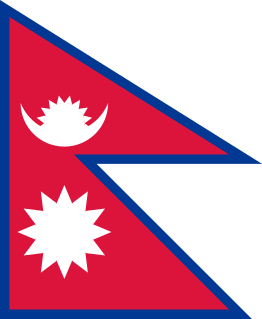
Nepal, officially the Federal Democratic Republic of Nepal, is a landlocked country in South Asia. It is located mainly in the Himalayas but also includes parts of the Indo-Gangetic Plain. With an estimated population of 26.4 million, it is 48th largest country by population and 93rd largest country by area. It borders China in the north and India in the south, east, and west while Bangladesh is located within only 27 km (17 mi) of its southeastern tip and Bhutan is separated from it by the Indian state of Sikkim. Nepal has a diverse geography, including fertile plains, subalpine forested hills, and eight of the world's ten tallest mountains, including Mount Everest, the highest point on Earth. Kathmandu is the nation's capital and largest city. Nepal is a multiethnic nation with Nepali as the official language.
The Government took positive preliminary steps with respect to religious freedom during the period covered by this report, and government policy contributed to the generally free practice of religion. The Interim Parliament, through the Interim Constitution, officially declared the country a secular state in January 2007; however, no laws specifically affecting freedom of religion were changed. Nonetheless, many believed that the declaration made it easier to practice their religion freely.
In 1970 Fr. Tom Gafney, S.J., picked up on the work of two French graduate students who had harbored nine street boys, [2] and expanded his work until the time of his murder in the Jesuit residence in 1997. By that time he had purchased a house accommodating 80 street children near St. Xavier's School, Jawalakhel, opened Nakipot Farm Center for boys with blindness, tuberculosis or leprosy, and founded Freedom Center for the rehabilitation of young drug addicts. Nepal has been a world-prominent drug center, and this has wreaked havoc with the country's youth. [3] Gafney's pioneering work exposing and decrying the drug problem in Nepal was from the start an embarrassment to the government. Until the 1990s Gafney's was the only drug treatment and rehabilitation center in a country whose official position was that there was no problem. [2] His services reached city-wide, with special attention to the young and drug addicts. After completing his term as superior at Xavier he began full-time work with the needy, serving also as their spokesman and advocate, and heavily involved in counselling. [4]
St. Xavier's School (Est-1951) was the first academic institution established by the Society of Jesus (Jesuits) in Nepal. Currently, it consists of student cohorts in twelve levels of study and operates an elementary school, a middle school, and a high school under a single administration. One of the oldest private schools in the country, St. Xavier's has historically been considered an elite institution, often attracting students from the upper crust of Nepal's society. The school's alumni have traditionally occupied high ranking positions within the government, bureaucracy, military or distinguished themselves nationally in other professions.
By 2011 the Freedom Center housed 28 men ages 18-24 and continued as a residential center for those suffering from drug dependency, as well as a continuing support for those who have passed through the program. Nakhipot Farm Center houses 25 men with serious diseases or mental illness. The men are taught income-generating skills like poultry farming, and the making of rope and chalk. They may stay at the center until they become self-sufficient and obtain a job. The center's goal is to expand to where it can reach more of the rural people who have problems with addiction or are physically or mentally handicapped, as well as orphans. [5]
Coordinates: 27°40′28.86″N85°18′49.7″E / 27.6746833°N 85.313806°E

A geographic coordinate system is a coordinate system that enables every location on Earth to be specified by a set of numbers, letters or symbols. The coordinates are often chosen such that one of the numbers represents a vertical position and two or three of the numbers represent a horizontal position; alternatively, a geographic position may be expressed in a combined three-dimensional Cartesian vector. A common choice of coordinates is latitude, longitude and elevation. To specify a location on a plane requires a map projection.