C is a general-purpose computer programming language. It was created in the 1970s by Dennis Ritchie, and remains very widely used and influential. By design, C's features cleanly reflect the capabilities of the targeted CPUs. It has found lasting use in operating systems, device drivers, and protocol stacks, but its use in application software has been decreasing. C is commonly used on computer architectures that range from the largest supercomputers to the smallest microcontrollers and embedded systems.
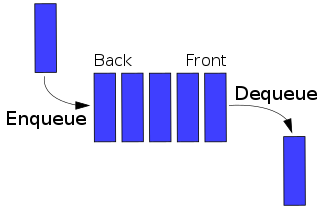
In computing and in systems theory, first in, first out, acronymized as FIFO, is a method for organizing the manipulation of a data structure where the oldest (first) entry, or "head" of the queue, is processed first.
In computer science, a linked list is a linear collection of data elements whose order is not given by their physical placement in memory. Instead, each element points to the next. It is a data structure consisting of a collection of nodes which together represent a sequence. In its most basic form, each node contains data, and a reference to the next node in the sequence. This structure allows for efficient insertion or removal of elements from any position in the sequence during iteration. More complex variants add additional links, allowing more efficient insertion or removal of nodes at arbitrary positions. A drawback of linked lists is that data access time is a linear function of the number of nodes for each linked list because nodes are serially linked so a node needs to be accessed first to access the next node. Faster access, such as random access, is not feasible. Arrays have better cache locality compared to linked lists.
In computing, a segmentation fault or access violation is a fault, or failure condition, raised by hardware with memory protection, notifying an operating system (OS) the software has attempted to access a restricted area of memory. On standard x86 computers, this is a form of general protection fault. The operating system kernel will, in response, usually perform some corrective action, generally passing the fault on to the offending process by sending the process a signal. Processes can in some cases install a custom signal handler, allowing them to recover on their own, but otherwise the OS default signal handler is used, generally causing abnormal termination of the process, and sometimes a core dump.
In computer programming, a reference is a value that enables a program to indirectly access a particular data, such as a variable's value or a record, in the computer's memory or in some other storage device. The reference is said to refer to the datum, and accessing the datum is called dereferencing the reference. A reference is distinct from the datum itself.

In computer science, a stack is an abstract data type that serves as a collection of elements, with two main operations:

Historically, the classic Mac OS used a form of memory management that has fallen out of favor in modern systems. Criticism of this approach was one of the key areas addressed by the change to Mac OS X.
In computer science, a smart pointer is an abstract data type that simulates a pointer while providing added features, such as automatic memory management or bounds checking. Such features are intended to reduce bugs caused by the misuse of pointers, while retaining efficiency. Smart pointers typically keep track of the memory they point to, and may also be used to manage other resources, such as network connections and file handles. Smart pointers were first popularized in the programming language C++ during the first half of the 1990s as rebuttal to criticisms of C++'s lack of automatic garbage collection.
C dynamic memory allocation refers to performing manual memory management for dynamic memory allocation in the C programming language via a group of functions in the C standard library, namely malloc, realloc, calloc, aligned_alloc and free.
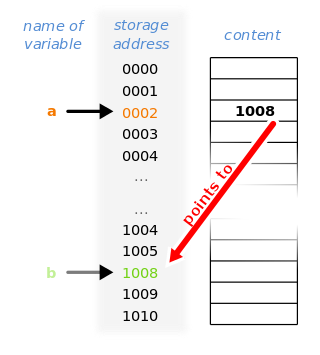
In computer science, a pointer is an object in many programming languages that stores a memory address. This can be that of another value located in computer memory, or in some cases, that of memory-mapped computer hardware. A pointer references a location in memory, and obtaining the value stored at that location is known as dereferencing the pointer. As an analogy, a page number in a book's index could be considered a pointer to the corresponding page; dereferencing such a pointer would be done by flipping to the page with the given page number and reading the text found on that page. The actual format and content of a pointer variable is dependent on the underlying computer architecture.
A stale pointer bug, otherwise known as an aliasing bug, is a class of subtle programming errors that can arise in code that does dynamic memory allocation, especially via the malloc function or equivalent.
Buffer overflow protection is any of various techniques used during software development to enhance the security of executable programs by detecting buffer overflows on stack-allocated variables, and preventing them from causing program misbehavior or from becoming serious security vulnerabilities. A stack buffer overflow occurs when a program writes to a memory address on the program's call stack outside of the intended data structure, which is usually a fixed-length buffer. Stack buffer overflow bugs are caused when a program writes more data to a buffer located on the stack than what is actually allocated for that buffer. This almost always results in corruption of adjacent data on the stack, which could lead to program crashes, incorrect operation, or security issues.
F Word or The F Word may refer to:

Dangling pointers and wild pointers in computer programming are pointers that do not point to a valid object of the appropriate type. These are special cases of memory safety violations. More generally, dangling references and wild references are references that do not resolve to a valid destination.
In computing, a null pointer or null reference is a value saved for indicating that the pointer or reference does not refer to a valid object. Programs routinely use null pointers to represent conditions such as the end of a list of unknown length or the failure to perform some action; this use of null pointers can be compared to nullable types and to the Nothing value in an option type.
Relocation is the process of assigning load addresses for position-dependent code and data of a program and adjusting the code and data to reflect the assigned addresses. Prior to the advent of multiprocess systems, and still in many embedded systems, the addresses for objects were absolute starting at a known location, often zero. Since multiprocessing systems dynamically link and switch between programs it became necessary to be able to relocate objects using position-independent code. A linker usually performs relocation in conjunction with symbol resolution, the process of searching files and libraries to replace symbolic references or names of libraries with actual usable addresses in memory before running a program.
In human–computer interaction, a cursor is an indicator used to show the current position on a computer monitor or other display device that will respond to input.
In software, a stack buffer overflow or stack buffer overrun occurs when a program writes to a memory address on the program's call stack outside of the intended data structure, which is usually a fixed-length buffer. Stack buffer overflow bugs are caused when a program writes more data to a buffer located on the stack than what is actually allocated for that buffer. This almost always results in corruption of adjacent data on the stack, and in cases where the overflow was triggered by mistake, will often cause the program to crash or operate incorrectly. Stack buffer overflow is a type of the more general programming malfunction known as buffer overflow. Overfilling a buffer on the stack is more likely to derail program execution than overfilling a buffer on the heap because the stack contains the return addresses for all active function calls.
Memory safety is the state of being protected from various software bugs and security vulnerabilities when dealing with memory access, such as buffer overflows and dangling pointers. For example, Java is said to be memory-safe because its runtime error detection checks array bounds and pointer dereferences. In contrast, C and C++ allow arbitrary pointer arithmetic with pointers implemented as direct memory addresses with no provision for bounds checking, and thus are potentially memory-unsafe.

