
Alan Mathison Turing was an English mathematician, computer scientist, logician, cryptanalyst, philosopher, and theoretical biologist. Turing was highly influential in the development of theoretical computer science, providing a formalisation of the concepts of algorithm and computation with the Turing machine, which can be considered a model of a general-purpose computer. He is widely considered to be the father of theoretical computer science and artificial intelligence.
Alan Turing (1912–1954) was a British mathematician, logician, cryptanalyst and computer scientist.

Sackville Gardens is a public space in Manchester, England. It is bounded by Manchester College's Shena Simon Campus on one side and Whitworth Street, Sackville Street, the Rochdale Canal and Canal Street on the others.

The Alan Turing Memorial, situated in Sackville Gardens in Manchester, England, is a sculpture in memory of Alan Turing, a pioneer of modern computing.

John Sampson Macfarlane Leech is a British Liberal Democrat politician who was Member of Parliament for Manchester Withington from 2005 to 2015. Since 2016, he has represented Didsbury West on Manchester City Council.

King's College Boat Club is the rowing club for members of King's College, Cambridge. The first record of King’s rowing is in 1838.

Stephen Kettle is a British sculptor who works exclusively with slate.

The Alan Turing Building, named after the mathematician and founder of computer science Alan Turing, is a building at the University of Manchester, in Manchester, England. It houses the School of Mathematics, the Photon Science Institute and the Jodrell Bank Centre for Astrophysics (JBCA). The building is located in the Chorlton-on-Medlock district of Manchester, on Upper Brook Street, and is adjacent to University Place and the Henry Royce Institute.
The Turing test is a test of a machine's ability to exhibit intelligent behaviour by Alan Turing.
The Alan Turing Year, 2012, marked the celebration of the life and scientific influence of Alan Turing during the centenary of his birth on 23 June 1912. Turing had an important influence on computing, computer science, artificial intelligence, developmental biology, and the mathematical theory of computability and made important contributions to code-breaking during the Second World War. The Alan Turing Centenary Advisory committee (TCAC) was originally set up by Professor Barry Cooper

The fourth plinth is the northwest plinth in Trafalgar Square in central London. It was originally intended to hold an equestrian statue of William IV, but remained bare due to insufficient funds. For over 150 years the fate of the plinth was debated; in 1998, the Royal Society for the encouragement of Arts, Manufactures and Commerce (RSA) commissioned three contemporary sculptures to be displayed temporarily on the plinth. Shortly afterwards, Chris Smith, Secretary of State for Culture, Media and Sport, commissioned Sir John Mortimer to seek opinions from public art commissioners, critics and members of the public as to the future of the plinth.
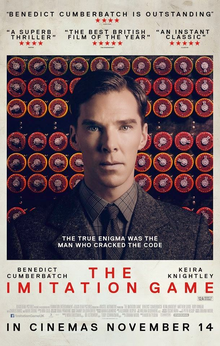
The Imitation Game is a 2014 American period biographical thriller film directed by Morten Tyldum and written by Graham Moore, based on the 1983 biography Alan Turing: The Enigma by Andrew Hodges.

The Alan Turing Institute is the United Kingdom's national institute for data science and artificial intelligence, founded in 2015 and largely funded by the UK government. It is named after Alan Turing, the British mathematician and computing pioneer.
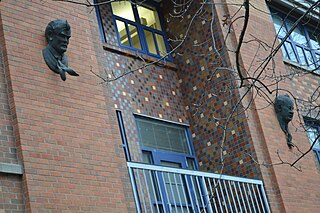
Alan Turing, sometimes spelled Allen Turing and also known as Allen Turing Gargoyle, is an outdoor 1988 hammered copper sheet sculpture of Alan Turing by Wayne Chabre, installed on the exterior of Deschutes Hall on the University of Oregon campus in Eugene, Oregon, in the United States. The portrait face in high relief measures approximately 3 feet (0.91 m) x 1.5 feet (0.46 m) x 1.5 feet (0.46 m) and cost $2,500. Its condition was undetermined when the Smithsonian Institution surveyed the work as part of its "Save Outdoor Sculpture!" program in March 1993.

The "Alan Turing law" is an informal term for the law in the United Kingdom, contained in the Policing and Crime Act 2017, which serves as an amnesty law to pardon men who were cautioned or convicted under historical legislation that outlawed homosexual acts. The provision is named after Alan Turing, the World War II codebreaker and computing pioneer, who was convicted of gross indecency in 1952. Turing received a royal pardon posthumously in 2013. The law applies in England and Wales.

A statue of Alan Turing, created in slate by Stephen Kettle in 2007, is located at Bletchley Park in England as part of an exhibition that honours Turing (1912–1954). It was commissioned by the American businessman and philanthropist Sidney Frank (1919–2006).
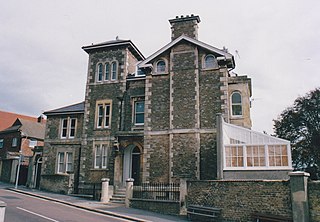
Baston Lodge is a residential villa in St Leonards-on-Sea, Hastings, East Sussex, southern England.
Alan Turing was an English mathematician, computer scientist, logician, cryptanalyst, philosopher, and theoretical biologist. He left an extensive legacy in mathematics, science, society and popular culture.
