
The Scout movement, also known as Scouting or the Scouts, is a voluntary non-political educational movement for young people. Although it requires an oath of allegiance to a nation's leaders and, in some countries, to a god, it otherwise allows membership without distinction of gender, race or origin in accordance with the principles of its founder, Lord Baden-Powell. The purpose of the Scout Movement is to contribute to the development of young people in achieving their full physical, intellectual, emotional, social and spiritual potentials as individuals, as responsible citizens and as members of their local, national and international communities. During the first half of the twentieth century, the movement grew to encompass three major age groups for boys: Cub Scout, Boy Scout and Rover Scout. In 1910, the Girl Guides was created, encompassing three major age groups for girls: Brownie Guide, Girl Guide and Girl Scout and Ranger Guide. It is one of several worldwide youth organizations.

A Scout is a child, usually 10–18 years of age, participating in the worldwide Scouting movement. Because of the large age and development span, many Scouting associations have split this age group into a junior and a senior section. Scouts are organized into troops averaging 20–30 Scouts under the guidance of one or more Scout Leaders. Troops subdivide into patrols of about 6–8 Scouts and engage in outdoor and special interest activities. Troops may affiliate with local, national, and international organizations. Some national Scouting associations have special interest programs such as Air Scouts, Sea Scouts, outdoor high adventure, Scouting bands, and rider Scouts.

Samuel Augustus Barnett was a Church of England cleric and social reformer who was particularly associated with the establishment of the first university settlement, Toynbee Hall, in east London in 1884. He is often referred to as Canon Barnett, having served as Canon of Westminster Abbey from 1906 until death.

Scouts Canada is a Canadian Scouting association providing programs for young people, aged 5 to 26, with the stated aim "to help develop well rounded youth, better prepared for success in the world.". Scouts Canada, in affiliation with the French-language Association des Scouts du Canada, is a member of the World Organization of the Scout Movement (WOSM). 2019-20 youth membership stood at 53,259, an 18% decline from 64,693 in 2014-15. Over the same period, volunteer numbers also declined 18%, from 20,717 in 2015 to 16,885 in 2020. Scouts Canada has declined significantly in size since its peak: youth membership is down 82% from 288,084 in 1965 and volunteer numbers are down 50% from 33,524 in 1965.

Gilwell Park is a camp site and activity centre for Scouting and Guiding groups, and is the home of leadership training in the Scout movement. The site is also used by schools and other youth organisations and hosts social events such as weddings and birthday parties. The 44 hectare (109 acre) site is in Sewardstonebury, Epping Forest, close to Chingford, London.

The Scout Association is the largest Scouting organisation in the United Kingdom and is the World Organization of the Scout Movement's recognised member for the United Kingdom. Following the origin of Scouting in 1907, the association was formed in 1910 and incorporated in 1912 by a royal charter under its previous name of The Boy Scouts Association.
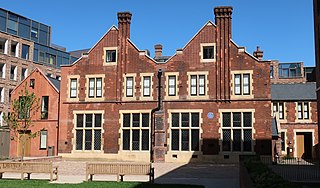
Toynbee Hall is a charitable institution that works to address the causes and impacts of poverty in the East End of London and elsewhere. Established in 1884, it is based in Commercial Street, Spitalfields, and was the first university-affiliated institution of the worldwide settlement movement—a reformist social agenda that strove to get the rich and poor to live more closely together in an interdependent community. It was founded by Henrietta and Samuel Barnett in the economically depressed East End, and was named in memory of their friend and fellow reformer, Oxford historian Arnold Toynbee, who had died the previous year.

A summer camp or sleepaway camp is a supervised program for children or teenagers conducted during the summer months in some countries. Children and adolescents who attend summer camp are known as campers. Summer school is usually a part of the academic curriculum for a student to make up work not accomplished during the academic year.
Venturer or Venture Scouts are programs in some Scouting organisations for young people of various age ranges in the 14–20 age range. A participant in the program is called a Venturer.
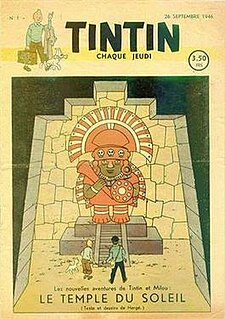
Tintin was a weekly Franco-Belgian comics magazine of the second half of the 20th century. Subtitled "The Magazine for the Youth from 7 to 77", it was one of the major publications of the Franco-Belgian comics scene and published such notable series as Blake and Mortimer, Alix, and the principal title The Adventures of Tintin. Originally published by Le Lombard, the first issue was released in 1946, and it ceased publication in 1993.

Scouts de Argentina is one of the national Scouting associations of Argentina. Scouting was officially founded in Argentina in 1912, shortly after the publication of "Scouting For Boys" in Spanish, which was granted a National Charter in 1917, and was among the charter members of the World Organization of the Scout Movement in 1922. Scouts de Argentina has 75,000 members as of 2020.

Sir Cyril Arthur Pearson, 1st Baronet,, was a British newspaper magnate and publisher, best known for founding the Daily Express.
Scouting started in Victoria as early as 1907 and local Boy Scout patrols and troops formed independently.

Christopher George Walter James, 5th Baron Northbourne, 6th Baronet, DL, FRICS, was a British farmer and aristocrat. He was one of the ninety hereditary peers elected to remain in the House of Lords after the passing of the House of Lords Act 1999 until his retirement in 2018, and sat as a crossbencher.
Sir Jack Petchey is an English businessman and philanthropist.

PGL Travel Ltd is a company founded in 1957 and is a provider of school activity courses and summer camps for children in the United Kingdom. Along with NST, European Study Tours and StudyLink it is a part of the HB Education group, owned by Midlothian Capital Partners

Three Harbors Council is a local council of the Boy Scouts of America serving three southeastern Wisconsin counties: Milwaukee County, Racine County, and Kenosha County. Its name and logo refer to the three major port cities of Milwaukee, Racine, and Kenosha on Lake Michigan.
Scoutreach was a division of the Boy Scouts of America that emphasized service to rural and urban areas and to minority populations. It became the All Markets Strategy.
The National Camps Corporation was a British government-funded non-profit organisation established under the Camps Act 1939. The role of the corporation was to construct and administer camps in the countryside that could be used for educational experiences.

The Derbyshire Miners' Holiday Camp at Skegness, on the east coast of England, was opened in May 1939, to provide an annual holiday for Derbyshire coal miners and their families. It was seen as a pioneering venture and was part of a broad range of welfare benefits provided by a national Miners' Welfare Scheme established in the 1920s. The camp enabled miners and their families to have a week's holiday by the sea, many for the first time. Its creation owed much to the campaigning work of the trades union, the Derbyshire Miners' Association and, in particular, to the inspiration of Henry Hicken, one of the Derbyshire Miners' leaders. The Skegness camp finally closed in the late 1990s, coinciding with the demise of the British coal mining industry and the continued growth in the availability of affordable holidays in Spain and elsewhere. A similar, but smaller, camp for Derbyshire miners and their families was opened after the Second World War, in Rhyl, on the north coast of Wales.

