
A platformer is a sub-genre of action video games in which the core objective is to move the player character between points in an environment. Platform games are characterized by levels with uneven terrain and suspended platforms of varying height that require jumping and climbing to traverse. Other acrobatic maneuvers may factor into the gameplay, such as swinging from vines or grappling hooks, jumping off walls, gliding through the air, or bouncing from springboards or trampolines.

Bejeweled is a tile-matching puzzle video game by PopCap Games, developed initially for browsers in 2001. The first game developed by PopCap under their current name, Bejeweled involves lining up three or more multi-colored gems to clear them from the game board, with chain reactions potentially following.
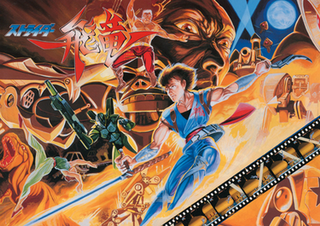
Strider, released in Japan as Strider Hiryū, is a hack-and-slash platform game released in arcades in 1989 by Capcom. Set in a dystopian future where Earth is ruled by the tyrannical Grandmaster Meio, it follows the titular Strider named Hiryu as he attempts to end his tyrannical reign for good. The game resulted from cooperation between Capcom and manga publisher Moto Kikaku. It marked the video game debut of Strider Hiryu, after the character was introduced in the 1988 manga Strider Hiryu.

Strider 2, released in Japan as Strider Hiryū 2, and then as Strider Hiryū 1&2, is a platform video game. It is developer and publisher Capcom's 1999 sequel to the original Strider. This game is the second sequel to Strider produced, following U.S. Gold's 1990 noncanonical Strider II, a game with which Capcom was not directly involved. The Capcom-produced Strider 2 makes no references to the Western-only Strider Returns/Strider II. The game was released for arcades in 1999 and was ported to the PlayStation in 2000.
A spiritual successor is a product or fictional work that is similar to, or directly inspired by, another previous work, but does not explicitly continue the product line or media franchise of its predecessor, and is thus only a successor "in spirit". Spiritual successors often have similar themes and styles to their source material, but are generally a distinct intellectual property.

Gravity Force is a video game series for the Amiga. The first game in the series was published commercially by Kingsoft GmbH in 1989, as a Thrust-clone. The aim is to pilot a spacecraft through caverns avoiding enemy fire. The ship is subject to gravity and inertia and colliding with terrain or the walls of the cave results in destruction of the ship.
WayForward Technologies, Inc. is an American independent video game developer and publisher based in Valencia, California. Founded in March 1990 by technology entrepreneur Voldi Way, WayForward started by developing games for consoles such as the Super NES and Sega Genesis, as well as TV games and PC educational software. In 1997, they relaunched their video games arm, placing the company as a contractor for publishers and working on a variety of licensed assets.

Osman is a side-scrolling action platforming game produced by Mitchell Corp. that was released as a coin-operated arcade game in 1996. Many ex-Capcom staff including Kouichi Yotsui, worked on the original arcade version of Strider and designed Osman as an unofficial sequel to Strider. Yotsui directed both titles.

Strider II, is a side-scrolling platform game published by U.S. Gold and originally released for various computer platforms in 1990. It is a European-developed sequel to Capcom's arcade video game Strider, which U.S. Gold previously ported to home computers in Europe.
Turok is a series of first-person shooter video games based on the comic book character of the same name. It is set in a primitive world inhabited by dinosaurs and other creatures. The series was originally developed by Acclaim Studios Austin as Iguana Entertainment and published by Acclaim Entertainment from 1995 until Acclaim's bankruptcy in September 2004. The series was then developed by Propaganda Games and published by Touchstone Games. The series generated more than $250 million in revenue by 2002.
Star Wars has been expanded to media other than the original films. This spin-off material is licensed and moderated by Lucasfilm, though during his involvement with the franchise Star Wars creator George Lucas reserved the right to both draw from and contradict it in his own works. Such derivative works have been produced concurrently with, between, and after the original, prequel, and sequel trilogies, as well as the spin-off films and television series. Commonly explored Star Wars media include books, comic books, and video games, though other forms such as audio dramas have also been produced.
The Babylonian Castle Saga is a Japanese role-playing video game franchise developed and published by Bandai Namco Entertainment, formerly Namco, for arcades and home video game platforms. Beginning in 1984 with the arcade title The Tower of Druaga, the series would spawn a total of nine sequel and spin-off games, alongside a manga, soundtrack albums, and two anime series by Gonzo K.K. Later entries in the series would be developed by Endo's personal game company, Game Studio.

Human Killing Machine is a 2D fighting video game. The game was developed by British company Tiertex, who hired external team Blue Turtle to produce the graphics, and published by U.S. Gold, released in March 1989. It was touted as a sequel to Tiertex's home computer conversion of Street Fighter. It was released for 8-bit and 16-bit home computer formats.

Illusion, known in Japan as I Love Mickey Mouse, is a series of platforming video games developed and published by Sega for its consoles Master System, Sega Genesis and Game Gear. The series follows the adventures of Disney's cartoon character Mickey Mouse between various fantasy worlds. The series includes Castle of Illusion, and its sequels Land of Illusion, World of Illusion and Legend of Illusion.
Atlantis is a media franchise owned by The Walt Disney Company. The franchise began in 2001 with the release of the film Atlantis: The Lost Empire.
Tetris 2 is one of various sequels to the original Tetris tile-matching puzzle video game released in 1985, generally referring to improvements or new modes added to a platform-specific port of Tetris released by a particular publisher.
Stride is a free and open-source 2D and 3D cross-platform game engine originally developed by Silicon Studio. It can be used to create video games for PC, mobile devices and virtual reality.

Blaster Master is a video game series that was originally developed and published by Sunsoft. It began with the 1988 video game Blaster Master for the Nintendo Entertainment System, and the series has been rebooted twice. The first reboot, Blaster Master: Overdrive, was released in 2010 and intended to "rebuild the Sunsoft brand in North America", but it received mediocre reception from critics and did not see a follow-up.

Achievement Unlocked is a 2008 Adobe Flash platform video game developed by John Cooney and published by Armor Games. It was developed in four days. The player controls an elephant who moves and jumps around a level with the goal of completing every achievement. Such achievements include finding all numbers, dying, or even doing nothing for enough time.
