Siam is the former name of Thailand, and is used to refer to the historical region of Central Thailand, usually including Southern Thailand.
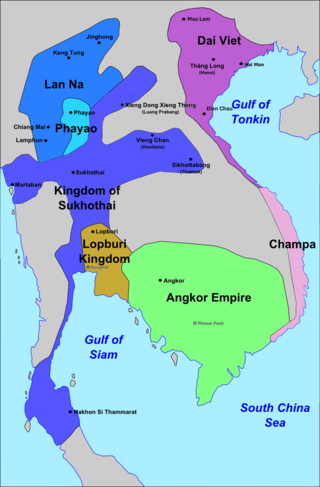
The Sukhothai Kingdom was a post-classical Siamese kingdom (maṇḍala) in Mainland Southeast Asia surrounding the ancient capital city of Sukhothai in present-day north-central Thailand. The kingdom was founded by Si Inthrathit in 1238 and existed as an independent polity until 1438, when it fell under the influence of the neighboring Ayutthaya after the death of Borommapan.
The provinces of Thailand are administrative divisions of the government of Thailand. The country is divided into 76 provinces proper, with one additional special administrative area. They are the primary local government units and act as juristic persons. They are divided into amphoe (districts) which are further divided into tambon, the next lower level of local government.

Chiang Mai is the largest Province (changwat) of Thailand by area. It lies in upper northern Thailand and has a population of 1.78 million people. It is bordered by Chiang Rai to the northeast, Lampang and Lamphun to the south, Tak to the southwest, Mae Hong Son to the west, and Shan State of Burma to the north. The capital, Chiang Mai, is 685 kilometres (426 mi) north of Bangkok.

Phitsanulok, is a province of central Thailand. It borders the provinces of Uttaradit to the north, Loei and Phetchabun to the east, Phichit to the south, Kamphaeng Phet to the southwest, and Sukhothai to the west. Its border was shared with Laos (Sainyabuli) to the northeast. Covering an area of 10,815 square kilometres (4,176 sq mi), Phitsanulok is the fifteenth-largest province in Thailand. As of 2023, it has a population of about 840,000, making it the eighth-most populous province in the region.

Sukhothai is one of Thailand's seventy-six provinces (changwat); it lies in lower northern Thailand. Neighboring provinces are Phrae, Uttaradit, Phitsanulok, Kamphaeng Phet, Tak, and Lampang. Sukhothai can be translated as 'dawn of happiness'.

Nan is one of Thailand's seventy-seven provinces (changwat), and lies in upper northern Thailand. Neighboring provinces are : Uttaradit, Phrae, and Phayao. To the north and east it borders Sainyabuli of Laos.
Chonburi is the capital of Chonburi Province, Thailand.

Thai art refers to a diverse range of art forms created in Thailand from prehistoric times to the present day, including architecture, sculpture, painting, textiles, decorative arts, crafts, ceramics, and more. While Buddhism has played a significant role in Thai art, with many sculptures and paintings depicting Buddha images and religious themes, nature, including flora and fauna, as well as mythical creatures, has been a major inspiration for Thai art, with colorful motifs appearing in various types of art forms. In contemporary Thai art, traditional works remain significant and continue to influence artists' concepts.
The Nakhon Si Thammarat Kingdom, Nagara Sri Dharmarashtra or the Kingdom of Ligor, was one of the major constituent city states (mueang) of the Siamese kingdoms of Sukhothai and later Ayutthaya and controlled a sizeable part of the Malay Peninsula. Its capital was the eponymous city of Nakhon Si Thammarat in what is now Southern Thailand.

Ratchaburi or Rajburi, Rat Buri) is a town in western Thailand, capital of Ratchaburi Province.
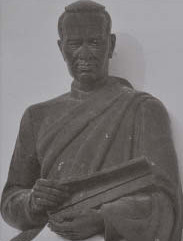
Borommatrailokkanat or Trailok (1431–1488) was the king of the Ayutthaya Kingdom from 1448 to 1488. He was one of many monarchs who gained the epithet King of White Elephants. He was the first Thai king to possess a "noble" or white elephant, which, according to Buddhist belief, was a "glorious and happy sign". His reign was also known for massive reforms of Thai bureaucracy and a successful campaign against the Lan Na Kingdom to the north. He was revered as one of the greatest monarchs of Thailand.

The lands situated in the present-day Phitsanulok Province of Thailand have been inhabited since the Stone Age, although the neolithic inhabitants of the region are not likely to have been the ancestors of the modern Thai people who reside there today. The earliest historical records relating to what is now Phitsanulok Province indicates that at a time prior to or during the 11th century, the present-day city of Phitsanulok was but a small strategic Khmer outpost known as Song Khwae. During the next century, in 1188, Nakhon Thai, located near the center of the present Phitsanulok Province, was established as the capital city of the Singhanavati Kingdom, an early city-state of Thailand. Later, during Thailand's Sukhothai Period, the city of Phitsanulok emerged as a major city in the east of the Sukhothai Kingdom, and the great temples of Wat Chula Manee, Wat Aranyik and Wat Chedi Yod Thong were constructed. In 1357, the renowned Wat Phra Sri Rattana Mahathat was erected, and the Ayutthaya Period witnessed the construction of several of the province's other chief temples. Phitsanulok served for 25 years as the capital city of the Ayutthaya Kingdom. In 1555, King Naresuan the Great was born in the city of Phitsanulok. Naresuan played a significant role in the history of Thailand, as he expanded the kingdom to its greatest territorial extent, by conquering sizable portions of modern-day Burma and Cambodia. In recent times, Phitsanulok Province has become an important agricultural center, part of the Bread Basket of Thailand, providing rice and other crops to consumers in Thailand and throughout the world. Extensive agricultural development over the last hundred years or so has spawned a modern infrastructure in the urban areas of the province, bringing with it an array of modern roads, universities, hospitals and other conveniences. Over the years, the Nan River and its tributaries have played a substantial role in the history and development of the region by providing a route for transportation, fertile soil for agriculture, and water for irrigation. The river waters have also served as a route for enemy invaders, and have been the source of periodic widespread flooding throughout the province.
Ayutthaya, Ayudhya, or Ayuthia may refer to:

Sukhothai Football Club is a Thai professional association football club based in Sukhothai province. They play in the Thai League 1. Sukhothai FC represents the Sukhothai Province mainly known for being the first Kingdom of Thailand. Their main team colors are red and white and their away colors are black and green. Sukhothai FC play all their home matches at the Thalay Luang Stadium which has a maximum capacity of 9,500.
Saw Zein was king of Martaban from 1323 to 1330. He inherited a newly independent kingdom from his elder brother Saw O but spent much of his reign putting down rebellions. Although he regained the Mon-speaking provinces of Lower Burma, he could not recover the Tenasserim coast from Martaban's former overlord Sukhothai.

Phitsanulok is a city in Northern Thailand, the capital of Phitsanulok province and the tenth-largest city in Thailand. It is 360 km north of Bangkok and has a population of 281,929 people as of 2021. The city was founded in the 13th century under the name Song Khwae and represents one of the oldest cities in Thailand.

The Sukhothai script, also known as the proto-Thai script and Ram Khamhaeng alphabet, is a Brahmic script which originated in the Sukhothai Kingdom. The script is found on the Ram Khamhaeng Inscription and the Lö Thai inscription.

