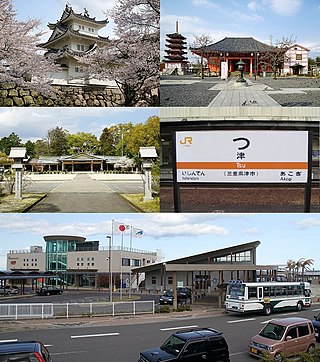
Tsu is a city located in Mie Prefecture, Japan. As of 31 July 2021, the city had an estimated population of 274,879 in 127,273 households and a population density of 390 persons per km². The total area of the city is 711.11 square kilometres (274.56 sq mi). Although the second largest city in the prefecture in terms of population, its designation as the prefectural capital and its holding of a large concentration of national government offices and educational facilities make the city the administrative and educational center of Mie Prefecture.

The Black Ships was the name given to Western vessels arriving in Japan in the 16th and 19th centuries.

Kenji Mizoguchi was a Japanese film director and screenwriter, who directed about one hundred films during his career between 1923 and 1956. His most acclaimed works include The Story of the Last Chrysanthemums (1939), The Life of Oharu (1952), Ugetsu (1953), and Sansho the Bailiff (1954), with the latter three all being awarded at the Venice International Film Festival. A recurring theme of his films was the oppression of women in historical and contemporary Japan. Together with Akira Kurosawa and Yasujirō Ozu, Mizoguchi is seen as a representative of the "golden age" of Japanese cinema.

Townsend Harris was an American merchant and politician who served as the first United States Consul General to Japan. He negotiated the "Harris Treaty" between the US and Japan and is credited as the diplomat who first opened Shogunate Japan to foreign trade and culture in the Edo period.

Yūzō Yamamoto was a Japanese novelist and playwright. His real name was written as "山本 勇造" but pronounced the same as his pen name.
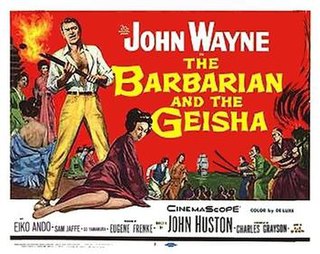
The Barbarian and the Geisha is a 1958 American adventure drama film directed by John Huston and starring John Wayne. The film was shot primarily on location in Japan.
Eiko Ando is a Japanese actress best known for her role as Okichi opposite John Wayne in The Barbarian and the Geisha in 1958.

Sessue Hayakawa was one of the first Asian actors and filmmakers to gain great fame and success in the United States. He starred in both English-language and Japanese-language films. His career peaked during the silent film period but continued on and eventually thrived in the talkie era, culminating with an Academy Award-nominated performance in The Bridge on the River Kwai in 1957.
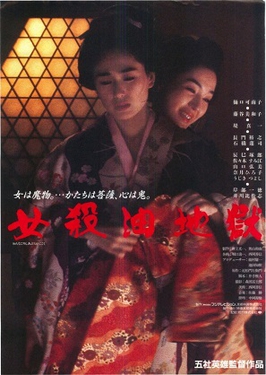
The Oil-Hell Murder is a 1992 Japanese film directed by Hideo Gosha. It was Japan's submission to the 65th Academy Awards for the Academy Award for Best Foreign Language Film, but was not accepted as a nominee.

Nagasaki Shinchi Chinatown is an area located in Nagasaki, Nagasaki, Japan. Today this area is a shopping strip covering many blocks.
Yatarō gasa (弥太郎笠), literal English title: Yataro’s Travel Hat, is a 1957 color Japanese film directed by Kazuo Mori.

Katsutaro Kouta was a Japanese female geisha and ryūkōka singer, who performed in the "New-Min'yō" style of singing. Kouta came to be most well known, alongside another popular geisha singer, Ichimaru, in the "Katsu-Ichi Era".

Takekurabe is a 1955 Japanese drama film directed by Heinosuke Gosho. It is based on Higuchi Ichiyō's 1895-1896 novella Takekurabe.

Tōjin Okichi is a 1954 Japanese drama film directed by Mitsuo Wakasugi.

Tōjin Okichi, a.k.a.Okichi, Mistress of a Foreigner or Mistress of a Foreigner, is a 1930 silent drama film by Kenji Mizoguchi, based on the novel by Gisaburō Jūichiya. Only a fragment of the film has survived.
The Judith of Shimoda is a play attributed to Bertolt Brecht. Long believed to be incomplete, a full German playscript of The Judith of Shimoda was reconstructed by Hans Peter Neureuter and published by Suhrkamp (Frankfurt/Main) in 2006. Markus Wessendorf's 2008 translation of this playscript into English received its first stage production in April 2010 at the Kennedy Theatre in Honolulu and was published in 2019 in a collection of Brecht's dramatic fragments.
Kurofune is a 1940 Japanese-language western-style opera by Kosaku Yamada, which is regarded as the first Japanese opera. It is based on the Black Ships story of Tōjin Okichi and a geisha "caught up in the turmoil that swept Japan in the waning years of the Tokugawa shogunate".
The Emperor's Cook is a 2015 Japanese television drama based on the novel Tennō no Ryōriban by Hisahide Sugimori, depicting the life of imperial cook Tokuzō Akiyama. It premiered on TBS on 26 April 2015, starring Takeru Satoh in the lead role. The 1st episode is 108 minutes, 2nd, 3rd, and 6th episodes are 64 minutes long. The series was well received by the public, earning the highest viewership rating in its time slot during its run time.
Tasukenin Hashiru (助け人走る) is a Japanese television jidaigeki or period drama, that was broadcast in 1973–1974. It is the third in the Hissatsu series and is based on Saga Sen's Seibei-ryū Gokui.
Hana no Shōgai (花の生涯) is a 1963 Japanese television series. It is the 1st NHK taiga drama.
This page is based on this
Wikipedia article Text is available under the
CC BY-SA 4.0 license; additional terms may apply.
Images, videos and audio are available under their respective licenses.
