Luo Ben, better known by his courtesy name Guanzhong, was a Chinese novelist who lived during the Ming dynasty. He is also known by his pseudonym Huhai Sanren. Luo Guanzhong is credited with writing Romance of the Three Kingdoms, one of the Four Great Classical Novels of Chinese literature.
Tang or TANG most often refers to:

The Lantern Festival, also called Shangyuan Festival and Cap Go Meh, is a Chinese traditional festival celebrated on the fifteenth day of the first month in the lunisolar Chinese calendar, during the full moon. Usually falling in February or early March on the Gregorian calendar, it marks the final day of the traditional Chinese New Year celebrations. As early as the Western Han dynasty, it had become a festival with great significance.

Li Jing, courtesy name Yaoshi, posthumously known as Duke Jingwu of Wei, was a Chinese military general, strategist, and writer who lived in the early Tang dynasty and was most active during the reign of Emperor Taizong. In 630, Li Jing defeated the Göktürks, led by Jieli Khan, with just 3,000 cavalry soldiers in a surprise attack, allowing the Tang Empire to subjugate the Göktürks and reduce them to the status of a vassal under the Tang Empire. Li Jing and Li Shiji are considered the two most prominent early Tang generals.

Tangyuan are a traditional Chinese dessert made of glutinous rice shaped into balls that are served in a hot broth or syrup. They come in varying sizes, anything between a marble to a ping-pong ball, and are sometimes stuffed with filling. Tangyuan are traditionally eaten during the Lantern Festival, but because the name is a homophone for reunion and symbolizes togetherness and completeness, this dish is also served at weddings, family reunions, Chinese New Year, and the Dōngzhì festival.
Chinese imperial cuisine is derived from a variety of cooking styles of the regions in China, mainly from the cuisines of Shandong and Jiangsu provinces. The style originated from various Emperors' Kitchen and the Empress Dowagers' Kitchen, and it is similar to Beijing cuisine which it heavily influenced.
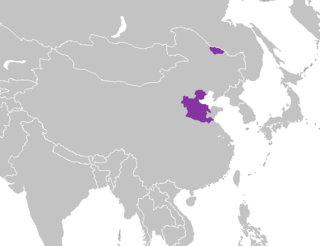
Jilu or Ji–Lu Mandarin, formerly known as Beifang Mandarin "Northern Mandarin", is a dialect of Mandarin Chinese spoken in the Chinese provinces of Hebei and the western part of Shandong and Xunke, Tangwang & Jiayin counties of Heilongjiang. Its name is a combination of the abbreviated names of the two provinces, which derive from ancient local provinces. The names are combined as Ji–Lu Mandarin.

Tang, is a Chinese surname. The three languages also have the surname with the same character but different pronunciation/romanization. In Korean, it is usually romanized also as Dang. In Japanese, the surname is often romanized as To. In Vietnamese, it is commonly written as Đường. It is pronounced dhɑng in Middle Chinese, and lhāŋ in Old Chinese. It is the 64th name on the Hundred Family Surnames poem.

The siege of Suiyang was a military campaign during the An Lushan rebellion, launched by the rebel Yan army to capture the city of Suiyang from forces loyal to the Tang dynasty. Although the battle was ultimately won by the Yan army, it suffered major attrition of manpower and time. The siege was noted for the Tang army's determination to fight to the last man, as well as the large-scale cannibalism practised by the defenders, who in this way were able to hold out longer.
Tang Gonghong is a Chinese weightlifter who competed in the 2003 Afro-Asian Games and 2004 Summer Olympics.
Tang Eng Iron Works is a steelmaking company in Taiwan. Its headquarters is in Siaogang District of Kaohsiung.

Tang Zaili, courtesy name Zhifu, was a Chinese civil servant and prominent military figure in the Qing dynasty and later the Republic of China. He was Military Counselor to Yuan Shikai, President of the Republic of China, and later served as China's Chief Military Delegate at the Paris Peace Accords in 1919.
Tang Haoming, also known as Deng Yunsheng, is a Chinese novelist. He is best known for writing biographical novels of Zeng Guofan, Zhang Zhidong, and Yang Du. He is now the vice president of Hunan Writers Association.
Tangyuan is a town in Linqing, Liaocheng, in western Shandong province, China.

Bua loi or bua loy is a Thai dessert. It consists of rice flour rolled into small balls, and cooked in coconut milk and sugar. Some Bua loi also adds sweet egg into the recipe. It was inspired by Tangyuan, a Chinese dessert that is traditionally eaten around the Lantern festival. Bua Loi is also traditionally eaten during the Dongzhi Festival in Thailand, which is a festival for the Chinese-Thai bloodline. There are a variety of versions of Bua loi such as ones that use food coloring instead of natural color, use soy milk instead of Coconut cream, add sliced pumpkin inside the rice balls, et cetera. There are other types of Bua loi from other countries such as China, Japan, Indonesia, Myanmar, Philippines, Southern Vietnam and Malaysia. 1 cup of Bua Loy has total calories of 295.5 kilocalories, protein of 10.4 grams, carbohydrate of 6.3 grams, and fat of 25 grams.
Tang Yuan is a Chinese football player.
Pingyuan Commandery was a historical commandery of China, existing from Han dynasty to Tang dynasty. It was centered around present-day northwestern Shandong province.
